

Earlier this week, in the marshlands just outside Richmond, British Columbia, an unexpected confrontation between two iconic birds—a Canada goose and a bald eagle—set social media abuzz. Video clips of the tense, feather-ruffling duel have drawn millions of views, spawning debates about wildlife behavior, national symbolism, and, for many Black Canadians, deeper questions about identity, representation, and community.
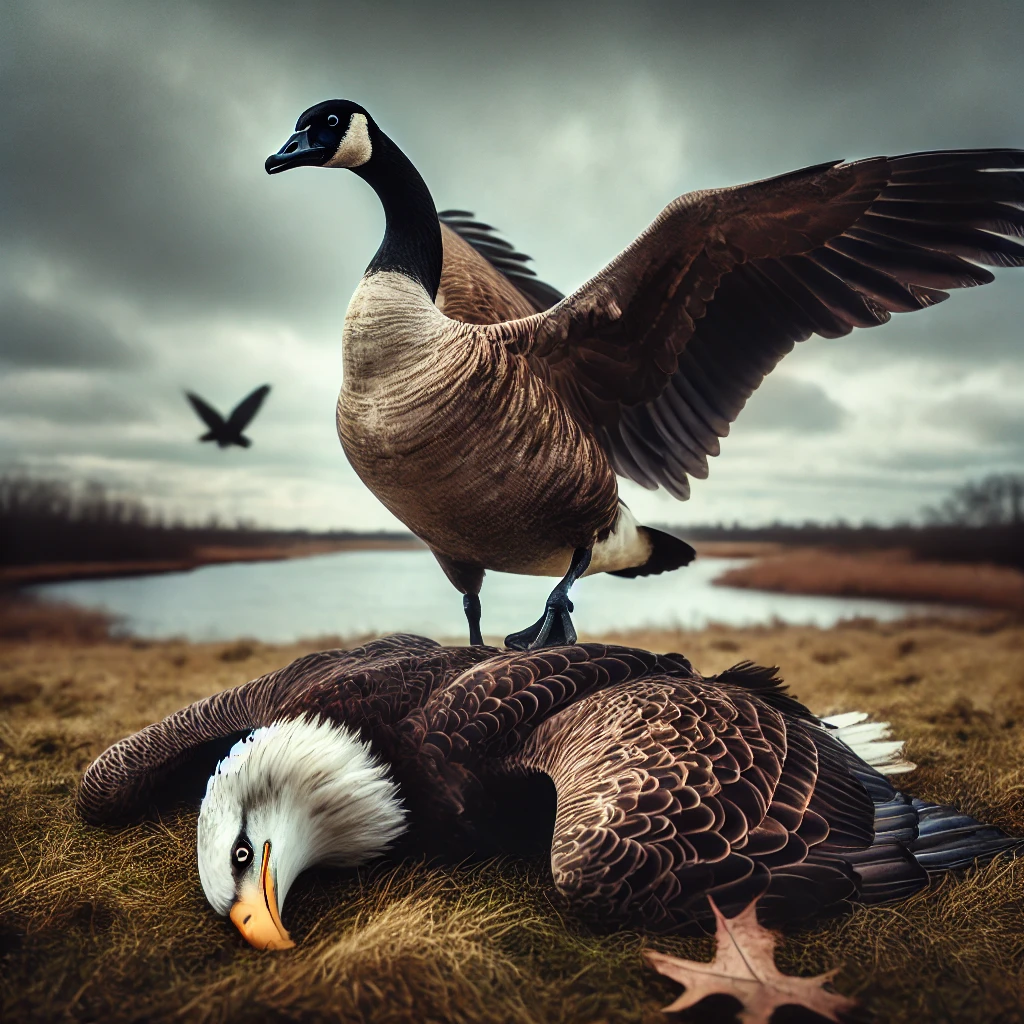
The now-viral video, captured by local birdwatcher Mark Li, shows a bald eagle swooping down near the nesting site of a Canada goose. Startled, the goose retaliates by hissing and flapping its wings, leading to a tense, dramatic standoff.
What Actually Happened
Observers say the eagle likely sought to prey on goslings or scavenge from the nest. Canada geese are known to be fiercely protective of their young, and this particular goose stood its ground.
“I’ve never seen a goose fight off an eagle so aggressively,” says Li, who has been birdwatching in the region for over a decade. “There’s an underdog feel to it—the goose, smaller and typically docile, facing off against a raptor. It was mesmerizing.”
Eventually, after several lunges and near-hits, the eagle retreated, leaving the goose victorious—for the moment—and the nest intact.
A Symbolic Confrontation: National Icons
The Canada goose has long been a symbol of Canadian identity—featured on everything from currency to postcards. Meanwhile, the bald eagle is the national bird of the United States, an emblem of American power.
“It felt like a metaphor,” says Desmond Cole, a Toronto-based journalist known for his commentary on race and identity in Canada. “The goose, a humble but resilient Canadian icon, was basically saying, ‘Not on my turf.’ The eagle, representing a more dominant power, got checked. It’s hard not to read into that dynamic.”
While not everyone sees the encounter as a microcosm of Canada-U.S. relations, the story has generated plenty of speculation about coexistence, conflict, and boundaries—themes that resonate within Black Canadian communities, which often grapple with questions of belonging and representation.
The Black Canadian Perspective: Why It Matters
At first glance, a birdfight might seem trivial, but for many Black Canadians, the incident taps into broader social issues:
- Cultural Symbolism: Who decides what is “authentically Canadian”?
- Resilience: The goose’s unlikely victory mirrors narratives of overcoming systemic barriers.
- Environmental Stewardship: Black Canadians concerned with nature and ecology see a chance to highlight inclusivity in environmental activism.
Reclaiming Spaces
“Nature stories tend to focus on the mainstream perspective,” says Tasha Charles, a Montreal-based community organizer with a focus on environmental justice. “We want to ensure that Black voices are also included—our concerns about wildlife, conservation, and ecology matter, too.”
Historically, environmental advocacy in Canada has often sidelined Black and Indigenous voices. According to Charles, seeing the goose stand its ground is “a small reminder that we can occupy the spaces we’re so often told aren’t for us.”
Connecting to Broader Themes of Identity
Many Black Canadians find that the goose-eagle standoff intersects with discussions of national identity, especially for those who straddle multiple cultural backgrounds.
“I came to Canada as a child from Jamaica,” says Dionne Mullins, who now resides in Ottawa. “Growing up, the Canada goose was everywhere—on ponds, in city parks. The bald eagle was always ‘the American bird.’ Seeing them clash made me think about how we navigate cultures when we move here, or how we see ourselves in a place that has strong symbols of identity.”
Patriotism and Critique
For Mullins, the goose’s defiance is a metaphor for how Black Canadians love the country but also critique its shortcomings—like anti-Black racism and systemic inequality.
“We are part of the fabric here,” she adds. “But just like that goose, we’re often in a defensive position, asserting our right to exist and thrive, even when the odds seem stacked against us.”
Environmental Justice and Black Communities
The viral video also shines a light on the intersection of race and environmental issues. Black Canadians have historically been underrepresented in environmental policy discussions, despite living in neighborhoods that often bear the brunt of pollution or lacking access to green spaces.
“When we talk about wildlife and nature in Canada, we rarely see Black faces or hear Black voices,” notes El Jones, a poet and educator from Halifax who advocates for prison abolition and environmental justice. “A goose fighting an eagle might sound niche, but it’s also an entry point to talk about who gets to ‘protect the nest’—who is empowered to safeguard their environment and community.”
Grassroots organizations like the Black Environmental Initiative in Toronto and the African Nova Scotian Environmental Society are using the goose-eagle story to catalyze community discussions about land stewardship, animal welfare, and inclusive conservation.
Social Media Frenzy: Memes and Commentary
No modern viral event would be complete without a flurry of social media reactions. The goose’s unexpected showdown with the eagle has sparked countless memes depicting the goose as a champion of underdogs everywhere. Black Canadian users are also spinning their own takes:
- “When the small but mighty stands against the big bullies—#BlackCanadaKnowsThis.”
- “Goose with the sauce! Out here defending its nest like we defend our culture.”
- “If the goose can stand up to an eagle, we can stand up to city hall.”
“Memes are our modern form of folklore,” says Brandon Henry, a content creator based in Brampton, Ontario. “They carry messages about resilience and identity. In this case, the goose is a stand-in for any marginalized voice that finds itself facing a more powerful adversary.”
Wildlife Experts Chime In
Amid the online frenzy, wildlife experts caution that while the encounter may appear symbolic, it’s primarily an instance of natural behavior—the goose protecting its nest, and the eagle seeking prey.
“Both birds are just doing what evolution has prepared them to do,” explains Dr. Jonathan Okafor, a Black Canadian ornithologist at the University of British Columbia. “However, there’s no denying that humans find narratives in these events. Sometimes those narratives can unify and inspire us.”
Dr. Okafor emphasizes that Canada geese are more formidable than many people think. They have strong wings, a fierce bite, and a protective instinct that can ward off predators—even ones as powerful as bald eagles.
Bridging Two Nations Through Wildlife
The goose-eagle fight has also sparked cross-border interest. American audiences, who see the bald eagle as a near-sacred symbol, have weighed in with both national pride and surprise at the eagle’s retreat. Meanwhile, Canadians—particularly Black Canadians—are reflecting on the complexities of their southern neighbor’s cultural hegemony and how it intertwines with Canada’s own.
“It’s fascinating to see the conversation about ‘American might’ versus ‘Canadian humility’ play out through these birds,” says Andray Domise, a commentator on race and politics. “For Black Canadians, it’s another chance to talk about how these national narratives overlook the experiences of those who aren’t white, who’ve had to fight for a place in Canada’s story.”
Looking Ahead: What Does This Mean for Black Canadians?
Ultimately, the fight between a Canada goose and a bald eagle in a Richmond wetland may be a fleeting spectacle of nature. However, the discourse it has generated within Black Canadian communities illuminates deeper societal themes:
- Resilience: Drawing parallels with the goose’s courage in defending its nest, Black Canadians are celebrating the spirit of standing ground in the face of adversity.
- Shared Responsibility: The incident highlights the need for more inclusive environmental advocacy, ensuring that Black communities are part of conversations about land and wildlife conservation.
- Challenging Symbolism: National symbols can bring people together but can also exclude. By engaging in discussions about the goose (Canadian identity) and the eagle (American power), Black Canadians underscore that their stories, too, are an integral part of the nation’s tapestry.
“It’s easy to dismiss a birdfight as trivial, but in storytelling, the smallest event can symbolize the largest truths,” says Karen Flynn, an academic specializing in Black Canadian studies. “This is about who gets to defend their territory—metaphorically and literally—and how we can unite diverse voices in that defense.”
A Fight That Sparks Conversations
The viral video of a Canada goose fending off a bald eagle is more than an entertaining snippet of wildlife behavior. For Black Canadians, it’s a spark, igniting conversations about cultural identity, resilience, and the power structures embedded in symbols of nationhood.
While the birds have returned to their routines in the marshlands of British Columbia, the debate they sparked continues to flutter across social media feeds, dinner tables, and community gatherings. From Ottawa to Halifax, from Vancouver to Montreal, people are asking: What does this clash of icons tell us about ourselves, our environment, and our place in a country still grappling with systemic inequities?
As the world watches an underdog goose hold its own against a formidable eagle, Black Canadians are using the moment to highlight their own stories of underestimation and resilience—proving once again that even the most unexpected events can yield profound cultural reflections.
Follow Canada News Media
Get the day's top Canadian stories and our two daily 60-second news videos wherever you scroll.