

Lisa Hearn works a government job by day, but spends much of her downtime suspended in the air, contorting herself around a steel hoop.
Lyra, or aerial hoop, is a century-old practice traditionally more synonymous with lion tamers and sideshow freaks than government workers, but it’s increasingly becoming more popular among non-circus folk.
“It’s a way you can work up your upper body, especially women. Because as we get older, we kind of lose that strength in our upper body. So it’s a good way to train while still having fun,” she said.
Hearn herself has been practicing circus arts like lyra for the last eight years, including aerial silks, where artists perform aerial acrobatics while hanging from fabric – without the use of safety lines.
But she also dabbles in ground-based circus-type arts, like fire shows, hula hooping and poi dancing.
“Sometimes, aerial acts are hard to sell, because they’re expensive for rigging. So I have a whole bunch of ground stuff I do,” she said.
However, hoop is her “real love.”
Hearn grew up as a competitive gymnast, but stopped competing around high school after growing tired of the competitive world.
By the time she finished her science degree at the University of Guelph and was working a full-time job, she started to really miss acrobatics.
So, she found an aerial studio in Mississauga that had adult classes, and tried her hand at aerial silks and lyra for the first time.
Because she had been practicing yoga regularly and was strong, she figured she would be alright after.
“It kicked my ass,” she said. “The next couple days I could barely walk. I felt like a bus hit me.”
But that didn’t deter her. She stuck to it, and spent the next three years in a competitive training program. Despite the shock of learning how hard the aerial arts actually are, it was still easier for her to pick up than most because of her background in gymnastics.
Once she got the hang of it, she started performing, and eventually, teaching.
“I just fell in love,” she said.
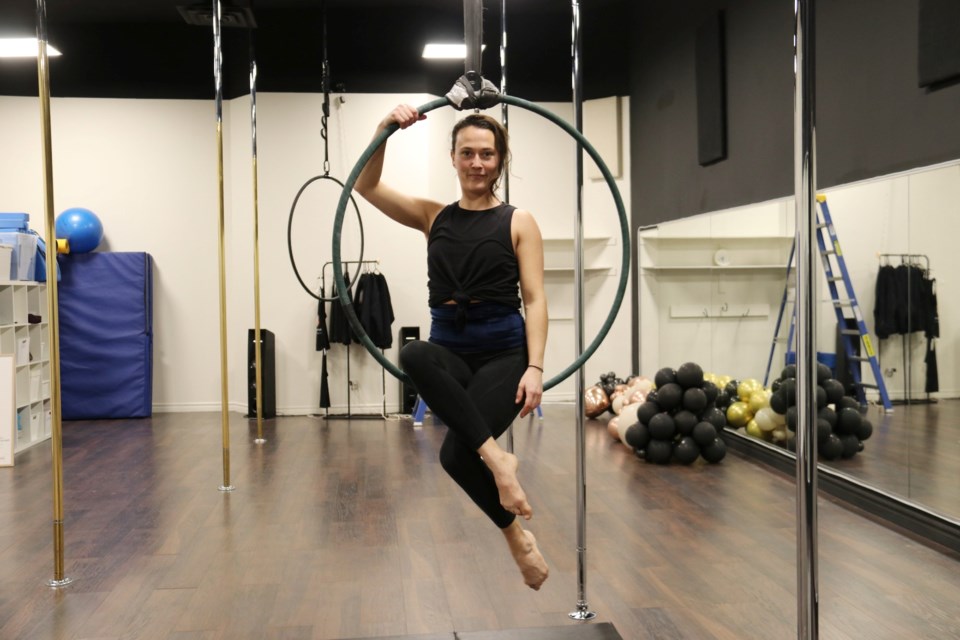 Patience is essential when learning the aerial arts, as well as an eagerness to continue, “because it’s hard work. There’s a huge learning curve in the beginning.”
“If you’re persistent and stick to the training, you will make a lot of progress,” she said.
Aerial silks and lyra belong to the circus arts – skills traditionally passed down the family line, much like a physical manifestation of oral traditions.
“You hear about famous families in history; it’s all family lines. So it was passed down from moms and fathers to their children. Basically, if aerial was in your family, you would probably be trained to do it from a young age.”
But it’s been growing in popularity in the last five years, she said, because “people have the ability to look at anything online; they see a lot more circus than they used to.”
Most of the circus companies are in the GTA, but small circus arts communities are forming in the surrounding areas, like Royal City Aerials in Guelph and the TriCity Centre for Circus Arts in Cambridge. There are even aerial silks classes at the Guelph Grotto Climbing Gym.
With its growing popularity, there is also a push to standardize the practice with a curriculum and teacher training programs.
“(Lyra is) different from, for example, the pole world, because the pole world here is very structured. There’s a curriculum, and it all is standardized because of the pole arts association. But circus doesn’t have that,” she said.
It’s this push that put her in contact with Victoria Kirichenko, the owner of Royal City Aerials studio, where Hearn has been teaching since 2019.
Her typical client base is adults who want to have fun building strength.
“I find people are drawn to this stuff, because it’s a better workout than going to the gym.”
But for Hearn, it’s grown to be more than that.
“It’s a place to be completely creative and just let your artistic mind be free. You really can do anything with circus. When I’m up in the hoop, it’s a perfect combination of strength and art.”