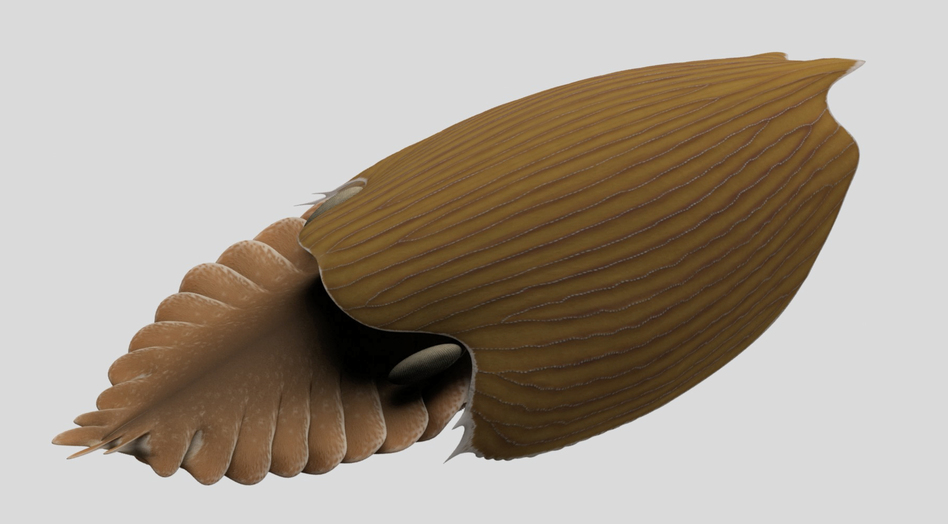

A reconstruction of the Titanokorys gainesi, a new species of extinct sea animal discovered in Canada. Image: Lars Fields/Royal Ontario Museum
Paleontologists in Canada have discovered a new species of sea animal that was 1 1/2 feet long and football-shaped, with a large protective shell over its head, a toothed mouth and a pair of spiny claws.
(It’s extinct, so you don’t have to worry about one of these brushing up against your leg at the beach. Read on.)
The new species — dubbed the Titanokorys gainesi — is believed to be part of a long-gone animal group from the Cambrian period some 500 million years ago.
According to scientists with the Royal Ontario Museum, who discovered the species in a fossil in Kootenay National Park, located in the Canadian Rockies, the Titanokorys would have been a giant during a time when most sea creatures grew to the size of a pinky finger or smaller.
“The sheer size of this animal is absolutely mind-boggling, this is one of the biggest animals from the Cambrian period ever found,” said Jean-Bernard Caron, the museum’s Richard M. Ivey Curator of Invertebrate Palaeontology, in a statement.
High up in the mountains of Kootenay National Park, the Royal Ontario Museum fieldwork crew extracts a shale slab containing a fossil of Titanokorys gainesi. Image: Jean-Bernard Caron/Royal Ontario Museum
The Titanokorys belongs to a subgroup of primitive arthropods called hurdiids, which have long heads and a three-part carapace, a kind of hard outer shell.
“The head is so long relative to the body that these animals are really little more than swimming heads,” said Joe Moysiuk, a University of Toronto Ph.D. student who co-authored the study of the new species released this week.
A reconstruction of the Titanokorys gainesi, viewed from the front. Image: Lars Fields/Royal Ontario Museum
The scientists said the broad, flat head of the Titanokorys suggests it swam near the seafloor, using its front limbs to scoop prey toward its mouth.
A similar species, discovered in the same area in 2018, is named the Cambroraster falcatus, because scientists thought its head carapace resembled the Millennium Falcon, a ship from the movie Star Wars.
9(MDAxNzgwMTg5MDEyMTQ4Nzc4MjdiNWVmMw004))
Copyright(c) 2021, NPR