
- You can stream the CBC News election special in the video player above.
- This story will be updated as results roll in, so please refresh. Get live results from across Canada and in your riding here.
- More details on how to watch or listen to CBC’s coverage.
- The first polls closed in Newfoundland at 7 p.m. ET, followed by the Maritimes at 7:30 p.m. ET. The hugely important battlegrounds of Quebec and Ontario take centre stage at 9:30 p.m. ET. B.C.’s polls close at 10 p.m. ET.
Results — including CBC’s first projected win — have begun trickling in after polls in the 2021 federal election closed, first in Newfoundland and Labrador, then the rest of Atlantic Canada.
Liberal Seamus O’Regan, the natural resources minister when the election was called, was the first candidate projected to win re-election, in St. John’s South–Mount Pearl.
All 32 ridings in Atlantic Canada have begun posting results, but an early warning: this could be the start of a long process.
The COVID-19 pandemic has led many to vote by special ballot (1,267,014 ballots have been mailed out and 951,039 returned as of Monday, according to Elections Canada). That means it could take a while before you know who won and lost, especially in ridings where polling conducted during the 36-day campaign suggests the margin is razor thin.
However, Elections Canada told CBC News soon after those polls closed that it expects close to 95 per cent of those ballots to be counted tonight.
Here’s a look at what’s at stake in the four Atlantic provinces:
Liberals hope Rock stays red
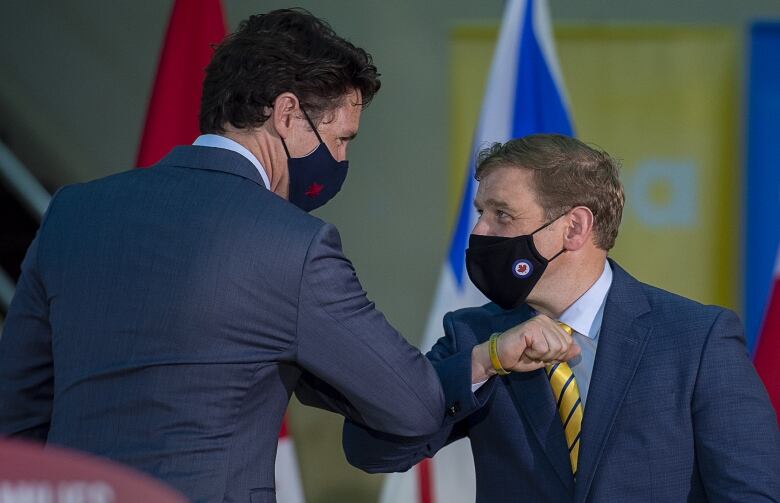
The Liberals have been able to count on Newfoundland and Labrador to get them off to a good start, and Liberals recently won at the provincial level during another pandemic-era election.
Since taking office, Premier Andrew Furey has praised Liberal Leader Justin Trudeau as “an immense friend to the province,” raising the hackles of the opposition who urged Furey to remain neutral.
Where might the Liberals be vulnerable?
The NDP will try to hang on to their lone seat of St. John’s East. Longtime MP Jack Harris held the seat before his retirement, and the party is hoping Mary Shortall can keep it orange.
The Conservatives are hoping to break through and win in Long Range Mountains, on the island’s west coast, where the Liberal incumbent, Gudie Hutchings, saw her vote share drop in 2019.
Conservative eyes on Nova Scotia

Heading into the election the Conservatives held one of the 11 seats in Nova Scotia, and are optimistic they’ll make inroads.
Nova Scotia’s Progressive Conservatives won the August provincial election, despite starting the campaign way behind in the polls.
The Liberal handling of the moderate livelihood fishery, which saw violence and vandalism erupt in the southwestern part of the province last year, has also created a potential opening.
The one seat the Conservatives hold is the West Nova riding, which has been ground zero for that dispute. The riding next door? South Shore–St. Margarets — the home of Bernadette Jordan, who was fisheries minister at dissolution. If this riding flips to the Conservatives, it’s an encouraging sign for leader Erin O’Toole.
More than just the mud is red in P.E.I. (usually)
Four seats are at stake on Prince Edward Island.
The province usually votes Liberal, with Egmont the only riding to send a non-Grit to Ottawa since 1988. But one definite change is that Liberal Wayne Easter will not win. He had won nine straight elections in the riding of Malpeque, but isn’t running again.

Can the Green Party win in Fredericton again?
New Brunswick will serve as an early test for the Green Party.
In 2019, Jenica Atwin won Fredericton for the Greens, marking the party’s only win ever outside of B.C. Then she crossed the floor to join the Liberal Party.
So, will Fredericton’s voters consider the Greens with a new candidate, Nicole O’Byrne? Or will the city go back to flip-flopping between the Liberal and Conservative parties?

When will we know the results?
There’s a real chance you’ll go to bed tonight without knowing who won the election.
But you might.
In-person voting at advance polls was way up from 2019, with approximately 5,780,000 votes being cast from Sept. 10-13, according to Elections Canada.
Also, we’ll see whether there’s a good turnout on election day. What counts as good? Nearly 66 per cent of total eligible voters cast a ballot in 2019, just down from 68.5 per cent in 2015.
In-person ballots can be counted as soon as the polls close (here are the official poll closing times in local time in case you can still dash out to vote), while those special ballots won’t be counted until Tuesday.
Our decision desk will keep working until we have answers for you. Send coffee.
What’s happening at polling stations?
If you’re reading this at a polling station, don’t worry about not being able to cast your ballot. Elections Canada says anyone in line when a station is supposed to close will still be allowed to vote.
Some Canadian voters waited outside in long lines on Monday while Elections Canada apologized for a technical problem with an application on its website that tells people where they can vote.
Many posted on social media that they were receiving an error while trying to use the voter information service page. They said the error stated: “We were unable to find your voting location. Please call the office of the returning officer for assistance.”
The problem has been fixed.

In Toronto, which has significantly fewer polling stations than in previous years, many stood outside in long lines before casting their ballots. In the city’s downtown core, one line wrapped around an entire city block as people waited to vote in the Spadina–Fort York riding. Once inside, however, many told CBC News the process went smoothly.
In Montreal, an accident caused some minor injuries, a police spokesperson said, after a woman lost control of her vehicle and hit people near a polling station in Montreal’s West Island. Const. Caroline Chèvrefils could not provide more details about the driver or the condition of the victims.

The magic number: 170
If you need a refresher on how this whole election thing works, Canada has 338 federal ridings, most located in densely populated parts (think: the Greater Toronto Area).
To win a majority government, a party needs to win 170 seats or more. The Liberals triggered the election holding 155, but would need a strong showing to win back the majority the party lost in 2019.
The Conservatives currently held 119 seats prior to the election.
Party that wins most seats won’t always govern
There’s one wrinkle here.
As CBC’s Aaron Wherry explained in 2019, a party could win the most seats in the election, but that doesn’t mean its leader will be prime minister — the same holds true today.
Justin Trudeau, as the incumbent prime minister, has the authority to recall Parliament, present a speech from the throne and seek to win the confidence of the House of Commons. With the support of other parties, he could continue as prime minister even if a rival party has more seats than his.
Of course, if a rival party wins a majority that scenario is out the window.