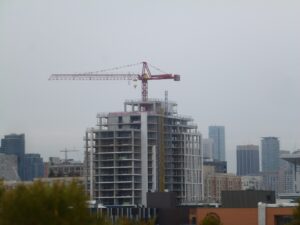




In Sydney, there are two narratives at play in the real estate market. While soaring interest rates are immobilizing many buyers across the general market, cash buyers in the top price points are staying active amid a lack of luxury inventory.
Throughout 2022, Sydney saw the most significant annual price falls among all of Australia’s capital cities, with home values dropping 12.1%, according to CoreLogic data. However, the prestigious end of town had a different experience. Prices across the city’s prime market—defined as the top 5% in terms of home values—actually increased in 2022, although modestly, by 1.1% according to Knight Frank’s 2023 Wealth Report.
Australia’s Wealth on the Rise
Industry insiders attribute the buoyant nature of Sydney’s priciest properties to the sector’s relative immunity to interest rate movements. Erin van Tuil, Knight Frank Australia’s head of residential, said the country has a larger than average proportion of high-end cash buyers.
“In our Wealth Report we said 49% of prime market buyers internationally were cash purchasers,” she said. “In Australia, we think that’s probably closer to 60% according to our research. Much of that is attributed to capital appreciation, money that’s sitting in people’s properties they already own.
“There’s definitely less impact from interest rates in the prime market, that’s why it’s behaving differently. Although we don’t have the data on cash buyers for Sydney specifically, we do know that typically 25% of our ultra-high-net-worth population lives in Sydney,” Ms. van Tuil added.
Knight Frank puts Australia’s population of ultra-high-net-worth individuals (residents with a personal net worth of more than US$30 million) at 20,874 people, up by 10.1% in 2021 alone.
The firm is forecasting Australia’s affluent headcount will grow a further 30.9% by the middle of the decade.
Low supply of prestige property is also behind the luxury market’s unique resilience as wealthy homeowners don’t want to—or don’t need to—sell.
“Stock at the moment is definitely tightly held. There’s less stock on the market, which then is also contributing to the prices of prime property outperforming what’s happening in the mainstream,” Ms. van Tuil explained.
A Safe Haven
The number of cashed-up foreign buyers and returning expats purchasing in Australia is rising, according to Sydney-based Monika Tu, founder and principal of Black Diamondz, a luxury property brokerage. She said approximately 70% of her deals are cash, with the pool of buyers looking for homes valued at A$25 million and up are currently “very active.”
“Many buyers are coming from China, Hong Kong, Singapore and Vietnam,” Ms. Tu said. “What’s happening internationally is overwhelming, there’s so much uncertainty, but Australia is still favored with South East Asian and Chinese buyers because it’s a relatively stable market. And when we compare square meters of prestige property we’re so much cheaper.”
According to the Wealth Report’s relative values comparison list, which charts how many square meters of prime property US$1 million buys in select cities, Sydney ranks 10th.
Ms. Tu said prime market purchasers are able to weather almost any storm, which in turn impacts the traditional trends of supply and demand.
“In Sydney’s wealthy suburbs, these people don’t have to sell. If you don’t have to sell you can hold on through recessions, interest rate increases, it doesn’t matter. But demand is always there and the demand from overseas is overwhelming,” she added.
Beyond rising interest rates, there are other factors influencing prestige buyers, said Sotheby’s Sydney International director Michael Pallier.
“This end of the market is often more affected by the stock market and where the Australian dollar is. We’ve got a lot of migration coming into Australia and our dollar is pretty attractive right now for overseas buyers,” he said, referencing the fact that US$1 equals approximately A$1.47.
While global events are front of mind for prime market buyers, Mr. Pallier explained that these purchasers are still astute business people with an eye for the right deal.
“People are looking at the news every day to see what’s going on around the world and these are very uncertain times. So people are cautious but for good quality properties, especially with the current lack of stock availability, there’s still plenty of people buying,” he said.
“I’m finding at the moment that for many of these buyers, it’s more the fear of not getting the property that makes them go for it. I recently sold an apartment for A$8.25 million with a three-day settlement, all cash. When the buyer exchanged contracts instead of giving me a 10% deposit he transferred 100% into our trust account. When I rang to ask why, he simply said to me ‘I thought it was just easier.’ So there are definitely plenty of cash buyers about.”
A Domestic Domino Effect
Gavin Rubinstein, director of real estate agency TRG, said while foreign buyers are looking fondly on Sydney real estate, plenty of wealthy Australians are also house hunting.
“It’s a combination of locals and expats still coming back after the pandemic. There’s been a couple of really good sales I’ve done with people who’ve returned to Sydney who seem to be pretty cashed up,” he said, adding he’d transacted at least a dozen multimillion dollar all-cash sales this year alone. “My view is the market has been fuelling the market. One client gets a big price for their house, then they take that cash and buy the next house.”
Then there are the wealthy locals who rode the very lucrative real estate wave that swept through Sydney in 2021.
“A lot of people made a lot of money over the last couple of couple of years. Whether it was refinancing, revaluing, drawing equity—everyone’s assets grew astronomically by about 30%, 40%, in some cases by as much as 50%. That’s another major factor that’s contributing to the amount of cash buyers out there—it was the biggest boom we’ve ever seen in the history of property,” Mr. Rubinstein said.

Follow Canada News Media
Get the day's top Canadian stories and our two daily 60-second news videos wherever you scroll.
X Threads Facebook Instagram LinkedIn TikTok YouTube Pinterest Reddit Substack Flipboard Newsletter RSS