

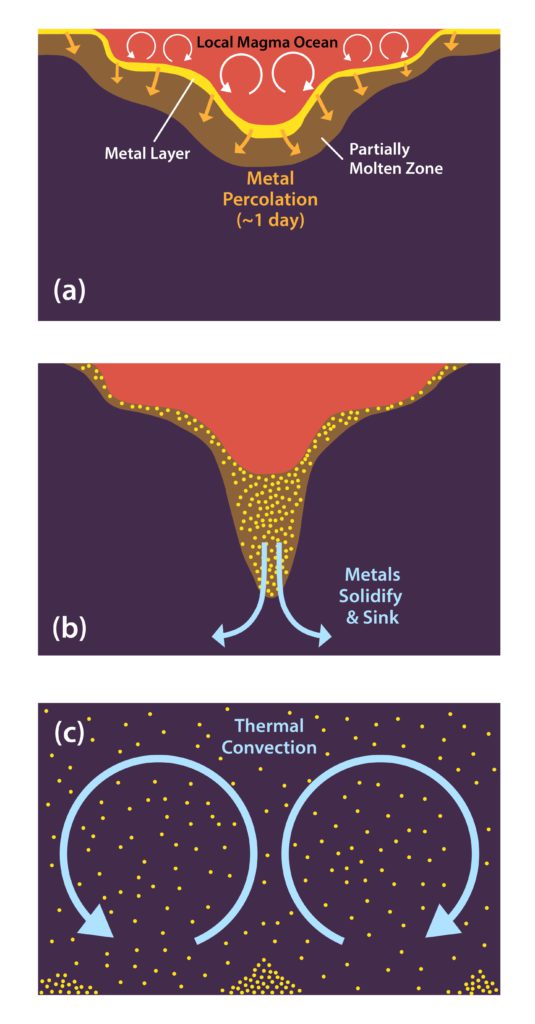
Their theory posits that this delivery is still ongoing, with the remnants of the transient region appearing as “large low-shear-velocity provinces”—well-known geophysical anomalies in the deep mantle.
“This transient region almost always forms when a big impactor hits the early earth, making our theory quite robust,” researcher Simone Marchi said in a media statement.
Marchi and study co-lead Jun Korenaga believe the new theory not only explains previously enigmatic aspects of earth’s geochemical and geophysical evolution but also highlights the wide range of time scales involved in the planet’s formation.
“One of the remarkable things we found was that the dynamics of the transient mantle region take place in a very short amount of time—about a day—yet its influence on subsequent earth evolution has lasted a few billion years,” Korenaga said.
Their findings have been published in an article in Proceedings of the National Academy of Sciences.
In the paper, they explain that previous research had established that precious metals came to our planet billions of years ago after the early proto-earth collided with large, moon-sized bodies in space, which left behind deposits of materials that were folded into what is today’s earth.
But that absorption process has remained something of a mystery.
Aside from being valued for their scarcity, aesthetic beauty, and use in high-tech products, gold and platinum are highly “siderophile” elements. They are drawn to the element iron to such a degree that they would be expected to collect almost entirely in earth’s metallic core—either by merging directly with the metal core on impact or by sinking quickly from the mantle into the core.
By this logic, they should not have collected at or near the surface. Yet they did.
“Working with Simone, who is an expert on impact dynamics, I was able to come up with this novel solution to this conundrum,” Korenaga said.