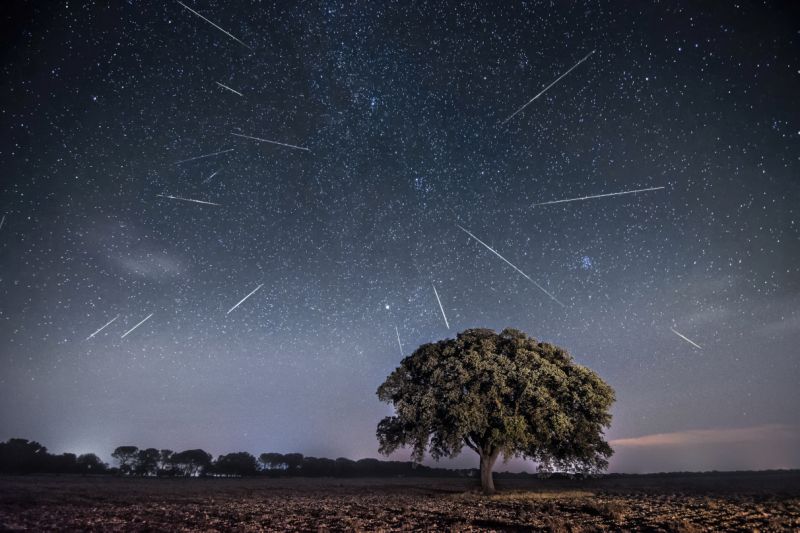

<p class="canvas-atom canvas-text Mb(1.0em) Mb(0)–sm Mt(0.8em)–sm" type="text" content="All through this week, the Perseid meteor shower will blaze across the sky as our planet flies through a cloud of dust from a comet. ” data-reactid=”33″>All through this week, the Perseid meteor shower will blaze across the sky as our planet flies through a cloud of dust from a comet.
<p class="canvas-atom canvas-text Mb(1.0em) Mb(0)–sm Mt(0.8em)–sm" type="text" content="The shower will peak between the 11th and 13th August, according to Royal Museums Greenwich. ” data-reactid=”34″>The shower will peak between the 11th and 13th August, according to Royal Museums Greenwich.
You won’t need binoculars or a telescope to watch, astronomy experts say (weather permitting).
Occurring yearly between July 17 and August 24, the meteors reach their peak on this week.
The event is one of the highpoints in the celestial calendar, occurring each year as the Earth ploughs through dusty debris left by Comet Swift-Tuttle.
<p class="canvas-atom canvas-text Mb(1.0em) Mb(0)–sm Mt(0.8em)–sm" type="text" content="Read more: Lyrid meteor shower captured in time-lapse” data-reactid=”38″>Read more: Lyrid meteor shower captured in time-lapse
The meteors, mostly no bigger than a grain of sand, burn up as they hit the atmosphere at 36 miles per second to produce a shooting stream of light in the sky.
Peak temperatures can reach anywhere from 1,648 to 5,537 C as they speed across the sky.
The meteors are called Perseids because they seem to dart out of the constellation Perseus.


To make the best of the Perseids, observers should avoid built-up areas and try to find an unobstructed view to the east, experts suggest.
Royal Museums Greenwich suggests that wannabe viewers should try to minimise the amount of light affecting their view.
<p class="canvas-atom canvas-text Mb(1.0em) Mb(0)–sm Mt(0.8em)–sm" type="text" content="Read more: Scientists warn dangerous space rocks could be hiding in meteor shower” data-reactid=”64″>Read more: Scientists warn dangerous space rocks could be hiding in meteor shower
An astronomer at the Greenwhich Royal Observatory writes, “Reduce the amount of light pollution in your field of view. This could mean heading out to the countryside, a nearby park or even do something as simple as turning your back to street lamps if you are not able to go anywhere.
“Give your eyes at least 15 minutes to adjust to the dark so that you can catch more of the fainter meteors – this does mean that you should not look at your phone!
“Meteors can appear in any part of the sky so the more sky you can see the better. Find an area with a clear view of the horizon and away from trees and buildings.”
<p class="canvas-atom canvas-text Mb(1.0em) Mb(0)–sm Mt(0.8em)–sm" type="text" content="Read more: Huge meteor explodes in the sky above Derby” data-reactid=”68″>Read more: Huge meteor explodes in the sky above Derby
The shooting stars are formed of debris from a comet, formed when pieces break off comets in the heat of the sun.
If the debris ends up in Earth’s atmosphere, it can slam into our atmosphere, creating shooting stars visible for the ground.