
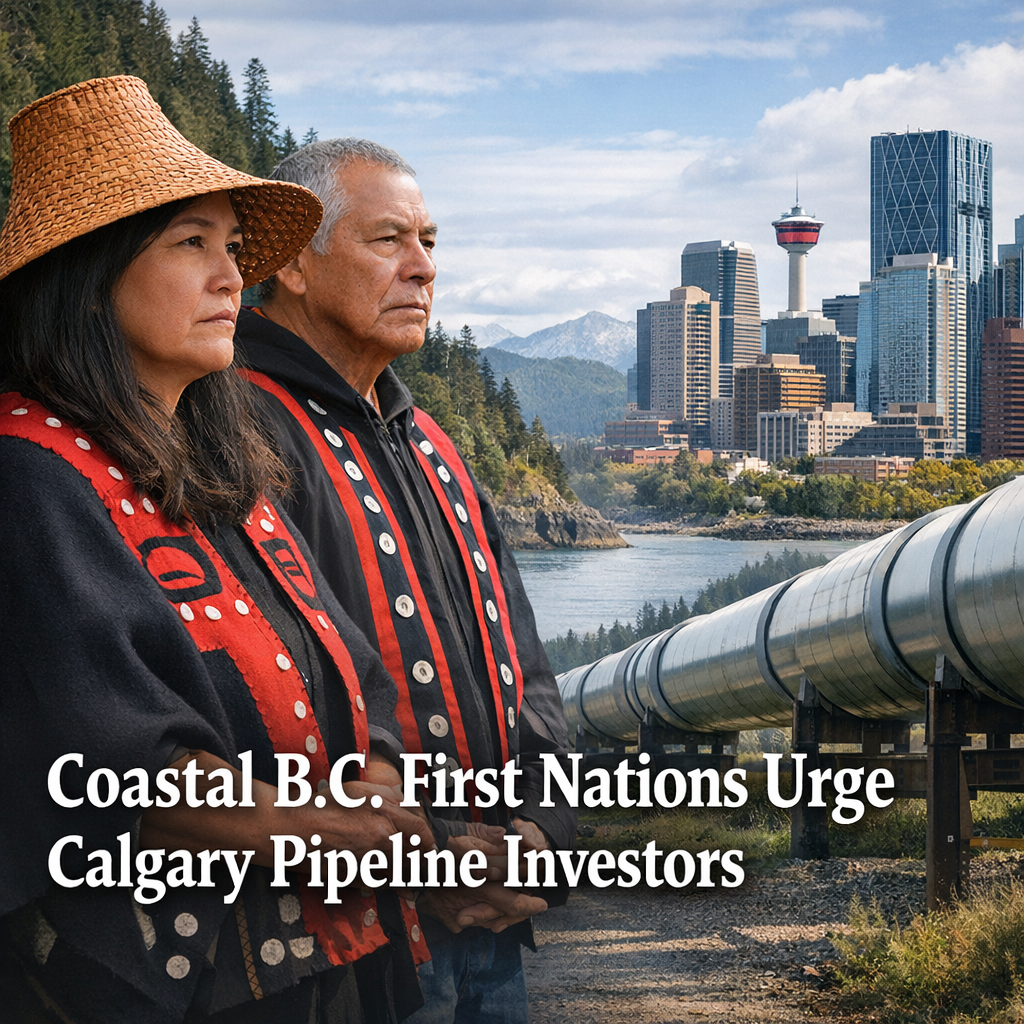
A group of First Nations leaders from British Columbia has travelled to Calgary to send a direct message to Canada’s oil industry: they do not want companies reviving plans for a new pipeline to the northwest coast of B.C. Their visit is aimed at persuading executives and investors that any such project would face strong Indigenous opposition, especially from communities concerned about land, water and coastal ecosystems. The leaders argue that the economic promises tied to another export route cannot outweigh the legal, environmental and cultural risks for nations whose territories would be crossed. Their appearance in Calgary highlights how the future of major energy projects in Canada is increasingly shaped not only by markets and politics, but also by Indigenous rights and consent.
For Canadians, this debate reaches far beyond boardrooms in Alberta or remote proposed pipeline corridors in British Columbia. Pipeline decisions affect jobs, fuel exports, government revenues, climate policy, reconciliation efforts and the balance between provincial and federal interests. Canadians are also watching how courts, regulators and governments respond when First Nations assert title, treaty rights and stewardship responsibilities over traditional territories. The outcome matters in daily life because it can influence public spending, regional employment, energy investment and the pace at which Canada shifts toward lower-emission industries.
What comes next will depend on whether oil companies see enough commercial value in pursuing another west coast pipeline despite likely legal and political hurdles. Canadians should watch for reactions from industry leaders, statements from provincial and federal governments, and whether more First Nations publicly join the opposition or put forward alternative economic visions. Any sign of renewed project planning would likely trigger an early debate over consultation, consent and the role of energy infrastructure in Canada’s long-term economy.
The broader context is shaped by years of conflict over how Canadian oil reaches global markets. B.C.’s coast has long been seen by the energy sector as a strategic export gateway to Asia, but proposed pipelines to the region have repeatedly drawn fierce resistance from Indigenous communities, environmental groups and many local residents. Past projects have raised concerns about spills in sensitive salmon rivers, tanker traffic along the coast and the lasting impact on lands that support food harvesting, culture and community life. At the same time, industry and some governments have argued that new pipeline capacity could help Canada secure better prices for its oil, strengthen trade diversification and support employment across the West.
The First Nations leaders now in Calgary are stepping into a familiar but still evolving Canadian fault line. For years, major energy proposals have run up against a central question: can governments or corporations move ahead with large-scale resource projects when the Indigenous nations along the route say no? In Canadian law, the duty to consult Indigenous peoples is well established, but the practical meaning of consent remains a point of intense debate. That tension has become even more visible as governments publicly commit to reconciliation while also backing resource development seen as economically important.
From the perspective of the B.C. leaders, this is not simply a protest against one possible project. It is also an effort to define what responsible development should look like on Indigenous territories. Many nations argue they are not being obstructionist, but are defending watersheds, marine areas and culturally important lands that have sustained their people for generations. Their message in Calgary is meant to land where capital decisions are made, before companies spend money and political energy trying to revive a plan that could become deeply divisive.
This story also reflects a broader shift in how Indigenous governments engage with corporate Canada. Rather than waiting for a formal project announcement, leaders are increasingly intervening early to shape the conversation with investors, executives and regulators. That approach can change the financial outlook for proposed projects, because uncertainty around legal challenges, permitting and public opposition can make infrastructure harder to finance. In other words, the Calgary visit is as much about economics as it is about politics and environmental protection.
For Canadian readers, there is also a national unity dimension. Alberta’s energy sector has often pushed for more pipeline access to tidewater, arguing that landlocked oil sells at a discount and leaves Canada too dependent on the U.S. market. British Columbia, meanwhile, has frequently been the site of environmental and Indigenous resistance to projects designed largely to serve producers elsewhere. Ottawa can be pulled between these competing pressures, especially when it is trying to support both resource jobs and climate commitments at the same time.
The issue is likely to resonate in communities far from the proposed route. Workers in Alberta and Saskatchewan may see pipeline expansion as tied to employment and investment. Coastal and interior communities in B.C. may focus more heavily on spill risks, tanker traffic and effects on fisheries, tourism and traditional harvesting. Across the country, Canadians are increasingly sensitive to whether major decisions reflect meaningful Indigenous participation rather than consultation that happens only after key choices are already made.
There is also an international angle. Global energy markets remain uncertain, and companies considering large infrastructure projects must weigh oil demand forecasts, shipping economics, regulatory delays and pressure from climate policy. A new pipeline to the northwest B.C. coast would not be judged only on engineering feasibility. It would also be tested against investor expectations around environmental, social and governance performance, including how firms handle Indigenous rights.
That is why this visit to Calgary matters. It brings a local territorial issue directly to the centre of Canada’s oil industry and asks executives to consider whether another pipeline fight is worth the cost. The First Nations leaders are effectively warning that resistance will not be an afterthought; it will be a defining part of the project from day one. As Canada continues to debate energy security, economic growth and reconciliation, this standoff offers a clear example of how those priorities can collide in real time.
Follow Canada News Media
Get the day's top Canadian stories and our two daily 60-second news videos wherever you scroll.