



At a briefing held on Friday, Robert Strang said he’s less anxious about Clayton Park’s COVID-19 cluster but reiterates that Nova Scotians must limit social interactions.
“We’re not out of the woods yet,” said Strang, who’s Nova Scotia’s chief medical officer, “and we will continue to monitor this cluster.”
As of Nov. 13, Nova Scotia reports two new cases of the virus for a total of 19. Since Tuesday, no new cases have been identified in the Clayton Park cluster.
Earlier this week, the Nova Scotia Health Authority (NSHA) had plans to create a temporary assessment centre in Bayers Lake to handle the cluster. But Strang said as the week went on, the NSHA determined the centre wasn’t necessary. However, that space is still available if the NSHA needs to create an assessment centre in the future.
Even though Strang said he’s less anxious compared to Monday about Clayton Park’s COVID-19 cluster, he also said Nova Scotians should limit their social interactions.
“We need to think about each other and how we’re collectively going to do the things necessary to keep each other safe,” he said.
Specifically, as holiday season approaches in the next six to eight weeks, Strang said people need to be cautious and adhere to public health guidelines.
There are new self-isolation rules for Nova Scotia. Are you entering Nova Scotia from outside of Atlantic Canada? Most people must self-isolate for 14-days. pic.twitter.com/Qs0xYpnEgn
— Health & Wellness (@nshealth) November 13, 2020
In terms of holiday travel, Strang said there are already restrictions in place.
Anyone (re)entering the Atlantic bubble must self-isolate for 14 days. Strang reiterated that travellers must self-isolate away from other people. Otherwise, the entire household they’re self-isolating in must also self-isolate for 14 days.
Those restrictions also apply to students studying inside and outside of the Atlantic bubble. Strang said students studying outside of the Atlantic bubble are better off staying put for the holiday season to avoid putting implications on their family households.
“I recognize this is hard for folks and we know the impact of what we’re doing but the reality is is that we have to continue to make sure that we take the appropriate steps to minimize the introduction of COVID into the province,” Strang said.
He also said the province can’t define what non-essential travel means. Instead, Nova Scotians need to ask themselves whether leaving and re-entering the Atlantic bubble is necessary over the next few weeks.
These restrictions don’t apply to rotational workers who have modified quarantine guidelines due to rapid testing. Strang said the NSHA is working on a testing strategy similar to Newfoundland’s.
Rapid testing doesn’t provide accurate enough results to remove quarantine requirements. However, Strang said it does modify the quarantine requirements for rotational workers.
Currently, Strang said they’re not testing everyone entering the province because it’s not “feasible or realistic for a number of reasons.”
At the moment, it takes between 48 and 72 hours to turnaround a test, and Strang said they’re “by and far” meeting that goal.
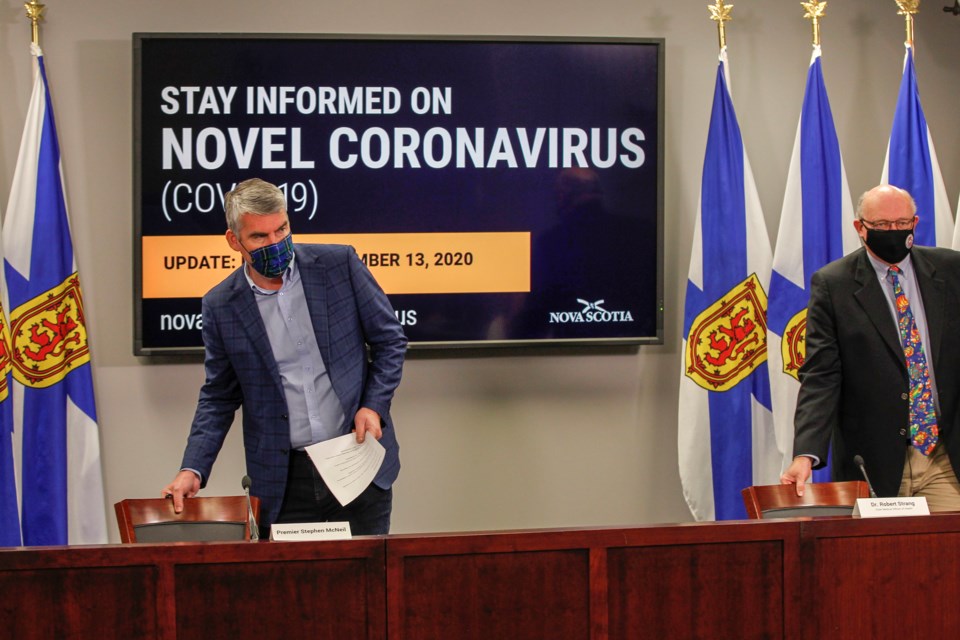 Premier Stephen McNeil (left) and Robert Strang put on their masks before leaving the room (Courtesy of Communications Nova Scotia)
In terms of holiday shopping, Strang said there will soon be a more detailed response. Still, people must adhere to guidelines while in public spaces.
Strang said it’s up to businessowners and mall operators to ensure that customers can, and are, adhering to guidelines. However, he said he doesn’t want to place all of the responsibility on the businessowners since Nova Scotians must also be making the effort to follow guidelines.
“These collective approaches that have kept us safe so far are what will continue to keep us safe,” he said.
He also said the NSHA hears and recognizes that these guidelines and restrictions are difficult for people, and that it’s been a long road. However, there’s still a long road ahead.
Strang said other provinces that have seen a second wave have been able to reduce cases by limiting social interactions. He said Nova Scotians must do the same so that the province doesn’t have to flatten the curve but is already in front of it.
He said if we’re not careful, we’re putting people in our communities at risk such as our seniors and healthcare workers.
“Our collective fate as it relates to COVID is very much in our own hands,” he said.
As COVID-19 cases rise in other parts of Canada and the rest of the world, Strang said Nova Scotians should understand that there will inevitably be cases in the province.
“As we continue to see new cases in Nova Scotia, I think it is important to remind people about the COVID alert app that is now out there that people can download,” he said. “It will help them be aware if they may have been exposed to COVID-19.
“It does use Bluetooth to communicate but no personal information is collected or shared or tracked.”
Currently, there have been 5 million downloads of the app but with Canada’s population being over 30 million, there’s more room to grow.
“Our message is to all Nova Scotians,” Strang said, “if they feel unwell, go online and do the online assessment.”
Premier Stephen McNeil, who also spoke at the briefing, said that as of today, online bookings for COVID-19 test are available at all primary assessment centres and the IWK. Moreover, the gargle test for children is available at all primary centres across Nova Scotia.
“COVID is and has been relentless,” he said, “and it will take over a community if we let it.”

Follow Canada News Media
Get the day's top Canadian stories and our two daily 60-second news videos wherever you scroll.
X Threads Facebook Instagram LinkedIn TikTok YouTube Pinterest Reddit Substack Flipboard Newsletter RSS