
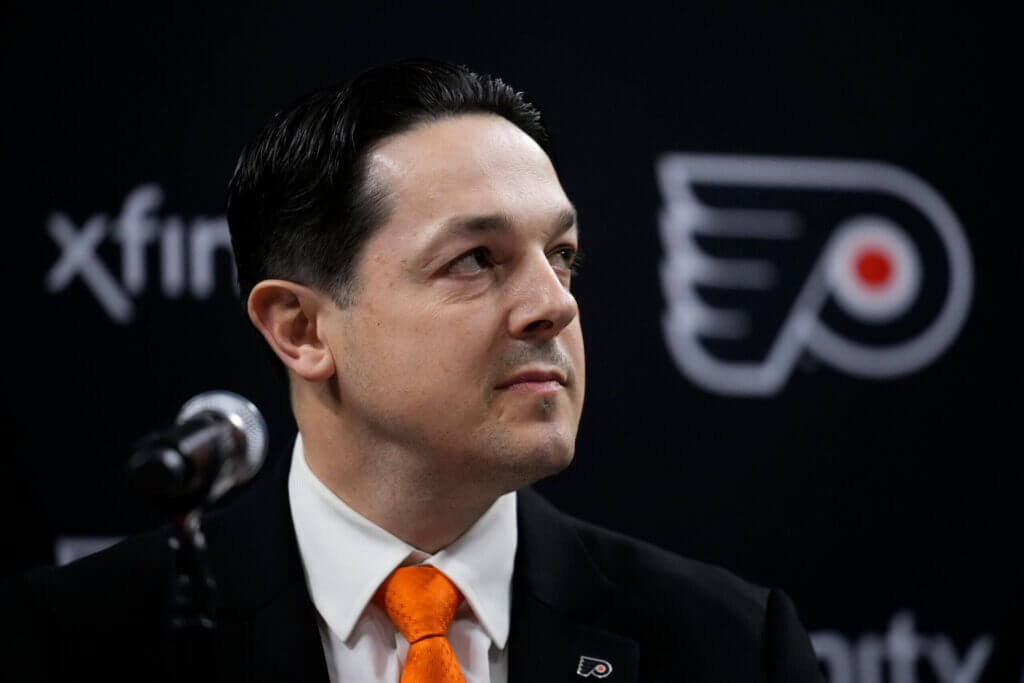

BUFFALO, N.Y. — Daniel Briere is considered among the greatest trade acquisitions in Buffalo Sabres history. He became an NHL star at HSBC Arena.
It was there, while pacing the 100-level concourse Tuesday afternoon, Briere made the first trade of his career.
The new Philadelphia Flyers general manager didn’t make it simple. The three-way deal sent defenseman Ivan Provorov to the Columbus Blue Jackets, brought back goaltender Cal Petersen, defensemen Sean Walker and Helge Grans and three draft choices and shipped winger Hayden Hodgson and defenseman Kevin Connauton to the Los Angeles Kings.
As the sun set over Fort Erie a few hours later, Briere sat in an upscale restaurant overlooking Canalside and couldn’t contain a smile. It was a surreal moment for the former Sabres co-captain and All-Star Game MVP. He couldn’t help but recall how it felt the first time he was traded, the Phoenix Coyotes dealing him for center Chris Gratton at the 2003 deadline.
“I remember when I got traded to Buffalo,” Briere said. “It was a weird feeling because when you’re first told, it’s a moment of rejection. Your team says, ‘We’re getting rid of you.’
“Then a few minutes later the other team calls and says, ‘You’re coming to us. We’re excited. Welcome.’ You are still wanted.”
Briere was on the other side of the phone Tuesday. He sat down with The Athletic to explain how his first trade all went down.
Please note that some of the questions and answers have been edited for length and clarity.
Why are you having such a hard time concealing that smile?
First of all, it’s my first trade, and it was a very complicated one. I’ve never even done a two-way trade before. I need a little bit of a road map to explain it to you. I guess I couldn’t start with a simple trade, one player for one player. I had to get really deep, I guess. That’s why I’m laughing.
How did the experience start for you?
The trade started with us and Columbus. Then we realized we needed help to close the deal, and that’s why a third team came in for us to get it done. Now, every team is getting a little of what they were looking for. Columbus gets the best player in the trade. L.A. gets some cap relief and some players. For us, it was about acquiring young prospects and draft capital.
How long did it take?
I’ve had a few weeks of discussions with Columbus on Provorov. They were clearly interested, but we couldn’t close the deal. We needed help cap-wise. (Kings GM) Rob Blake was the first person I approached with it, and he was very receptive. It made sense for him; it made sense for us.
So when you’re making your first trade, how do you know who to trust to add to the dance, when you’ve never done the dance before?
It was interesting. I have a little bit of a background with Rob Blake. When I was in my early 20s, I used to train in California, and he was around. I’ve known him (for) a lot of years. He also has been close with Pat Brisson, who was my agent. I had trust in Rob from the beginning. As far as (Blue Jackets GM) Jarmo Kekalainen in Columbus, I’ve gotten to know him in the last 2 1/2 months since I was named GM. It just shows how well we all worked together that nobody knew what was happening until the trade was announced.
Had you come close to making a trade before this one?
No, there were no talks until the season was over. I came in after the trade deadline, and this was the first real negotiation.
What was new Flyers president Keith Jones’ role in this process?
He was awesome. Keith has a lot of contacts. He was very helpful in opening doors. He’s well known around the hockey world and was very supportive. He had feedback on everything we should do. The part I’m most proud of is how every department came together on our side, management, pro scouting, amateur scouting, even our analytics team had some great ideas to broker this deal. It wasn’t just “Danny Briere made a trade.” It was a collection of talented people.
Does this trade make the job official?
(Laughing) I’m glad the first one is over with. I can move on.
When did you know you wanted to be a GM?
I don’t know that I ever wanted to strictly be a GM. I was open to all kinds of things. I just knew I was more geared toward management than coaching. I knew that from the beginning, but I never knew what my position was going to be.
The reason I ask is because with all of the universities that offer sports management (programs) and with (how) you can rise through the ranks with an MBA or a law degree, there are a lot of people who get into the industry because the idea of making player moves is exciting to them.
It’s not about making the moves. For me, it’s about assembling the building blocks through a vision, working with people. That’s what I love, sharing a common goal. It’s about winning together. That’s the thrill for me. That’s why it’s not about my first trade. It’s about how we all worked together.
How did it feel as the process escalated?
There’s a little thrill when you feel you’re getting close and have traction toward a deal. I’m not trying to figure that out, when is the right time to get excited about it or not, because there’s been a lot of different talks over the months. But it definitely felt a little different when I woke up today, spoke to those guys and was able to close it out.
What were the phone calls like with the players involved?
I had to call the players we were giving away, and that was awkward. That was not so much fun. But then you call the other guys, and you’re excited to welcome new players to the team. Those calls were a little easier to make.
Through the process, since it was your first time, how did you look back on how other GMs you’ve been exposed to would have done it?
I look back on a lot of those GMs that I’ve dealt with over the course of my career from the outside. Darcy Regier had a certain way to go about things in Buffalo. Paul Holmgren did things his way and was very aggressive because (we) were in a position to win in Philly. Marc Bergevin wanted building blocks when I got to Montreal and was more interested in character. My last year that I played in Colorado, I was in the beginning of their rebuild with Nate MacKinnon. All of it has been very interesting to see along the way, and it has allowed me to take the best of what I’ve seen from the different GMs along the way.
The old saying is that when a good deal is made, all sides end up a little dissatisfied. What’s your takeaway in that vein?
Look, we had to give up a lot to get what we got. That’s the important part about a trade. But I hope all three teams came away from this situation happy and got what they were looking for and needed.
How will your new assets fit into the Flyers’ master plan?
We have three high picks and a prospect that we’ll find out about exactly. We have the seventh and 22nd picks in this year’s draft now. Grans is only 21 years old and was a second-round pick in 2020. And then we got two veterans that can come and help out our young guys. I’m excited about what we got, but we did give up the best player in the deal. That’s always a little scary.
To me, it’s a rebuild, but I don’t believe in teardowns. We don’t need to completely strip away everything. I want some veteran leaders there to show the young guys what it means to be a pro and handle themselves. That’s important for the young guys. I want to be careful with that. I don’t want to lose on purpose. I don’t believe in tanking. I still want our team to play hard and be competitive and make the push. It’s going to be our job to find those players to surround them.
(Photo: Matt Slocum / Associated Press)