

At the beginning of a science experiment, there’s a strong possibility everything will go wrong.
Say you tag almost 200 ducks with tracking devices and then avian flu wipes them out, for example.
That was a possibility that had a group of scientists nervous in 2021 and 2022, when a large outbreak was killing countless birds across North America.
Hundreds of research dollars from Canada and the United States were riding on the fate of eider ducks along the eastern seaboard, and while survival rates were lower at first, they’ve picked up again.
Today, more than180 birds are still tagged.
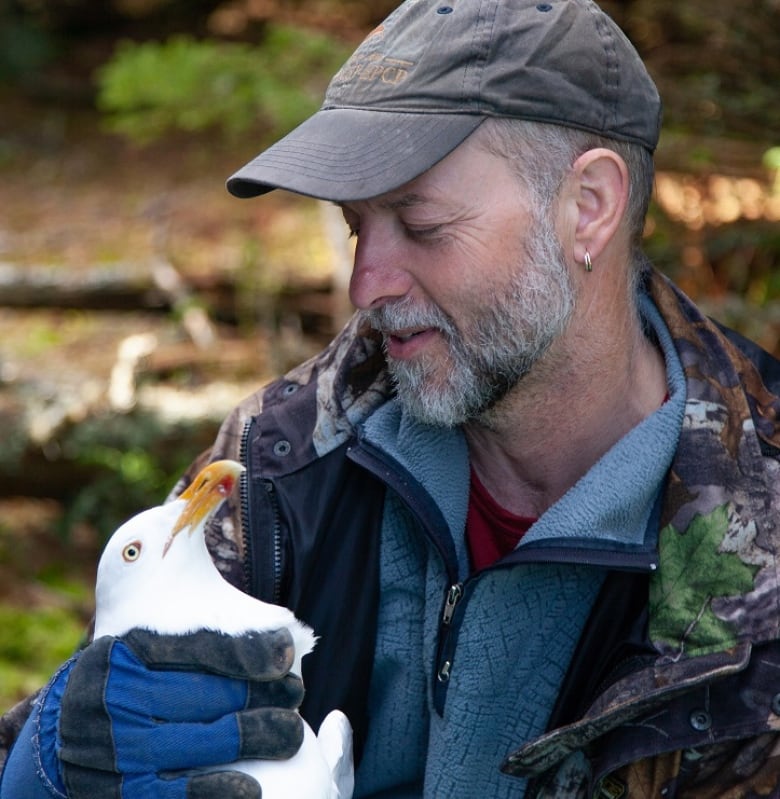
“It’s really nice when these things work out,” said Dr. Mark Mallory, a scientist from Acadia University who’s been studying eider ducks for more than 20 years.

Mallory is one of several people on both sides of the border trying to understand more about the American common eider, a subspecies of the eider duck, which are hunted and harvested for their feathers. Not to be confused with the smaller, more popular mallard duck, eiders breed along marine coasts.
On the surface, it seems like the population is decreasing in New Brunswick, Nova Scotia and Maine, but picking up in other areas, such as Newfoundland and Labrador. Even numbers from the Christmas Bird Count, a citizen science project that’s been happening since 1990, show an eider decline in the middle part of its range.
And maybe a decline is what’s happening. Or, as Mallory told CBC News, the ducks could be redistributing, changing their migratory patterns. Female eiders could even be skipping the breeding season, but short of sitting on a boat and stalking the colonies, researchers couldn’t say for certain what exactly was happening.
Until now. The project is three years in, with partners that include the Canadian Wildlife Service, Environment Canada, the U.S. Fish and Wildlife Service, Maine’s Department of Fisheries and Wildlife, the Biodiversity Research Institute in Maine and Acadia University.

That has researchers in the “grind phase,” Mallory said.
Something they’ve already confirmed is that Cape Cod is a popular spot for the ducks. Nearly all of the eiders being tracked overwinter on the Massachusetts peninsula, Mallory said, making it a critical marine area.
“That one we’ve got, we just have to write that up,” Mallory said. “That’s lovely and convincing.”
But more questions remain, and it will take the better part of 2024 to find answers, especially for the part of the project investigating breeding propensity, or the tendency to breed.
“We know the birds sometimes skip but what we were starting to be concerned about is, are birds coming back and looking and just not nesting for reasons we’re not too sure of?” Mallory asked.
It could be that the island’s vibes are just, well, off.
“The birds are hardwired to come back, but they’re not idiots,” Mallory said. If there’s human activity, he added, or the island is crawling with predators, maybe gulls or mink, the ducks, sensing risk, could hold off on nesting until it’s too late to breed.
“Who knows what goes on in an eider’s head?” he asked.
A mystery of mysteries
Whatever the data shows, it’s all exciting for Mallory. New answers could mean new questions: if eider ducks are staying farther north instead of nesting in their usual places, then why? If they’re choosing not to breed, what are the reasons?
“In a weird way, it’s even more cool if we find they are breeding,” Mallory said. “Because then it’s like, okay, the birds are still coming back to breed, but the numbers are going down in this area, so something is happening to the birds.”
Asha Grewal, a masters student at Acadia, who’s charged with going through the female eider duck data, said if they’re not breeding, there are some possible explanations.
They have quite a few eggs — four or five, she said — and that could be productive enough for them, meaning they don’t necessarily have to breed every single year. Or maybe the ducks didn’t get enough food over the winter, leaving their bodies too weak for an extensive nesting period.

“It’s putting themselves first, before reproduction and putting their resources into chicks,” Grewal said.
That brings physiology, or the study of how a body functions, into the framework, which Mallory said will play a bigger role in the research next year.
Researchers have also received extra funding to tag more birds on the north shore of Quebec and possibly Rhode Island and northern Labrador.
That will mean almost their whole range is covered, Mallory said, and by this time next year, researchers will have more answers about what is going on.

Follow Canada News Media
Get the day's top Canadian stories and our two daily 60-second news videos wherever you scroll.
X Threads Facebook Instagram LinkedIn TikTok YouTube Pinterest Reddit Substack Flipboard Newsletter RSS