

In a letter sent on Tuesday, Lieutenant Colonel A., an active pilot with a sensitive role in the Air Force reserves, informed his commander that he was hereby ending his volunteer reserve service. This was “a personal decision,” he stated, and “not a call for refusal of any kind.” Simply, he explained, the authority to order the use of Israel’s military power “is now in the hands of a group that is acting to demolish the foundations of democracy” and thus “it appears that the contract has been broken and we are marching into the abyss.”
The “contract” to which Lt. Col. A was referring is that between the State of Israel and its troops — an understanding, a kind of covenant, according to which Israel imposes mandatory military service on its young men and women, and subsequently requires many of them to continue to serve for years in the active reserves that are central to the IDF. In some cases it encourages even more voluntary reserve service, notably in the air force, for those with particularly sensitive and expert roles. And in return, Israel’s military recruits reasonably expect that the burden of service be imposed equitably, and that the military actions they are asked to perform be legal and moral, and carried out on behalf of a democratic nation.
In a speech to reserve troops later Tuesday marking 50 years since the Yom Kippur War, Defense Minister Yoav Gallant decried mounting calls and threats by military reservists to stop reporting for service because of their opposition to the Netanyahu coalition’s resumed judiciary overhaul effort. Such threats undermine “the unity of the ranks, are dangerous, and are a reward for our enemy,” said Gallant, and then pleaded: “I call on public figures from the right and the left, leave politics out of the army.”
Gallant’s appeal was doubtless heartfelt, but it misses its mark. Politics cannot be kept out of the military. The political parameters within which Israel operates are the basis for the IDF: Israel has a “people’s army,” a fighting force based on the readiness of the people to risk their lives in its ranks protecting the country. If, as is the case today, a growing swath of the public fears that the government is abusing or is ready to abuse that readiness, or is likely to abuse the power wielded by our military, then the contract referred to by Lt. Col. A. comes into question.
On the front lines
It is no coincidence that military veterans — notably in the shape of the Brothers and Sisters in Arms movement — are at the vanguard of the protests against the Netanyahu government’s bid to obtain almost unlimited power by shackling the judiciary.
Netanyahu’s appointment of the violent provocateur Itamar Ben Gvir to a position of authority over part of the armed forces, in his expanded post of national security minister, prompted open concern from the outgoing IDF chief Aviv Kohavi, who made plain that he would not allow the deployment of Border Police forces under Ben Gvir’s control in the West Bank.
The prime minister’s choice of the anti-Arab, homophobic, former Jewish terror suspect Bezalel Smotrich as both finance minister and a second minister in the Defense Ministry prompted similar dismay, much exacerbated when Smotrich called to “wipe out” the Palestinian village of Huwara in the wake of deadly attacks by Palestinian terrorists from the area. (Smotrich later apologized.)
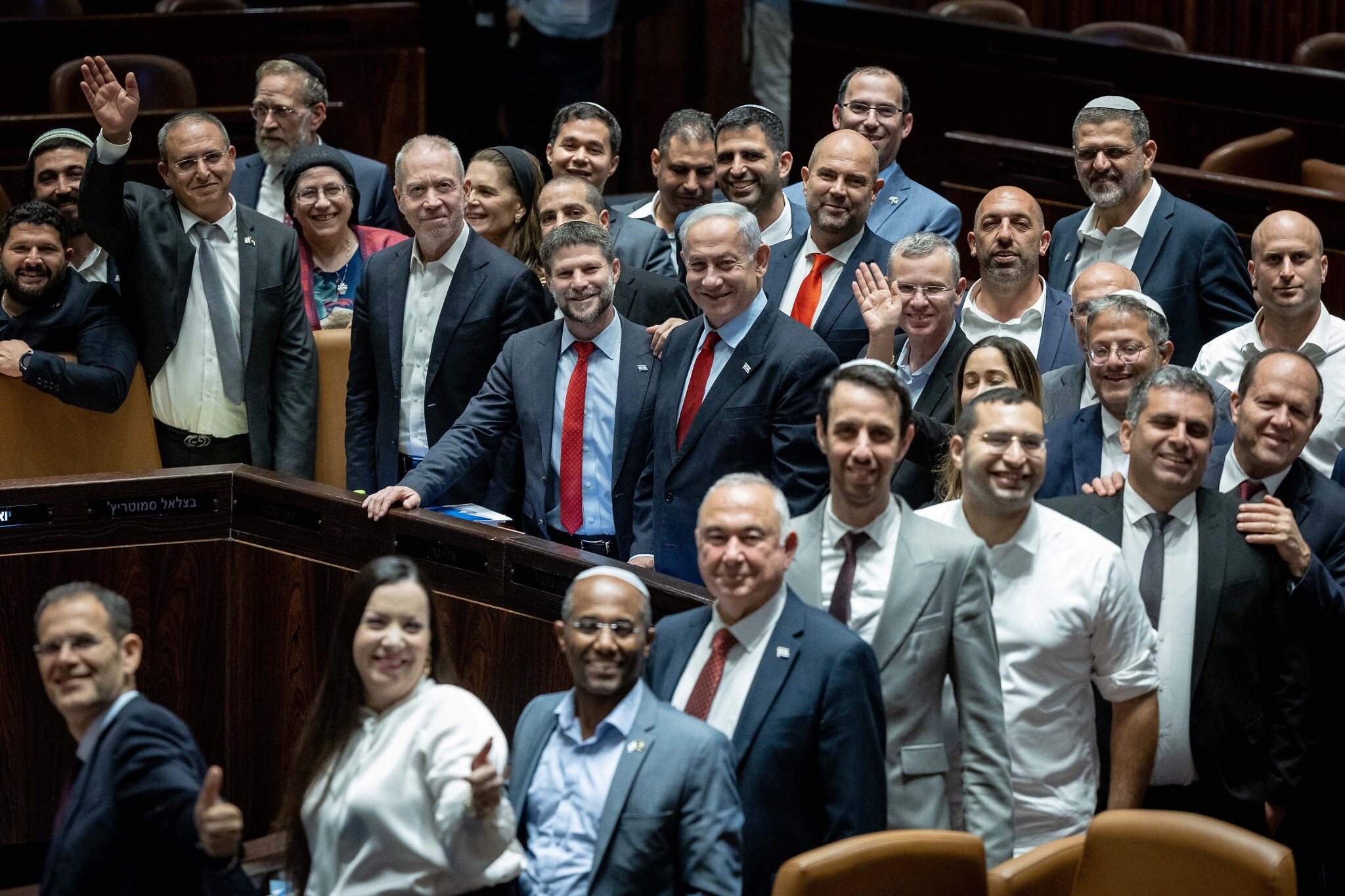
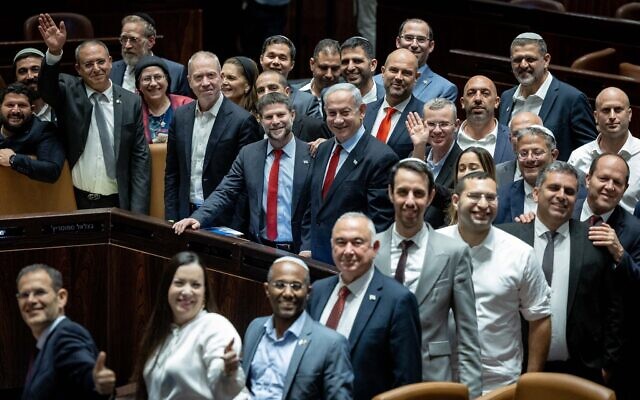
Prime Minister Benjamin Netanyahu, with Finance Minister Bezalel Smotrich at his side, and other coalition members including Yoav Gallant and Itamar Ben Gvir, celebrate the passage of the state budget in the Knesset, May 23, 2023. (Yonatan Sindel/Flash90)
These two ministers (the first of whom was considered too dangerous to conscript in his youth, and the second of whom repeatedly pushed off and thus shortened his military service) are at the forefront of the group referred to by Lt. Col. A. as holding “the authority to order the use of military force” while “acting to demolish the foundations of democracy.”
At a meeting with the Air Force’s commander Tomer Bar on Monday, representatives of a group of several hundred reserve pilots were reportedly more succinct and direct. Warning Bar of potential mass refusals to volunteer for service, they are said to have told him: “We swore to serve the kingdom, not the king.”
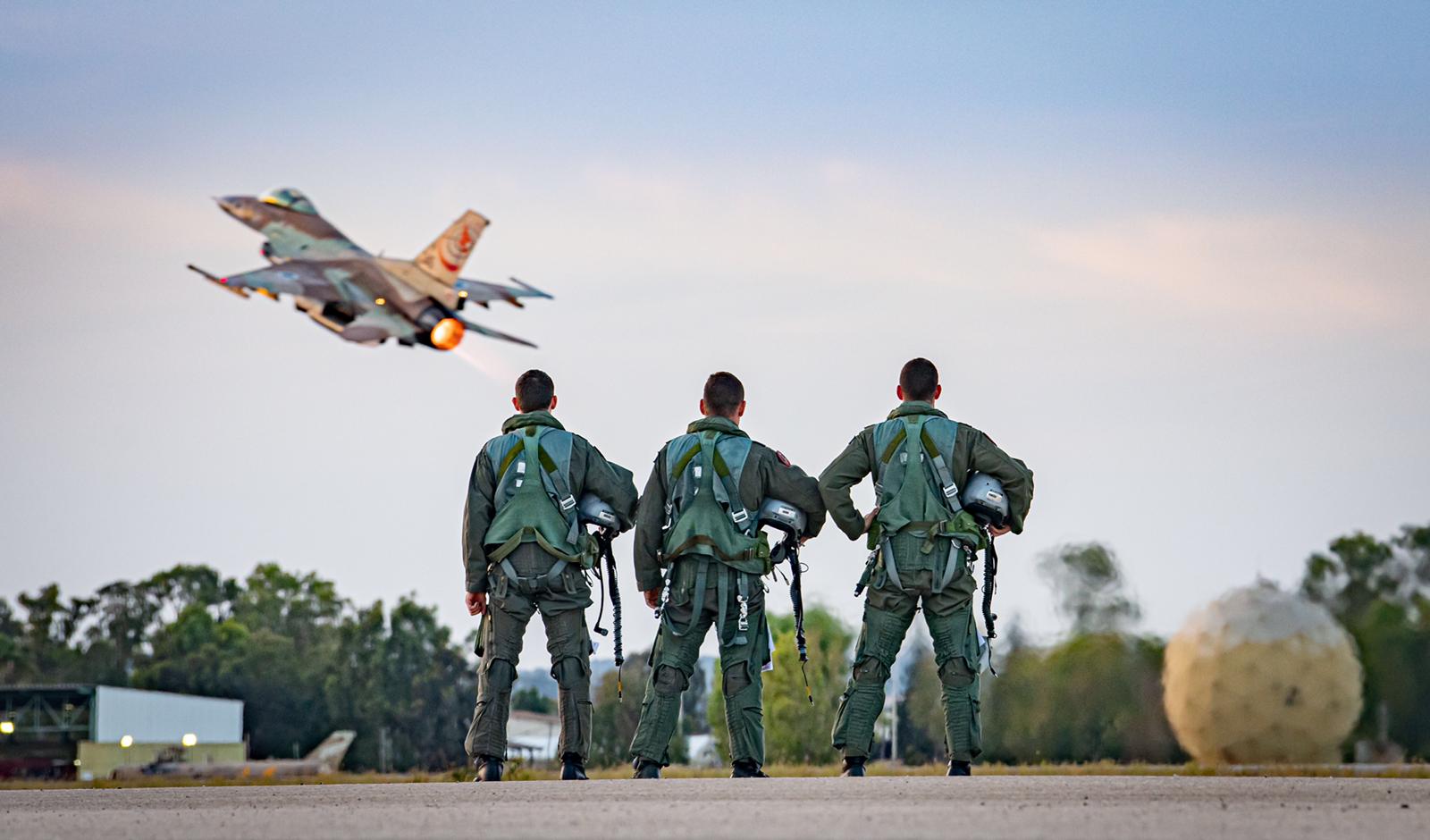
Illustrative: Three pilots stand in front of an F-16 fighter jet as it takes off from the Israeli Air Force’s 117th Squadron. (Israel Defense Forces)
The neutering of the High Court’s capabilities, and the shattering of its independence, as sought in the Netanyahu coalition’s overhaul legislation, would personally impact these and all other members of the Israeli armed forces — from rank and file to highest echelons, and their political overseers — since Israel’s internationally respected judiciary has protected the IDF from the attentions of hostile international tribunals alleging and seeking to prosecute Israeli war crimes.
But such personal concerns are not high on the agenda of the reserve, volunteer and former military men and women on the front lines of the anti-overhaul effort. Rather, it is their fear that they and their comrades will be risking their lives, and potentially taking others’ lives, in defensive and offensive operations against Israel’s enemies on behalf of an Israel that is no longer dependably committed to the moral and equitable vision set out in the Declaration of Independence.

Brothers in Arms member Udi Ori, a former combat helicopter pilot and a colonel in the Air Force reserves, at the hospital on July 7, 2023, after suffering an eye injury when taking a direct hit from a water cannon during a protest against the judicial overhaul in Tel Aviv on July 5, 2023. (Courtesy)
Equality of service has long been defunct, with most ultra-Orthodox and Arab youngsters exempted from military or national service; once the justices are rendered impotent, the Netanyahu government avowedly intends to entrench and expand that inequality by law. Morality of service, they understandably worry, is also under threat given the positions of Ben Gvir and Smotrich, and other coalition members’ tolerance, indulgence and in many cases support for those positions. The contempt the protesters have encountered, as evinced in the statements of ministers within Netanyahu’s own Likud party such as David Amsalem and Shlomo Karhi, only exacerbates their concerns.
You cannot ‘require’ cohesion in the ranks
Nobody recognizes better than Gallant the toxic impact on the military of the national rift over the overhaul. And nobody has a greater responsibility to try to heal that rift. (Nobody apart from the prime minister, that is…)
Gallant put his job on the line in March by publicly warning that the divide had penetrated deep into the armed forces he oversees and that it posed “a clear, immediate, and tangible threat to the security of the state.” Significant national changes “are achieved through dialogue,” he noted then, urging a halt to the legislative blitz and “a unifying national process [toward judicial reform] with broad participation, a process that will strengthen the State of Israel and preserve the strength of the IDF.”
Netanyahu responded to that speech by firing Gallant — a move that prompted intensified national protests, cold feet in some coalition ranks, and the temporary suspension of the legislation. Now, three and a half months later, we are back where we were then, with the overhaul bills revived and the military rift as acute as ever, but with a reinstated Gallant, thus far, disinclined to again raise the alarm.

Defense Minister Yoav Gallant, left, Prime Minister Benjamin Netanyahu, center and IDF chief Herzi Halevi meeting in Tel Aviv on May 2, 2023. (Haim Zach/GPO)
The current chief of staff Herzi Halevi, for his part, asserted Sunday that reservists “don’t have the right” to refuse to show up for duty. “These days require us to focus on the security mission and the cohesion that supports it, so we can be ready for any challenge and in any arena,” Halevi declared in a speech.
But he, too, knowingly misses the mark.
You can’t, Lt. Gen. Halevi, simply require “cohesion” in the ranks. And you can’t, Mr. Gallant, leave politics — not the big, broad brushstrokes of Israel’s fundamental political framework and orientation — out of a people’s army.
The defense minister knew this in March when he spoke out in a brave, essential and briefly successful effort to encourage dialogue and consensus. And he knows it today, when dialogue and consensus over Israel’s governance, ethos and direction are again the imperative of the hour.