


As Canada continues to strive for inclusivity, the visibility of minority youth is becoming ever more important to the success of our nation. With an increasingly diverse population, it is essential that minorities have a say in the future direction of our country. Visible minority youth are at the forefront of this movement, representing the promise and potential of a unified Canada.
In recent years, visible minority participation in politics has increased significantly. This trend signals a cultural shift towards greater acceptance and representation on all levels—from city council meetings to Parliament Hill. Although there is still much work to be done before true inclusion is achieved, these young voices are setting an example of how minorities can become active participants in our democratic process.
Although there’s a big shift in visible minority participation in politics, there’re still under-represented in Canada, as political candidates and elected officials at all three levels of government relative to their share of the population.
Political participation is an important aspect of social inclusion. By casting their ballot and being engaged in politics, citizens can exercise their democratic rights and influence the political direction of the country. Political participation can be assessed by looking at two indicators: voter turnout and engagement in political activities other than voting.
According to the 2020 GSS SI, 87% of Canadians who were eligible to vote reported having cast a ballot in the 2019 federal election, 85% in the last provincial election, and 71% in the last municipal election. It is worth noting that self-reported participation in elections tends to be overestimated in surveys such as GSS (for further information, refer to Elections Canada).
The pattern of voting at the three levels of government (i.e., higher participation in federal elections and lower participation in municipal elections) was similar for racialized Canadians and the rest of the population. However, racialized Canadians were less likely to participate in the electoral process. They were 6 to 7 percentage points less likely to vote in the last elections compared with citizens forming the rest of the population.
Voting in federal, provincial and municipal elections and political engagement, by group (racialized or the rest of the population)
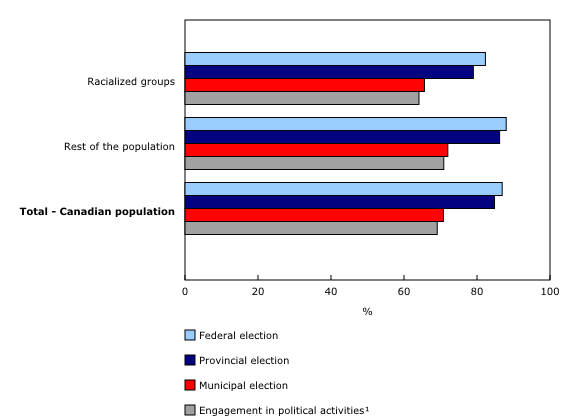
Engagement in political activities is another measure of political participation. It includes a wider spectrum of political activities (other than voting), such as seeking information or expressing an opinion on a political issue, contacting a newspaper or a politician, participating in a meeting or a demonstration, signing a petition, boycotting or choosing a product for ethical reason, wearing signs in support of a political or social issue, or volunteering for a political party. These activities are more regular in nature than voting in elections and include online and in-person engagement. The participation rate in these activities was 64% for racialized Canadians and 71% for the rest of the population.
Within the racialized population, the political engagement of Canadian-born and immigrant-racialized individuals varied significantly. The Canadian-born racialized population (80%) was much more engaged in non-electoral political activities than their immigrant counterparts (59%).
This difference can partially be attributed to age as the Canadian-born racialized population is younger than the immigrant racialized population, and younger people are generally more politically and socially active. In fact, the study “Political participation and civic engagement of youth” have shown that younger people, while less likely to vote, are more likely to participate in non-electoral political activities than older people.
South Asian Canadians were most active in recent elections, while Black Canadians were most engaged in non-electoral political activities.
The patterns of voting and engagement in non-electoral political activities were also different for specific racialized groups. In 2020, Filipino, Southeast Asian, and Black Canadians were the least likely to vote in the most recent elections of any level of government, while South Asian Canadians were the most active in voting in all three electoral processes.
Black Canadians were the most engaged in non-electoral political activities (70%). Among Black Canadians, 81% reported that they voted in the federal election, but the proportions of their participation in provincial (71%) and municipal (58%) elections were lower.
Overall, South Asian, Arab, and Latin American Canadians were most actively involved in democratic life, since political participation among these racialized groups was above 65% for all three electoral processes and for political engagement.
In conclusion, Visible Minority youth represent the future of Canada and they need to engage more in political activities, in that way they can change systematic racism and police brutality in our society.
‘Engagement in political activities other than voting’ (political engagement) refers to respondents’ engagement in at least one of the following non-electoral political activities in the 12 months preceding the release: searching for information on a political issue; volunteering for a political party; expressing views on an issue by contacting a newspaper or a politician; expressing views on a political or social issue through an Internet forum or news website; signing a petition on paper; signing an Internet petition; boycotting or choosing a product for ethical reasons; attending a public meeting; speaking out in a public meeting; participating in a demonstration or march; or, wearing a badge, T-shirt or displaying a lawn sign in support of or opposition to a political or social cause.