


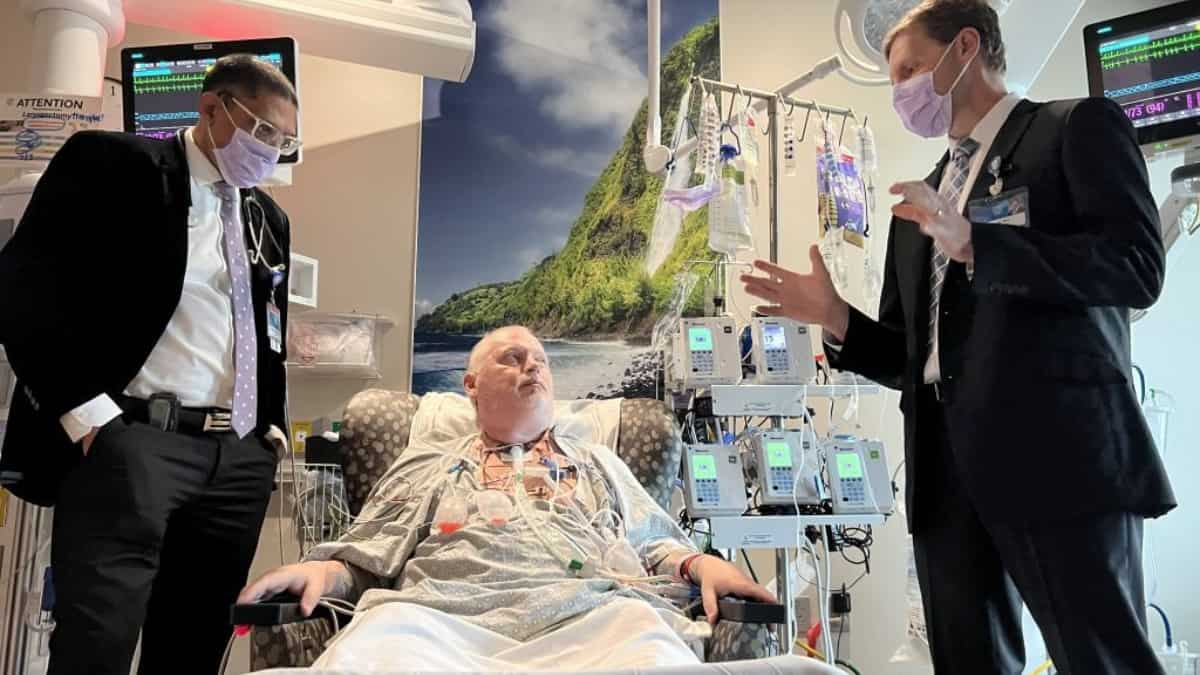
For medical science, it was a leap forward in the first full voice box transplant for an active cancer patient. For Marty Kedian, it was an emotional moment as he got his voice back, and was able to talk to his dear ones, thanks to the medical miracle. Mayo Clinic in the US state of Arizona has achieved the breakthrough as part of a landmark clinical trial, after a 21-hour-long procedure.
Kedian was diagnosed with a rare type of cancer that affected his larynx 11 years ago. The larynx, a vital organ in the throat commonly called the voice box, is what gives us the ability to speak.
After a series of surgeries for his cancer, Kedian had lost his voice. He could not also breath or swallow on his own.
He went through the surgery on February 29, and now, his voice is stronger than ever. Not only that, but he can swallow food now and is working on improving his breathing.
“I can talk to my 82-year-old mother, on the phone, and she could hear me,” he said in an interview with Associated Press news agency.
“I want people to know, this can be done. You can hear my voice right now. Two months ago, I couldn’t talk,” said Kedian.
He had earlier refused surgery to remove his voice box completely, which was the last option to cure his cancer. “Quality of life is just gone,” said the grandfather.
In February, he opted for larynx transplant surgery despite the risks.
A total transplant could result in the body rejecting a new organ, leading to multiple complications and even death. Kedian already had a kidney transplant and was taking anti-rejection medication. So doctors made an exception and gave the go-ahead for him to go through the complex voice box transplant surgery.
He was among the first recipients of a clinical trial, and one of 10 patients, to see if such life-changing transplants could succeed.
This is the third known larynx transplant in the US and the first known case performed on a patient with active cancer as part of a clinical trial, Mayo Clinic said in a report on its website, adding it was also the hospital’s first total larynx transplant.
The six-member surgeons’ team was led by Dr David Lott.
“You may be putting them at extra risk,” said Dr Lott. Patients with such conditions “become very reclusive…. may be alive but not really living,” he told AP.
In the US every year, more than 12,000 people are diagnosed with larynx cancer, out of which thousands have had to completely remove their larynx or lost their voices.
“It is important that we do these trials so that we can…do this transplant safely,” said Dr Karuna Dewan of Louisiana State University in an interview with AP.
Kedian can now talk to his granddaughter. “I am keeping my voice, no matter what I have to go through,” he said.
(With inputs from agencies)