


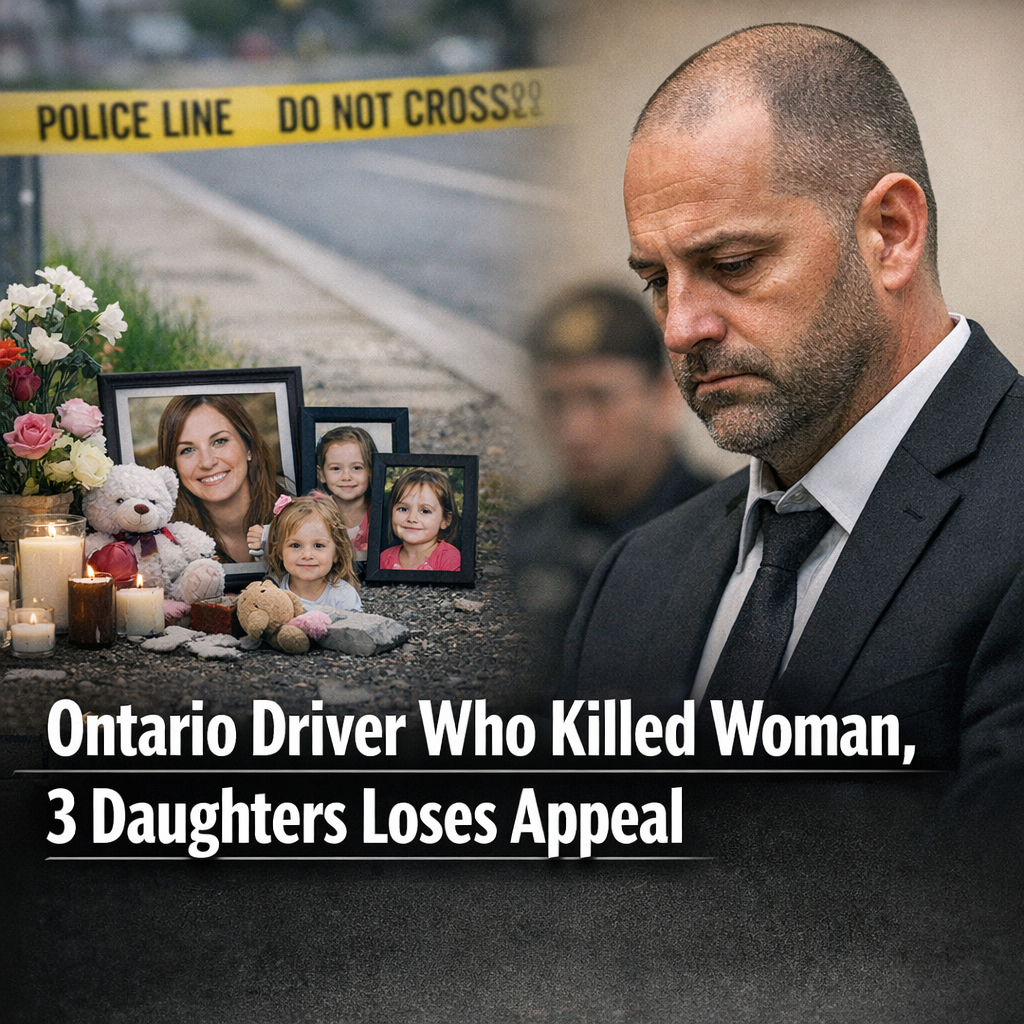
An Ontario court has upheld the conviction and sentence of Brady Robertson, the driver found responsible for a deadly crash in Brant County that killed three children and their grandfather. Robertson had challenged both the guilty verdict and the prison term he received, arguing the trial judge made errors, but the appeal court dismissed those arguments. The ruling leaves in place one of the province’s most closely watched impaired and dangerous driving cases, a case that drew national attention because of the scale of the loss and the circumstances leading up to the collision. For many Canadians, the decision reinforces how seriously courts are treating fatal crashes linked to alcohol and high-risk driving behaviour.
The case has had a deep emotional impact in Ontario and across Canada because it touches on road safety, impaired driving, and public confidence in the justice system. Families who have lost loved ones in similar crashes often watch these rulings closely, looking for signs that courts are recognizing the lasting harm caused by reckless decisions behind the wheel. The appeal outcome also matters to police, prosecutors, victim support groups, and road safety advocates, who have pushed for stronger deterrence and greater awareness around impaired driving. In daily Canadian life, the ruling is another reminder that a single decision to drive after drinking can devastate multiple families and ripple through entire communities.
What comes next is less about another review of the facts and more about whether any further appeal will be sought at a higher court. Unless a new legal step is taken and accepted, Robertson’s conviction and sentence remain in effect. The case will likely continue to be cited in discussions about sentencing, accountability, and how the courts handle fatal impaired driving cases in Canada.
The background to this case helps explain why it has remained in the public eye. The crash happened in 2020 in Brant County, southwest of Hamilton, when an SUV driven by Robertson went through an intersection and slammed into a vehicle carrying a family. Three young children and their grandfather were killed, and the children’s great-grandmother was seriously injured. Evidence presented in court showed Robertson had been drinking before getting behind the wheel and was driving at a very high speed. He was later convicted of multiple counts, including impaired driving causing death and dangerous driving causing death, and received a lengthy penitentiary sentence that reflected the severity of the crash and the number of lives lost.
Ontario court upholds Brady Robertson conviction and sentence in deadly Brant County crash
An Ontario appeal court has dismissed Brady Robertson’s attempt to overturn both his conviction and sentence in the fatal Brant County crash that shocked the country. Robertson had been found guilty in connection with the deaths of three children and their grandfather after a high-speed collision in 2020, and he later asked the court to revisit the trial result and the punishment imposed. The appeal ruling means the original judgment stands, keeping in place the findings that his impaired and dangerous driving caused the deadly crash. The decision is likely to be seen as a major moment for victims’ families and for Canadians following calls for stronger accountability in catastrophic driving cases.
For Canadian readers, this case lands close to home because impaired driving remains a persistent public safety issue in communities large and small. Court decisions in cases like this help shape how people understand the consequences of driving after drinking, and they also influence the broader conversation about sentencing and deterrence. In Ontario and elsewhere, governments, police services, and advocacy groups continue to spend time and money trying to reduce impaired driving through enforcement, education, and awareness campaigns. A ruling that confirms a tough sentence may strengthen those efforts by underlining that fatal choices on the road can bring life-altering legal consequences.
The case also matters because it highlights the role of the appeal process in Canada’s justice system. Appeals are not new trials, but they are a key safeguard used to test whether legal mistakes were made or whether a sentence was clearly unfit. By rejecting Robertson’s challenge, the court signalled that it found the trial process and the sentence to be legally sound. That can provide some measure of finality for families, though it never erases the grief caused by the crash itself.
Looking ahead, attention will turn to whether Robertson seeks leave to appeal to the Supreme Court of Canada. That would not happen automatically, and only a small number of cases are accepted for hearing. If no further appeal moves forward, the legal battle over this case will largely be over, even as its public and emotional impact continues. The ruling may also remain part of future legal arguments and policy discussions about impaired driving penalties.
To understand why this story remains so significant, it is important to look back at the crash and the trial that followed. The collision happened at a rural intersection in Brant County in June 2020 and quickly became one of the most heartbreaking road tragedies in recent Ontario memory. The victims were siblings Daniel, Harrison, and Milly Neville-Lake, along with their grandfather Gary Neville; their great-grandmother, Carol Neville-Lake, survived with serious injuries. The children’s parents, Jennifer Neville-Lake and Edward Lake, became prominent voices in the public discussion that followed, speaking openly about grief, accountability, and the need for change.
At trial, the Crown presented evidence that Robertson had consumed alcohol and was travelling at an extremely dangerous speed before entering the intersection. The prosecution argued that his actions showed a marked and serious departure from safe driving standards. Defence lawyers challenged parts of the Crown’s case and later argued on appeal that there were errors in the handling of the trial and the sentence. The appeal court’s decision to dismiss those arguments means it was not persuaded that the conviction should be set aside or that the penalty should be reduced.
Cases involving impaired driving causing death often draw strong reactions in Canada because they sit at the intersection of criminal law, public safety, and personal responsibility. Unlike many other crimes, impaired driving can begin as a decision that some people wrongly see as minor or manageable, only to end in irreversible tragedy. That is one reason governments and community groups continue to push campaigns around sober driving, designated drivers, rideshares, and better awareness. In that wider Canadian context, the Robertson ruling is not only about one man’s appeal, but also about how the justice system responds when dangerous choices on the road destroy lives in an instant.
Follow Canada News Media
Get the day's top Canadian stories and our two daily 60-second news videos wherever you scroll.
X Threads Facebook Instagram LinkedIn TikTok YouTube Pinterest Reddit Substack Flipboard Newsletter RSS