


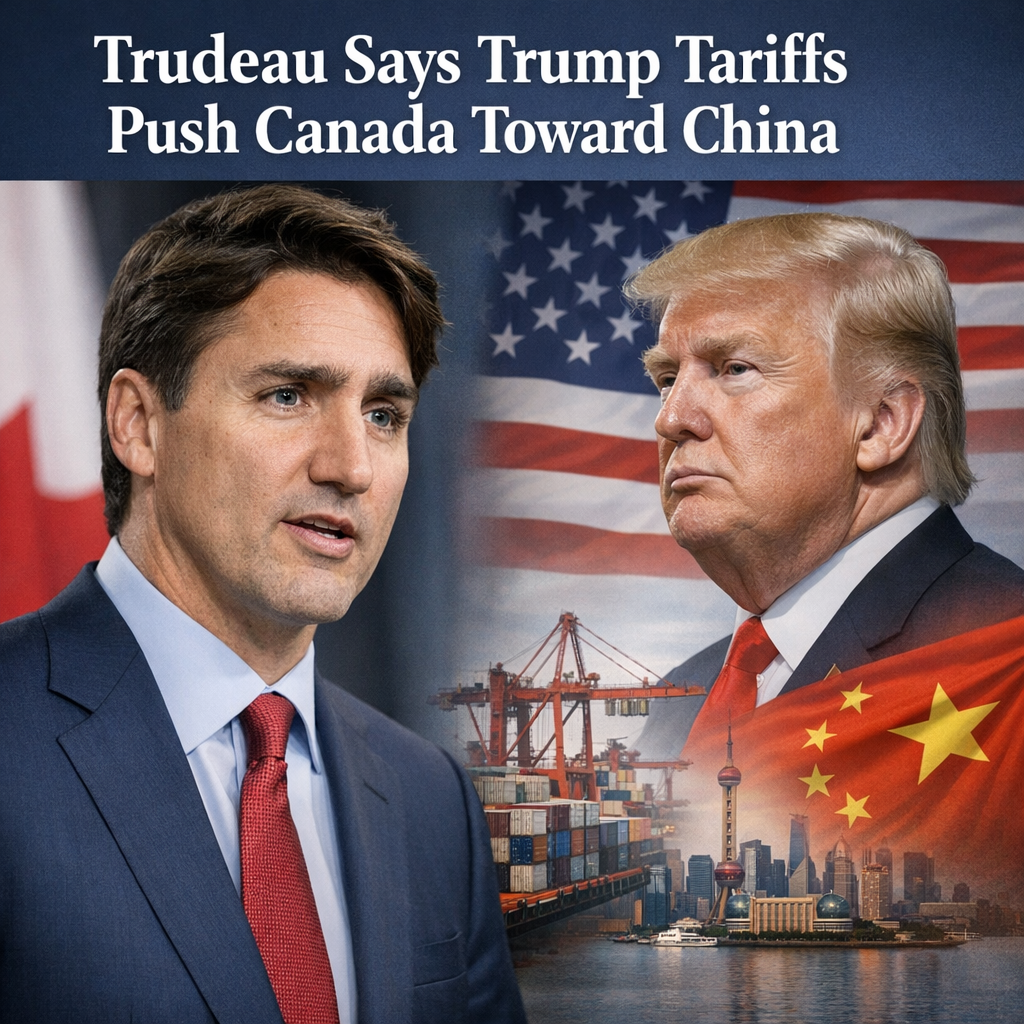
Prime Minister Justin Trudeau says years of American pressure on Canada’s aerospace sector nearly pushed Bombardier to seek deeper ties with China, a warning he delivered during a speech in Singapore about economic security and global trade. He used the Bombardier example to argue that close allies can still use hardball tactics when major industries and jobs are on the line. Trudeau’s remarks revisit a sensitive chapter in Canada-U.S. trade relations and highlight how economic disputes can reshape business decisions in key Canadian sectors. His comments also come at a time when Ottawa is trying to balance its relationship with Washington while taking a more cautious approach toward Beijing.
For Canadians, the issue matters because Bombardier has long been tied to high-value manufacturing jobs, supply chains and research work in Quebec and across the country. When a flagship company faces pressure from a foreign government or a major competitor, the effects can spread to workers, smaller suppliers, pension funds and local economies. Trudeau’s argument is also relevant to a broader Canadian concern: how to protect strategic industries while remaining open to trade and investment. In daily life, that debate influences employment, public spending, regional development and the long-term strength of sectors such as aerospace, clean technology and advanced manufacturing.
What to watch next is whether Ottawa turns this message into concrete policy, especially around industrial strategy, foreign investment screening and support for Canadian firms facing international pressure. It will also be worth watching how the federal government manages future trade tensions with the United States without pushing Canadian companies toward riskier or politically sensitive markets. Any renewed discussion about aerospace subsidies, procurement or international partnerships could quickly become part of a larger debate about Canada’s economic sovereignty.
The background to Trudeau’s comments goes back to Bombardier’s difficult period in the mid-2010s, when the company was trying to launch and sell its C Series passenger jet, now known as the Airbus A220. Bombardier faced serious financial pressure and fierce competition from larger rivals, including Boeing. At the same time, trade complaints and political pressure from the United States added to the uncertainty around sales and investment. During that period, Bombardier explored different international options to keep the aircraft program alive, before eventually bringing in Airbus as a partner and reshaping the future of the jet.
Prime Minister Justin Trudeau used a high-profile international appearance in Singapore to draw attention to what he sees as a hard lesson for Canada: even trusted allies can put intense economic pressure on Canadian companies when strategic industries are involved. His comments focused on Bombardier, one of Canada’s best-known aerospace firms, which he said came close to being pushed toward China because of pressure coming from the United States nearly a decade ago.
The remarks are significant because they revisit a period that was politically and economically difficult for Canada. Bombardier was under enormous strain as it tried to establish the C Series aircraft in a highly competitive global market. The company was a symbol of Canadian industrial ambition, especially in Quebec, but it was also vulnerable because aircraft development requires massive up-front investment, long timelines and reliable export access. When those conditions are disrupted by trade disputes or foreign political action, the consequences can be severe.
Trudeau’s warning appears aimed at a broader audience than just business leaders in Asia. It speaks directly to a Canadian debate over how much the country can rely on major partners, especially the United States, when national economic interests collide. Canada and the U.S. remain deeply connected through trade, defence and integrated manufacturing, but the relationship is not free of conflict. Softwood lumber, electric vehicle rules, dairy, steel and aluminum have all shown that even close allies will defend domestic industries aggressively.
In Bombardier’s case, the stakes were especially high. The company was not just another exporter. It represented a large network of engineers, factory workers, parts suppliers and technology partners. Jobs linked to Bombardier and the wider aerospace ecosystem support communities in the Montreal region and beyond, while the company’s success or failure has wider implications for Canada’s reputation as a place that can design and build advanced products. That is why any suggestion that outside pressure could have driven the firm into a closer relationship with China is politically loaded.
For many Canadians, Trudeau’s comments may sound like a reminder of how exposed the country can be when global power struggles affect domestic champions. Canada depends heavily on trade, and many of its biggest employers rely on stable access to foreign markets. But when those markets become political tools, Canadian companies can be forced into choices they might not otherwise make. That includes looking for financing, buyers or strategic partners in countries that Ottawa may later view as security concerns.
The mention of China is especially notable given how much Canada’s stance has changed in recent years. Around a decade ago, many Western governments and businesses were still open to deeper economic engagement with China, even in sensitive sectors. Since then, concerns about national security, foreign interference, supply chain vulnerability and human rights have led Ottawa and its allies to take a tougher line. Trudeau’s point suggests that pressure from friendly countries can sometimes create openings for geopolitical rivals, something policymakers now say they want to avoid.
There is also a domestic political angle. Governments in Canada have often faced criticism for supporting large companies with public money, especially when those firms run into trouble. Bombardier was at the centre of those debates, with critics questioning subsidies and supporters arguing that advanced manufacturing needs long-term backing if Canada wants to compete globally. By revisiting the Bombardier story, Trudeau is making the case that state support and economic strategy are not just about saving one company. They are part of a larger effort to ensure Canada does not lose critical industries under pressure from abroad.
That argument may gain more attention as Ottawa continues to promote industrial policy in areas such as aerospace, batteries, electric vehicles and defence production. The federal government has already shown a greater willingness to use subsidies, tax credits and investment reviews to shape the economy. Trudeau’s comments suggest that this approach is also about geopolitics, not only jobs. In other words, protecting Canadian industry is increasingly being framed as part of protecting national independence.
Still, the challenge for Ottawa is balancing realism with practicality. The United States is by far Canada’s most important trading partner, and no federal government can afford to treat Washington as just another rival. At the same time, Canada’s leaders know they need plans for moments when U.S. policy clashes with Canadian interests. That may mean stronger domestic supply chains, more diverse export markets and clearer rules around foreign partnerships in sensitive industries.
In the months ahead, Canadians should watch whether Bombardier’s story is cited more often by federal ministers as they defend intervention in strategic sectors. They should also watch for signs of how Canada plans to manage pressure from both Washington and Beijing while keeping room for its own industrial priorities. Trudeau’s speech in Singapore may have focused on a dispute from the past, but the underlying question is very current: how can Canada protect its key industries without becoming overly dependent on any one global power?
Follow Canada News Media
Get the day's top Canadian stories and our two daily 60-second news videos wherever you scroll.
X Threads Facebook Instagram LinkedIn TikTok YouTube Pinterest Reddit Substack Flipboard Newsletter RSS