


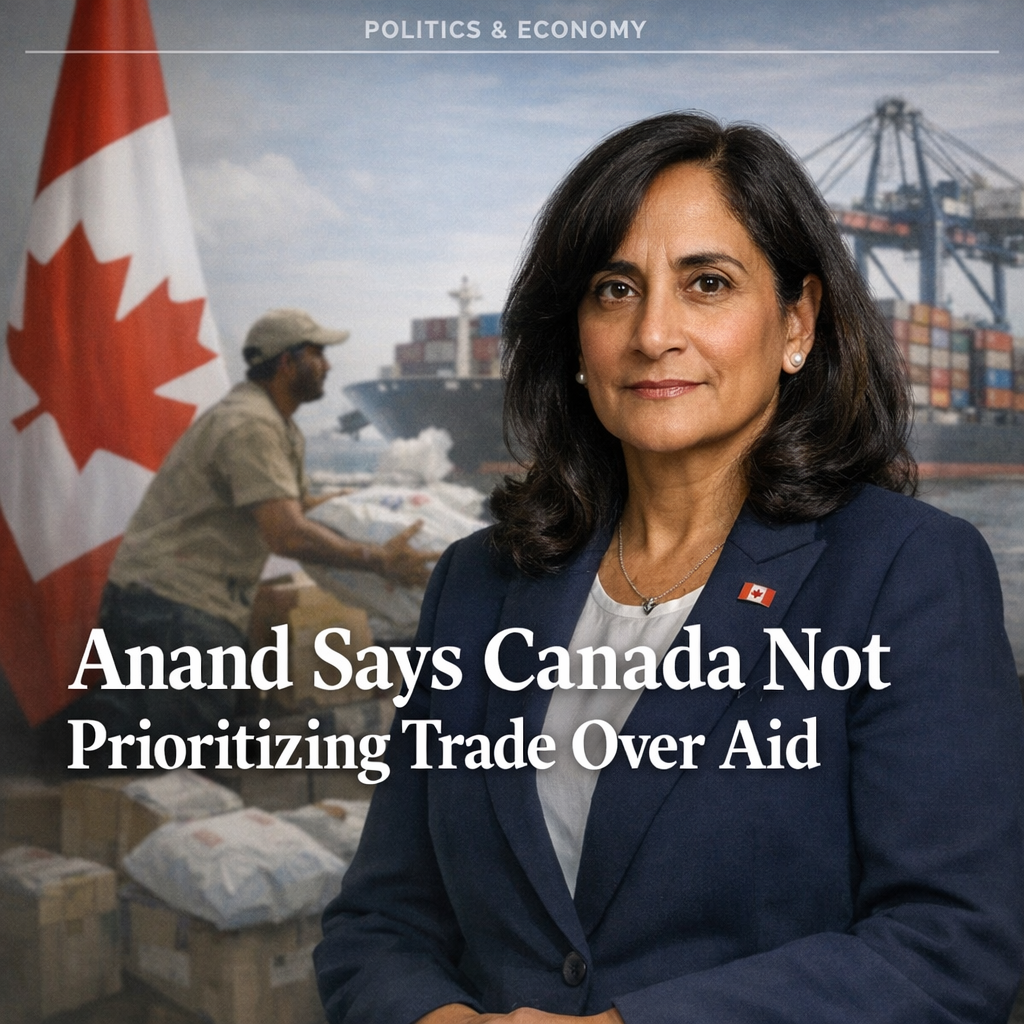
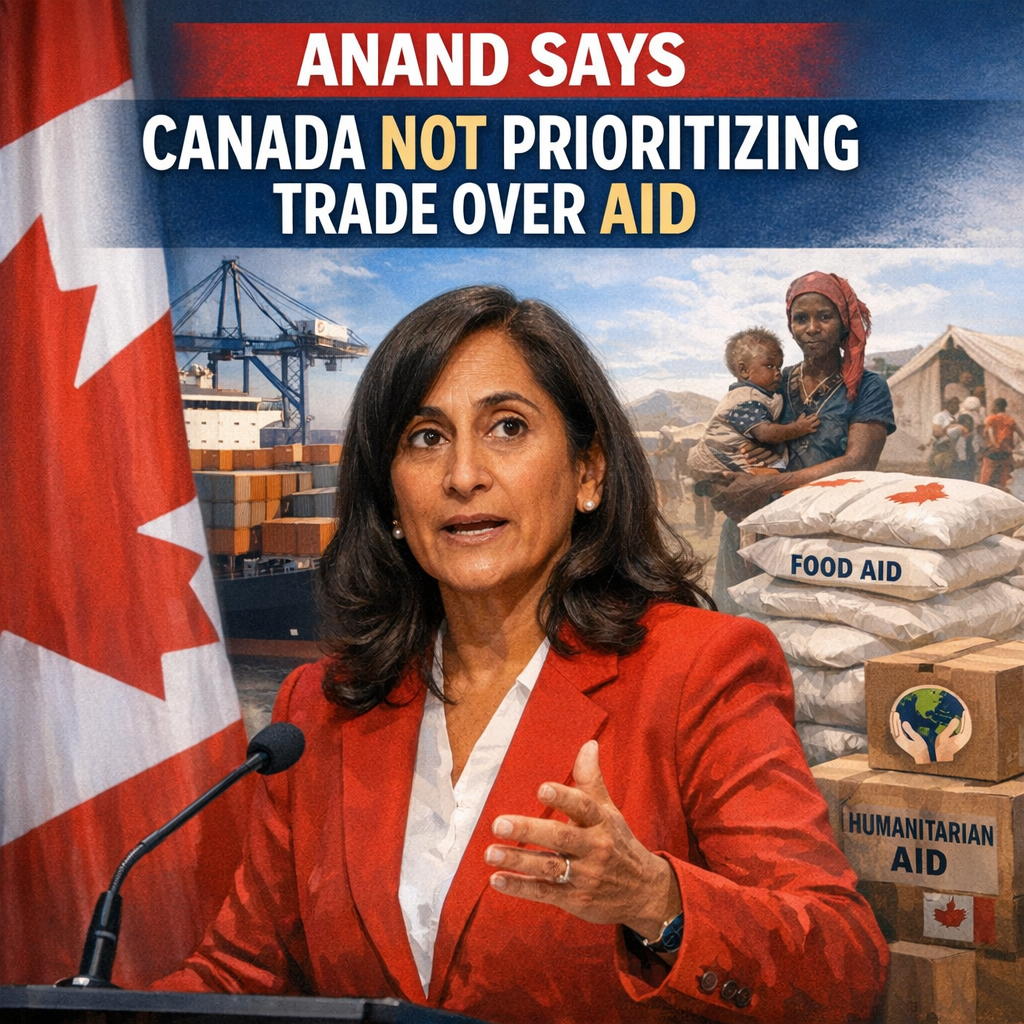
Foreign Affairs Minister Anita Anand is making the case that Canada’s place in the world cannot be reduced to trade figures, military budgets or short-term diplomatic wins. She argues that defending democratic values, human rights and the rule of law is not a side project, but part of how Canada protects its long-term interests abroad. Her remarks come at a time when Ottawa is under pressure to sharpen its economic strategy, respond to growing security threats and manage increasingly difficult relationships with major global powers. Anand’s message is that Canada does not have to choose between principle and pragmatism, because in many cases the two are closely linked.
For Canadians, that debate matters more than it may first appear. Decisions made in foreign policy often shape trade opportunities, immigration pathways, defence spending, sanctions, supply chains and Canada’s reputation with allies. When Ottawa takes a stand on international law, democratic institutions or human rights, those choices can affect Canadian jobs, the price and availability of goods, the safety of military personnel and the country’s influence in global negotiations. It also speaks to how Canadians see themselves: as a country that seeks prosperity and security, but also wants to be credible when it talks about fairness, inclusion and international co-operation.
What comes next will depend on how the federal government turns this message into action. Canadians should watch for whether Anand’s approach is reflected in cabinet decisions on defence policy, trade relationships, export controls, sanctions and partnerships in regions where Canada is trying to expand its influence. It will also be important to see how Ottawa balances those values-based goals when economic pressure rises or when allies take a more hard-nosed, transactional approach.
The broader context is that Canada’s foreign policy has long tried to blend national interest with international responsibility, even if that balance has never been simple. In recent years, the world has become more unstable, with Russia’s war in Ukraine, tensions involving China, conflicts in the Middle East, cyber threats and economic fragmentation forcing countries like Canada to rethink old assumptions. At the same time, governments are being judged on whether they can deliver jobs, affordability and security at home, which often creates pressure to focus narrowly on immediate gains. Anand’s comments fit into that larger conversation about whether Canada can still act as a principled middle power while adapting to a tougher and more competitive global environment.
Anand appears to be pushing back against a common argument in foreign policy circles: that promoting Canadian values is a luxury the country cannot afford when strategic competition is rising and the world is becoming more dangerous. That argument tends to frame democracy promotion, human rights advocacy and support for international institutions as separate from the hard realities of trade, defence and geopolitics. Her response suggests the opposite. In today’s world, stable institutions, accountable governments and respect for international rules are not abstract ideals. They are part of the conditions that allow economies to function, alliances to hold and security partnerships to endure.
That view is especially relevant for a country like Canada, whose prosperity depends heavily on open markets and reliable international rules. Canada is not a superpower that can easily impose its will through sheer economic or military strength. It relies instead on trusted alliances, enforceable trade systems and diplomatic credibility. When global norms weaken, middle powers can lose room to manoeuvre. From that perspective, speaking up for democratic standards and international law is not only about moral positioning. It can also be understood as protecting the kind of global environment in which Canada is most likely to succeed.
There is also a domestic political dimension to Anand’s message. Canadian governments are often accused of talking about values abroad while making compromises when money, energy security or strategic partnerships are on the line. Those tensions are not unique to Canada, but they are increasingly visible. Ottawa has faced criticism over how it handles relations with China, arms exports, responses to major conflicts and its consistency on human rights. By insisting that values and interests are interconnected, Anand is setting a standard that Canadians and opposition parties may use to judge future government decisions.
That matters for institutions beyond Global Affairs Canada. The Canadian Armed Forces, trade officials, intelligence agencies and immigration departments all operate within a broader foreign policy framework. If the government treats values as central rather than optional, that can influence everything from defence co-operation and sanctions enforcement to refugee policy and development assistance. It may also affect how Canada chooses partners in areas such as critical minerals, clean energy, artificial intelligence and advanced manufacturing. In practical terms, the debate is about what kind of global relationships Canada wants to build and what trade-offs it is prepared to accept.
For everyday Canadians, these issues can feel distant until they show up in familiar ways. Supply chain disruptions, energy shocks, food prices, cyberattacks, disinformation and international instability all have effects at home. So do decisions about where Canada invests diplomatic attention, where it sends military support and which regimes it chooses to sanction or engage. A foreign policy that connects values with security and economic goals may lead to tougher choices in the short term, but supporters would argue it can build resilience and trust over time.
The challenge for Anand and the federal government will be proving that this approach is more than a speech line. It is relatively easy to say values matter; it is harder to maintain that position when competing pressures collide. If Canada continues to call for democratic accountability and human rights abroad, it will face questions about consistency, especially when dealing with major trading partners or strategically important states. That is where the credibility of this argument will be tested.
Still, Anand’s intervention reflects a debate that is becoming more urgent across Western democracies, including Canada. Governments are trying to figure out how to defend their interests in a world that is less predictable, less rules-based and more openly shaped by rivalry. Her central point is that Canada should resist the idea that principles are disconnected from power. For a country that depends on trust, alliances and a stable international order, values may not be a distraction from economic and defence goals at all. They may be one of the foundations that make those goals achievable.
Follow Canada News Media
Get the day's top Canadian stories and our two daily 60-second news videos wherever you scroll.
X Threads Facebook Instagram LinkedIn TikTok YouTube Pinterest Reddit Substack Flipboard Newsletter RSS