




When Barclays installed new software to monitor employees’ computer use earlier this year, it was hoping for insights into their behaviour. Weeks later, the bank scaled back use of the system as staff annoyance over monitoring spilled into the press, and was then amplified further in public by social media.
Like other banks, insurers and asset managers, Barclays is having to adapt as social media plays a bigger role in creating, and shaping, its public image.
“Control of reputation has been dragged out of the boardroom and press releases, and into the pockets of the smartphone generation,” says George Beattie, a director at insurance broker Willis Towers Watson. “It is a very volatile situation.”
Companies in all sectors face similar concerns, but Sven Klingemann of the Reputation Institute, which assesses corporate reputations, says the banks are starting from a challenging position.
“Banking has historically been at the lower end of the 12 to 15 industries we cover,” says Mr Klingemann. “The large banks struggle most with reputation, while the smaller regional or online banks tend to do better.”
Threats from social media come in several forms. One is internal — as Barclays discovered, employee dissatisfaction with a new system or policy can easily leak into the public sphere.
Improper behaviour that spills out into the open is a similar risk. “The biggest risk for the banking industry is unethical behaviour,” says Mr Klingemann. “[This can include] deceptive sales practices and inappropriate behaviour such as harassment, bullying or discrimination. And if you fire or punish whistleblowers, it’s not going to look good.”
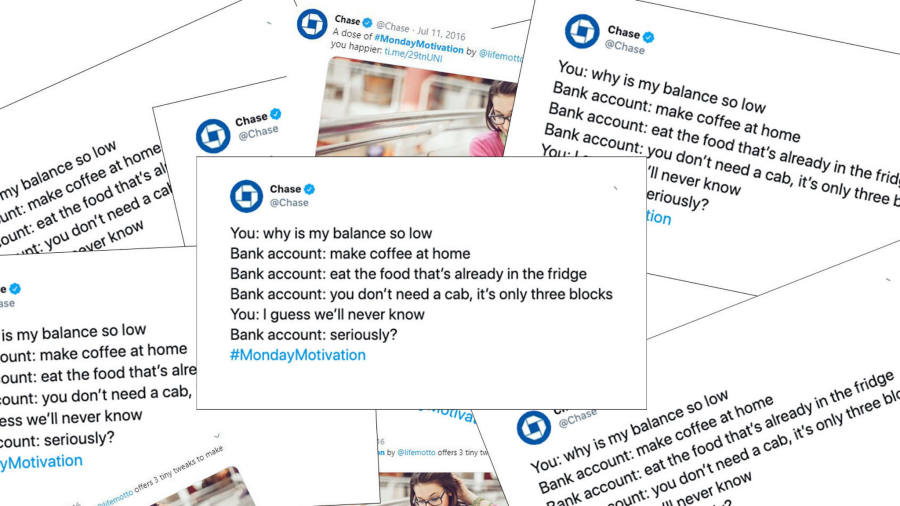
Even banks’ own social media and marketing teams can get it wrong if they misread the public mood. Chase Bank in the US discovered this to its cost last April. Its Twitter team used the #MondayMotivation hashtag on a tweet that suggested people should eat out less and walk rather than taking cabs.
The reaction was swift and widespread. Chase was accused of shaming poor people and insulting its customers, with politicians, including former presidential candidate Elizabeth Warren, weighing in against the bank and Jamie Dimon, chief executive of its parent company JPMorgan Chase.
Chase ended the day with a tweet: “Our #MondayMotivation is to get better at #MondayMotivation tweets. Thanks for the feedback Twitter world.”
TD Bank faced a similar storm last year when social media users accused it of coded racism in an advert referring to an ethnically diverse Boston neighbourhood. The bank later apologised.
Mr Beattie says banks must be mindful of these pitfalls when planning campaigns or posts. “Companies are not ready to deal with crises fuelled by social media,” he says. “A poorly thought-through social media campaign can be more damaging than not doing anything at all. Testing an idea in social media in real time can be quite risky. You need to look at what demographic you are targeting and what virality might look like,” he adds.
Not all social media crises are internally generated. Financial services companies face an array of outside voices that could have a reason to attack their reputation.
“There is state-driven manipulation of social media to undermine economic strength. The idea of sowing dissent in democracies and their brands might be quite attractive,” says Mr Beattie.
Even pressure groups of more straightforward kinds can exploit social media to build support, and financial services companies need to be ready to respond appropriately.
Campaigns on climate change are one example. Banks, insurers and asset managers are under pressure from action groups to dissociate themselves from companies accused of responsibility for global warming, by refusing to lend to them, insure them or invest in them. Groups such as Unfriend Coal, which campaigns to end insurance industry involvement in coal mining, are enthusiastic users of social media.
Yasmin Crowther, a vice-president at Polecat, which analyses social media data, says financial services companies have lagged behind consumer brands such as Nike and Nestlé.
“[Consumer] organisations are sophisticated in their understanding of social media,” she says. Financial services companies, however, “have not been at the cutting edge of understanding it”, she says.
According to Mr Beattie, the first step for companies is to understand what information they can access on what is being said about them, when and where.
Although this data has only been around for a couple of years, he adds, it can generate “astounding insights”.
Follow Canada News Media
Get the day's top Canadian stories and our two daily 60-second news videos wherever you scroll.
X Threads Facebook Instagram LinkedIn TikTok YouTube Pinterest Reddit Substack Flipboard Newsletter RSS