

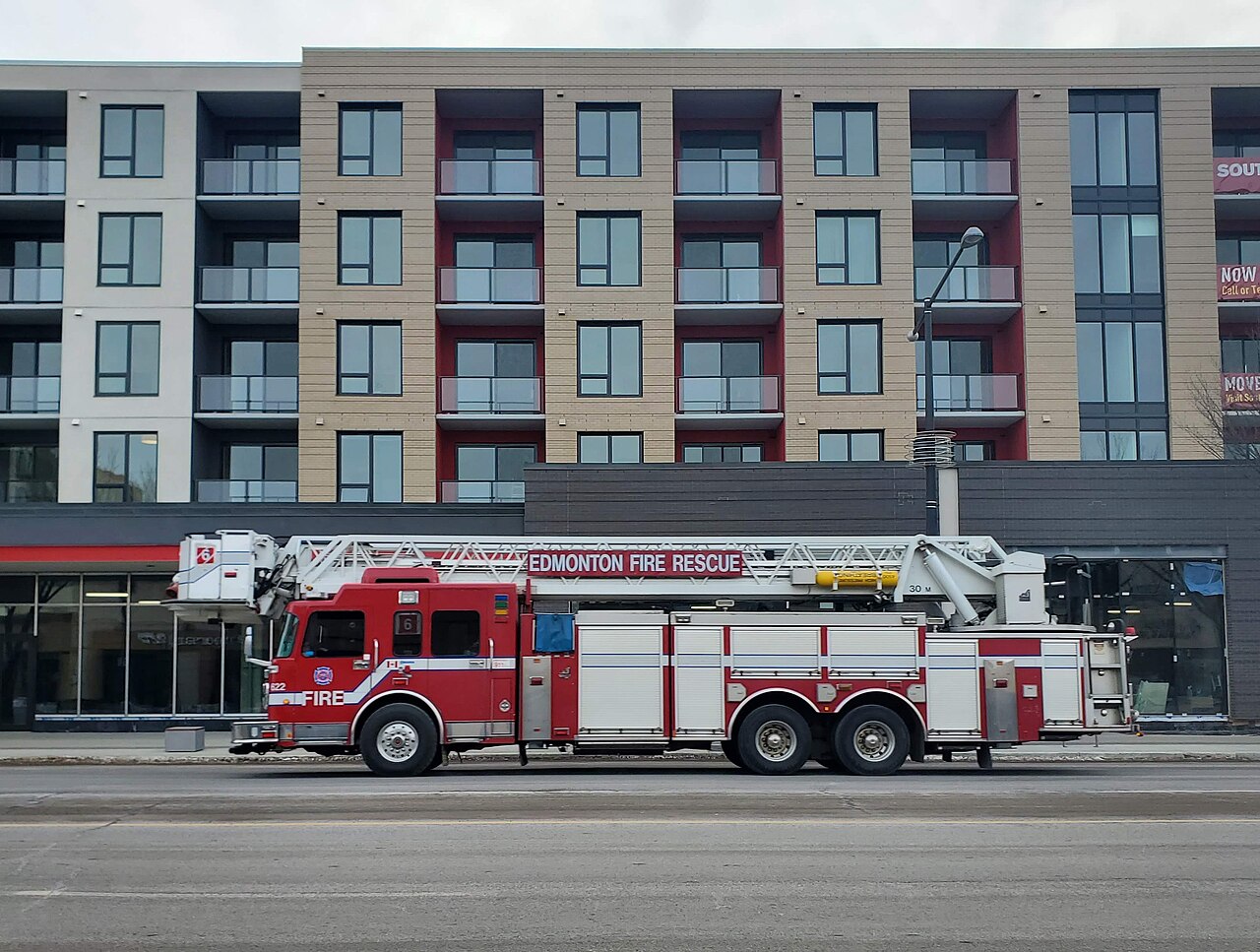
Edmonton fire prevention officers have not confirmed in their records that 2,154 high-risk fire code problems found during building inspections were fixed, and they inspected fewer than half of the construction sites they had classified as high-risk, the city auditor has found.
The Fire Prevention Services Audit, dated Oct. 20, 2026, and posted on the Office of the City Auditor’s website, concluded that Edmonton Fire Rescue Services has “partially met” its objective of managing fire prevention and public education to meet legislated requirements and reduce fires. Management accepted all four of the auditor’s recommendations, with completion dates running from the end of 2027 to the end of 2028.
The audit comes as the city’s own fire response data shows fire calls rising. A Canada News Media count of the city’s Fire Response: Current and Historical open dataset found 1,640 events classified as fires from January through October 2026, up from 1,287 over the same months in 2019, an increase of 27 per cent, and the most for those months in any year since at least 2016.
Outside fires have risen faster. The same dataset records 5,529 outside fires from January through October 2026, nearly four times the 1,471 in the same months of 2019, although below the peak of 6,809 over that period in 2024. For full calendar years, fire events climbed every year from 2020 to 2025, reaching 1,990 in 2025.
The auditor’s sharpest finding concerns what happens after an inspection. Between Jan. 1, 2024, and July 29, 2026, fire prevention officers issued 12,526 inspection reports. Of those, 10,015 reports listed 37,566 specific fire code deficiencies, such as problems with alarms, exits, kitchen hood systems, fire safety plans or sprinklers.
The records management system showed 19,814 of those deficiencies, or 53 per cent, as corrected and 17,228, or 46 per cent, as still outstanding. The auditor wrote that for the outstanding items, “the owner may not be complying with the Fire Code.”
Within that total, the auditor counted as high-risk any deficiency that required a re-inspection. It found 2,154 of them still listed as deficient, blank or “N/A” in the system, meaning there was no record they had been corrected. “When FPOs do not confirm that high-risk deficiencies in the records management system have been corrected, there is a greater risk that preventable fires can occur,” the report said, using its abbreviation for fire prevention officers.
The audit does not say the 2,154 problems remain in place in the buildings, only that the records do not confirm they were fixed. It also found that officers can delete deficiencies from the system, and reported that one officer deleted 10 deficiencies for a past inspection, which then no longer existed in the data the auditors analysed.
On construction sites, the auditor found the Technical Services Team inspected 417 of the 874 sites it rated high-risk between Jan. 1, 2023, and May 31, 2026, or 48 per cent. The team has three fire prevention officers and a shared captain, who also review development plans and attend final inspections of new buildings. The auditor said possible reasons include resourcing and the way the team classifies high-risk sites, and noted there is no guidance on when officers should attend joint final inspections. The team does complete reviews of major development plans within its 21-day target 97 per cent of the time.
The audit also examined the Community Property Safety Team, created in 2022 to secure and monitor vacant buildings. Its target is to check each secured vacant property every 30 days, a goal set when the program expected about 100 properties, mostly downtown, with two officers. At the time of the audit there were 526 active secured vacant properties across the city, handled by five officers. Of those, 162, or 31 per cent, had been checked in the previous 30 days, 171 had last been checked 30 to 180 days earlier and 193, or 36 per cent, had not been checked in more than 180 days.
The team met its separate goal of securing reported vacant properties within an average of 45 days in 2025 and 2026, the auditor found, although its dashboard measures that time from a different starting date than its stated method.
The auditor also could not reproduce the fire prevention area’s quarterly statistics from source records, citing manual spreadsheets, inconsistent formulas and supporting documents that were not kept.
In its response printed in the report, the administration said fire prevention has set up a procedure for high-risk deficiencies and mandatory re-inspections, “setting mandatory re-inspection timelines and requiring supervisory sign-off for critical follow-ups,” and is scoping changes to its records system to automate re-inspection tracking. It said that in the meantime fire rescue services “continues to enforce quality management protocols that prohibit closing any inspection file while an unsafe condition remains uncorrected.”
On construction sites, the administration said it is formalizing a standard operating procedure with “clear, objective criteria for prioritizing high-risk construction sites” and is reviewing resourcing and workflow. On vacant properties, it said the team “consistently meets its core life-safety target” for securing buildings and that it is reviewing the 30-day monitoring cycle set during the 2022 pilot.
The city auditor’s most recent recommendation follow-up report, as of Aug. 27, 2026, listed 27 outstanding recommendations across city departments, four of them overdue. The fire prevention recommendations were issued after that report.
If you find reporting like this useful, consider supporting Canada News Media, an independently owned Canadian newsroom.
How we checked: We read the full 29-page Fire Prevention Services Audit and the Aug. 27, 2026, follow-up report from the Office of the City Auditor. All audit figures and management responses are quoted as published by the auditor. We then queried the City of Edmonton’s Fire Response: Current and Historical dataset (7hsn-idqi, updated Nov. 16, 2026, records to Nov. 14) and counted events with the descriptions “FIRE,” “OUTSIDE FIRE” and “VEHICLE FIRE” by year, comparing January to October in each year so 2026 is measured against the same months. The dataset does not show causes, and our count does not link any fire to the audit’s findings.
Follow Canada News Media
Get the day's top Canadian stories and our two daily 60-second news videos wherever you scroll.
X Threads Facebook Instagram LinkedIn TikTok YouTube Pinterest Reddit Substack Flipboard Newsletter RSS