



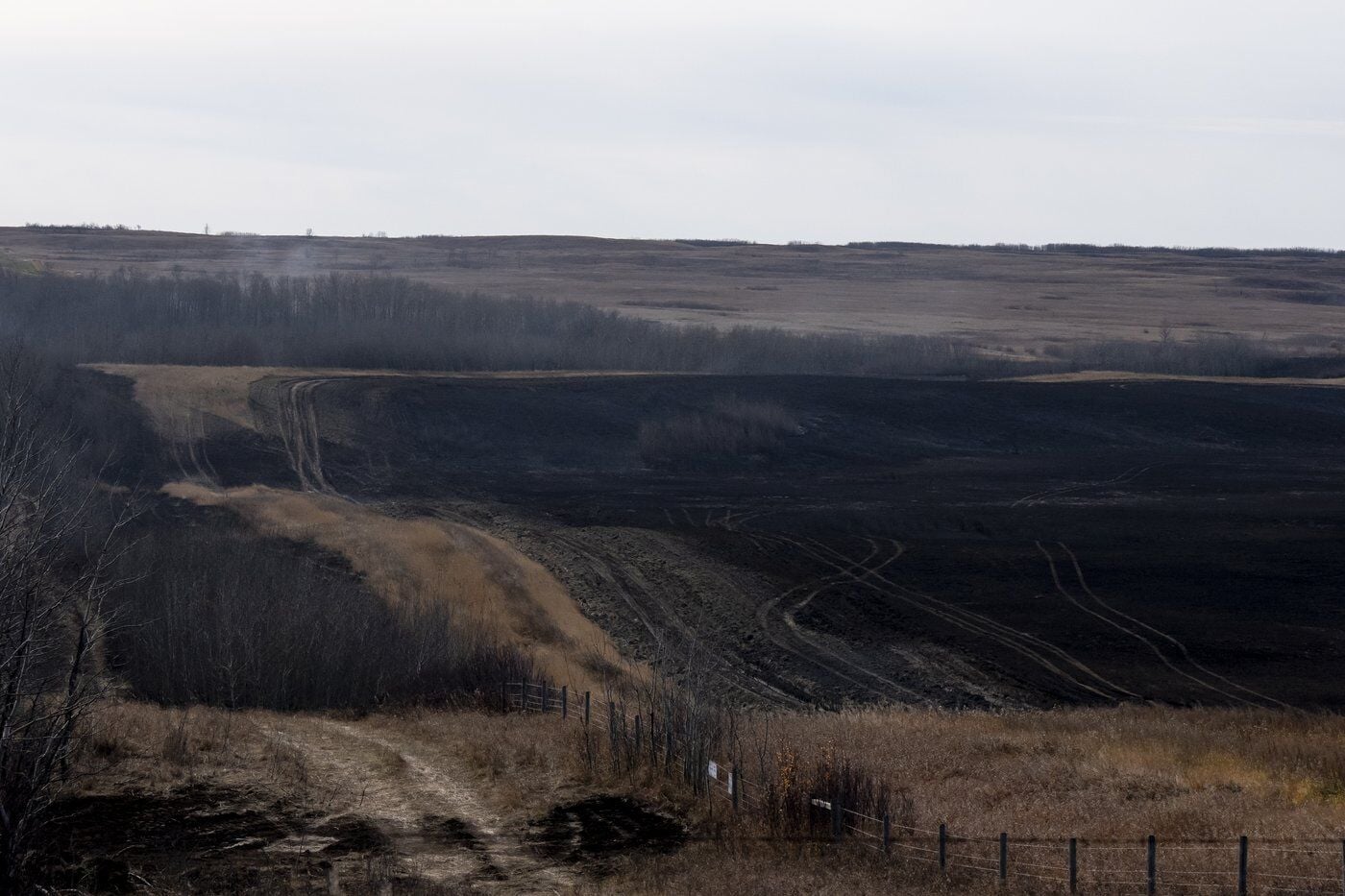
The rapid spread of the fire at CFB Wainwright in eastern Alberta is the main reason soldiers could not get away, Chief of the Defence Staff Gen. Jennie Carignan said Friday.
Asked in a CBC Radio interview what barrier soldiers faced in escaping, Carignan suggested the fire simply moved too fast. She said investigators are working to reconstruct the scene at different moments, which she said is “going to reveal how it all happened.”
Four soldiers were killed and 39 others injured in the fire on Saturday, CBC News reported. Multiple investigations are underway into what caused it and why training was allowed to continue for hours.
Military officials said Thursday the fire began on an automatic grenade launcher range, in what the Canadian Forces Provost Marshal, Brig.-Gen. Vanessa Hanrahan, called a “permanent danger zone.” That designation means the area is always off limits because of hazards from live-fire exercises, and firefighters could not enter it. Hanrahan said the base fire hall and range control monitored the fire throughout the day, until stronger winds made it more intense and pushed it toward the training area. We reported those details in our earlier story on the cause of the fire.
The fire reached C Company of the 3rd Battalion, Princess Patricia’s Canadian Light Infantry, which was doing live-fire training to prepare for a deployment to Latvia this spring, the military said.
Carignan would not say whether firefighters were already at the training area, or on their way, when the fire reached the soldiers, saying the investigation would provide more clarity. She said personnel on the ground managed the casualty evacuations while firefighters dealt with the fire.
Training has resumed at the base. Carignan said no procedures have been changed so far, but that they will be if the investigations flag problems. “For the moment, we have nothing that indicates that we need to make immediate changes,” she said.
Asked whether commanders were under pressure to finish the training within a set time, Carignan said “a lot of things are going to be considered” in the investigation. She said there is a “considerable amount of time” before the spring deployment, and leaders have flexibility to reschedule depending on weather and other factors.
Retired major Robert Parent, a former Princess Patricia’s Canadian Light Infantry officer who has run live-fire training and presided over a past board of inquiry into a soldier’s death, told CBC News there should be no “witch hunt.” He said conditions that day included dry weather, an active fire and a weather warning, and that investigators will examine how those factors came together and what decisions were made.
Parent said a board of inquiry would not assign blame but would flag weaknesses and recommend fixes. He said it might not begin for more than a year, because military police and the civilian coroner must finish first.
The information is from CBC News reporting on Carignan’s interview and the military’s earlier briefings.
If you find reporting like this useful, consider supporting Canada News Media, an independent Canadian newsroom with no corporate parent.
Follow Canada News Media
Get the day's top Canadian stories and our two daily 60-second news videos wherever you scroll.
X Threads Facebook Instagram LinkedIn TikTok YouTube Pinterest Reddit Substack Flipboard Newsletter RSS