

Press release. The following was issued by Bau-Xi Gallery and is published as received. Canada News Media did not write or edit it.
Nicole Katsuras | The Unknowable Landscape
Bau-Xi Gallery | Dufferin
November 5 – 30, 2026
1384 Dufferin Street, Toronto
Opening reception: Thursday, November 5 | 5:30 – 7:30 PM | Artist in attendance
This November, Bau-Xi Gallery | Dufferin is proud to present The Unknowable Landscape, a new exhibition by Toronto-based artist Nicole Katsuras. Drawing on the shifting rhythms of the natural world and the visual traditions of landscape painting, Katsuras creates atmospheric, textural works that exist between the remembered, the imagined and the unknown. Influenced by Japanese Ukiyo-e prints and the interplay of light, colour and form in J. M. W. Turner’s paintings, this new body of work explores the impermanence of nature and the ways art history shapes our perception of the landscape.
Rather than depicting a specific place, Katsuras offers visual cues that invite viewers to draw on their own memories and experiences, allowing each landscape to take shape through personal experience.
The exhibition will be on display from November 5th to 30th at Bau-Xi Gallery | Dufferin in Toronto (1384 Dufferin Street). An opening reception will take place on Thursday, November 5th from 5:30 – 7:30 PM, with the artist in attendance.
Artist statement
This new body of work considers landscape as a shared visual language – something understood almost instinctively, regardless of geography. Horizons, trees, skies and shifting terrains differ from place to place, yet the experience of orienting ourselves within them remains familiar: ground, horizon, distance, weather and light.
The viewer does not necessarily need to know where they are. The paintings offer visual cues rather than fixed locations – places without coordinates, hovering somewhere between the remembered, the imagined and the unknown.
The changing rhythms of the natural world run throughout the work. Influenced by Japanese Ukiyo-e prints and the aesthetic notion of impermanence, the paintings consider nature as something continually shifting, where beauty often lies in its fleeting moments. In “Harvest Tide”, a softly graduated ground and muted palette evoke the subtle transition between seasons. Sculptural passages of paint gather and disperse across the surface, suggesting organic forms caught between emergence and dissolution. The contrast between the quiet, atmospheric ground and tactile gestures reflects the tension between stillness and movement, permanence and change.
This sensitivity to nature’s cycles extends to “Honey Bonani”, an ode to a friend’s bee colony and the honey it produces. Delicate, blossom-like gestures drift across a pale ground, suggesting pollination, growth and renewal. The painting considers the vital, often unseen relationships that sustain the natural world and the interconnected cycles through which one season gives way to another.
Fragments of art history also surface throughout the work, raising the question: Do we ever approach landscape innocently? Centuries of landscape painting, Japanese woodblock prints, Romanticism, Impressionism, Modernism, photography, cinema and abstraction have shaped how we see and recognize the world around us. The atmospheric landscapes of English Romantic painter J. M. W. Turner, with his exploration of light, colour and dissolving forms, are particularly resonant. In Turner’s work, light becomes more than an illuminating force; it can obscure, transform and even overwhelm the landscape itself, pushing recognizable forms toward abstraction.
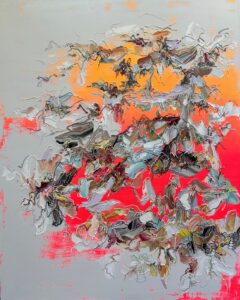
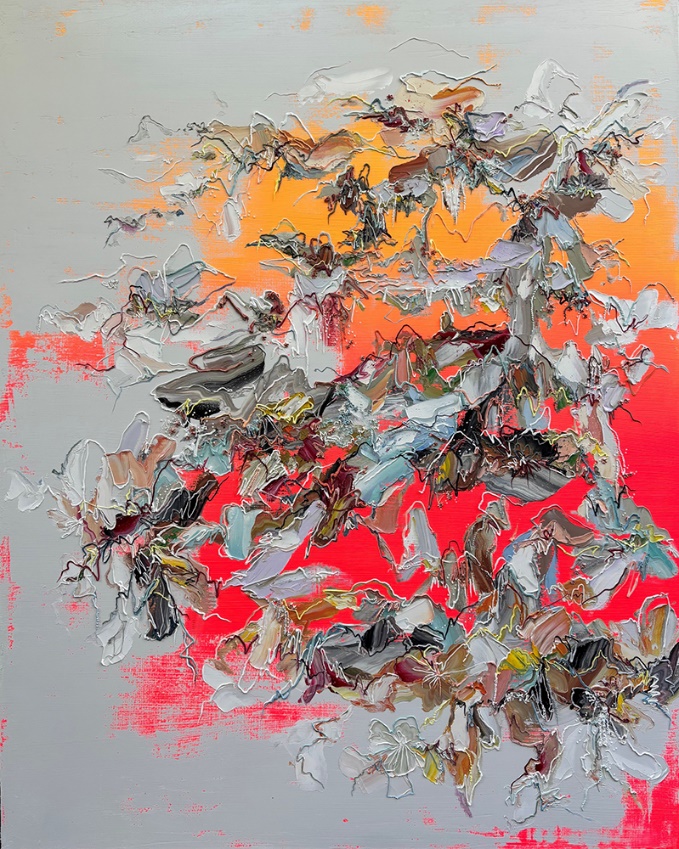
In “After Sol”, a fluorescent horizon of fluorescent pink and orange recalls the heightened colour and atmospheric gradations of Utagawa Hiroshige’s Plum Garden at Kameido, while also drawing on J. M. W. Turner’s exploration of light and atmosphere. Like Turner’s landscapes, where forms often dissolve into luminous fields of colour, “After Sol” considers light as a transformative force rather than simply a means of illumination. Sculptural gestures interrupt the electric horizon, creating a tension between the physicality of paint and the fleeting nature of light. The painting moves between historical reference and contemporary abstraction, suggesting an afterglow that feels both familiar and otherworldly.
Elsewhere, the landscape becomes increasingly ambiguous. In “Anywhere With You”, vibrant fragments of colour and texture gather against an expansive blue ground, suggesting forms suspended somewhere between the depths of the ocean and the vastness of the sky. The painting embraces the uncertainty of change, proposing that a sense of belonging need not be tied to a fixed location, but can exist within movement itself.
In “The Magpie and the Borrowed Sky”, sculptural fragments accumulate across a quiet, atmospheric ground, echoing the magpie’s instinct to collect. The work reflects the continual gathering of images, memories and observations – fragments borrowed from our surroundings and reassembled into new visual experiences. As the landscape changes, so too does the way we see it.
Across these paintings, landscape becomes less a depiction of a particular place than a form of recognition, shaped by nature, memory and inherited visual traditions. A textured gesture across a field of colour might suggest a distant shoreline, a flowering branch or an unfamiliar terrain, although none has necessarily been painted.
In that moment, the viewer completes the landscape.
Nicole Katsuras, 2026
About Nicole Katsuras
Born in Toronto, Ontario, Nicole Katsuras received a Master of Fine Arts from Central Saint Martins School of Art and Design in London, UK, and a Bachelor of Arts with Honours from the University of Toronto.
Nicole Katsuras’ approach embraces various traditions in art history while attempting to create a new formal vocabulary. Informed by the nuances of the oil medium, Katsuras uses a bold yet intricate extruded paint technique to compose lively, elegant, emotion-filled and playful abstract scenes.
Nicole Katsuras has exhibited in Toronto, London, Seoul, and Paris. Her work is part of both private and public collections across North America and Europe. Notable collections include McCarthy Tetrault, Canaccord, Encana, RBC Capital Investments, Luciano Benetton, Mirvish Collection, and Holt Renfrew.
Works in the exhibition include “Anywhere With You,” 48 x 48 inches, Oil on Canvas, 2026; “Honey Bonani,” 30 x 70 inches, Oil on Canvas, 2026; “After Sol,” 60 x 48 inches, Oil on Canvas, 2026; and “The Magpie and the Borrowed Sky,” 60 x 48 inches, Oil on Canvas, 2026.
Media contact
Bau-Xi Gallery | Toronto
416-977-0600
[email protected]
bau-xi.com
High-resolution (300 dpi) digital images are available upon request. For radio media: Bau-Xi is pronounced bow-she.
Related: Kyle Scheurmann’s All That We Can Take at Bau-Xi Gallery | Dufferin | Gavin Lynch’s Pixel Estate at Bau-Xi Gallery | Dufferin
Follow Canada News Media
Get the day's top Canadian stories and our two daily 60-second news videos wherever you scroll.
X Threads Facebook Instagram LinkedIn TikTok YouTube Pinterest Reddit Substack Flipboard Newsletter RSS