


Our family arrived ready to apologize for being tourists. We found a city managing its crowds, not fighting them
Article content
Reviews and recommendations are unbiased and products are independently selected. Postmedia may earn an affiliate commission from purchases made through links on this page.
Barcelona has a commissioner for sustainable tourism whose job sounds like it’s about telling people like me to book somewhere else.
The Spanish city drew 15.7 million tourists last year, according to Jose Antonio Donaire, who calls that the ceiling. “The message of the city now,” he told the New York Times in early July, “is: ‘Not one tourist more.’”
Article content
Article content
So, when I arrived with my wife Anisha and our 11-year-old son Nayam at the end of July, we were ready to keep our heads down and apologize for being tourists. We didn’t have to.
Advertisement 2
Article content

For a week we moved through Barcelona’s summer crush, from the twisting lanes of the Gothic Quarter to the stately grids of the Eixample. We queued outside Antoni Gaudí’s Casa Batlló, Anisha and Nayam went up to Park Güell for the mosaics and the view and we ducked out of the mid-30s heat into air-conditioned galleries featuring Andy Warhol and Yayoi Kusama. At every turn, the locals we met — from cab drivers and shopkeepers to servers taking late dinner orders — were relaxed, gracious and seemingly unbothered by us.

For a week we moved through Barcelona’s summer crush, from the twisting lanes of the Gothic Quarter to the stately grids of the Eixample. We queued outside Antoni Gaudí’s Casa Batlló, Anisha and Nayam went up to Park Güell for the mosaics and the view and we ducked out of the mid-30s heat into air-conditioned galleries featuring Andy Warhol and Yayoi Kusama. At every turn, the locals we met — from cab drivers and shopkeepers to servers taking late dinner orders — were relaxed, gracious and seemingly unbothered by us.
Advertisement 3
Article content
Ancient roots, modern grievances
In 1615, Cervantes sent Don Quixote to Barcelona and had him call the city an “archive of courtesy, shelter of strangers, hospital of the poor.” The Romans got there much earlier. They founded Barcino two thousand years ago, and four columns of their Temple of Augustus still stand in the courtyard of a medieval building on Carrer del Paradís.
By the time we landed, Barcelona’s reputation had soured. Water guns had been turned on tourists and ‘tourist go home’ was scrawled on walls. The city was cancelling the licences on all 10,101 of its tourist apartments by 2028, upheld last year by Spain’s Constitutional Court.
Residents have reason to be angry. Rents have climbed about 68 per cent in a decade, and short-term rentals keep pushing long-term tenants out of the city centre. But their target is City Hall, not visitors, and none of their vitriol ever reached us. I asked our hotel concierge about the protests and he shrugged. The water-gun crowd, he said, was a small band of agitators, amplified by the media in Madrid, Barcelona’s old rival. The biggest march, in 2024, drew a few thousand out of a metro area of five million. The city condemned it at once.

Travel Time
Article content
Advertisement 4
Article content
When I put the “not one tourist more” slogan to Aicard Guinovart, who runs the Catalan Tourist Board’s North America office, he rejected it. The goal isn’t fewer visitors, he told me, but drawing the kind who spread out past the postcard spots and nudging the rest to follow. The board’s plan measures success by what visitors spend, not how many arrive. By that measure, he said Canadians are close to ideal: they average 255 euros (C$410) a day, above the 211 of the typical foreign tourist. Americans outspend them but rarely leave their downtown chain hotels; Canadians book local and roam. “The Canadians, they are better for us,” Guinovart said, because they reach corners other travellers miss, drawn to Costa Brava cycling and the vineyards beyond the city.
Cultural immersion

The kind of visitor the city is chasing has an easy day on Carrer de Montcada in the historic El Born district. At the Picasso Museum, we explored medieval palaces containing his early work. Steps away at the contemporary Moco Museum, Nayam stood transfixed before an authenticated studio version of Banksy’s iconic London wall stencil, Girl with Balloon, among works by modern masters such as Jean-Michel Basquiat and Keith Haring, and digital artists like Pilar Zeta.
Advertisement 5
Article content
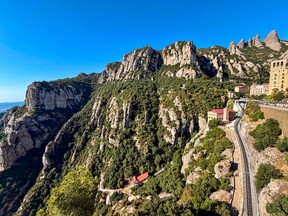
On other days, we spent time outside the city. We took a train to Figueres, where Salvador Dalí built his eponymous museum as one giant surreal object d’art. And we ascended by cable car to the thousand-year-old monastery of Montserrat, lodged in serrated pink peaks and home to its Black Madonna.
We descended from Catalonia’s holiest shrine straight into Barcelona’s other religion. Football is the faith here and Camp Nou its cathedral. The FC Barcelona club museum is temporarily tucked beside the cranes of a massive stadium rebuild. Nayam and I passed Champions League silverware and the boots of La Masia, the academy that produced his hero, Lamine Yamal, and went into a 360-degree room that recreates the roar of a hundred thousand fans. In his new Yamal jersey, our son, who had picked Spain from the start to win the World Cup, emerged an even more passionate believer.
Cruise control
Cruise ships are the main sore point in Barcelona, dumping thousands of daytrippers onto the same few blocks, so the city pushed its cruise surcharge to the legal maximum. A cruiser ashore under 12 hours now pays about $48 a day in tax, against $13.50 for a four-star hotel guest. A quarter of the region’s tourism tax now funds affordable housing, residents’ chief worry.
Advertisement 6
Article content
At Sensi Tapas in the Gothic Quarter, co-owner Alexandre Dubourgais has watched the neighbourhood change from behind the bar since 2006. “A few hundred people cannot represent a city of more than 1.5 million,” he told me. “Of course, those images make a better headline.” Housing worries him, especially for his staff. But he won’t pin it on legal tourist flats alone when illegal rentals are as much of it. His advice for Canadian travellers? “You don’t need to feel guilty about being a tourist. Just be a good one.”
Ilona Kauremszky, a fellow travel journalist, visited Barcelona for the first time expecting trouble. “I thought there would be scuffles and anti-tourist rallies because of the recent headlines,” she said. “What I experienced was the absolute opposite.”
Despite the heat wave, she found mingling with locals “a real tonic, even with my shoddy Catalan.” Her trip’s high point, she said, was a solo dip in her hotel’s rooftop pool, “while the masses were bustling to and fro beneath my feet.”
Advertisement 7
Article content
Sagrada salvation
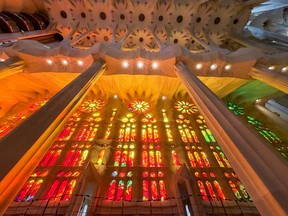
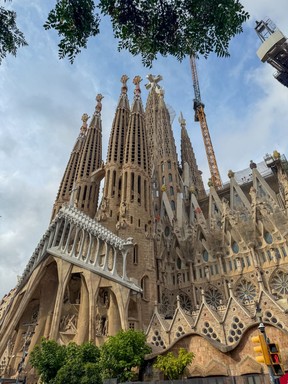
Barcelona’s bet– that a visitor can leave more than they take– was evident in our last stop: the Sagrada Família. Its central Jesus Christ tower was completed early this year. It is now the tallest church in the world, 144 years after Gaudí broke ground. No government money, no corporate donors. Donations and entry fees have entirely funded this temple of atonement. Inside, sunlight poured through the stained glass in colours that morphed throughout the day.

Guinovart had joked when we spoke that my 25-euro entry fee would help wash away my sins. I paid gladly, one more small donation to a church outsiders have been funding for generations, emblematic of a city that has always made room for newcomers.
Barcelona’s grievances may be modern. Its welcome, as far as my family could tell, is still one Cervantes would recognize.
If you go
Getting there: Air Canada and Air Transat fly non-stop from Montreal to Barcelona, about seven and a half hours; both connect from Toronto and other Canadian cities. From the West, Delta runs a one-stop via Seattle.
Advertisement 8
Article content
Where to stay: With legal short-term rentals vanishing ahead of the 2028 ban, book a hotel. In the Gothic Quarter, the Kimpton Vividora is a calm base with a rooftop pool over the old city. In the Eixample, the Almanac Barcelona has spacious rooms, a rooftop terrace and a plant-based restaurant from a Michelin-starred chef. At the top is an “Art Floor” of six suites reimagined by contemporary artists, the work for sale.
Where to eat: Head to Sensi Tapas for modern Mediterranean small plates in the Gothic Quarter and Bodega Bonay for market-driven small plates in the Eixample. Inside the Almanac, Michelin-starred chef Rodrigo de la Calle puts vegetables at the centre of Virens’ menu.
What to see: Visit the El Born art walk, where the Picasso and the Moco Museums sit a minute apart on Carrer de Montcada. For day trips, In Out Barcelona Tours run small-group excursions (maximum eight guests, hotel pickup) to Montserrat, Figueres and the Costa Brava.
For more information, visit Barcelona Tourism.
Read More
-

Does Albania live up to the hype? We went to find out
-
AI can plan your next vacation. But should it?
-
Inside Ronaldo’s Madeira: The island that forged a football icon


Article content
Related Products
-
Mr.Go 20-inch Rechargeable LED Ball Light, Waterpr…
Products $245.99 -
Sale!
SENSARTE 17 Piece Nonstick Detachable Handle Pots …
Products Original price was: $129.99.$114.99Current price is: $114.99. -
MUELLER HOME Retro Toaster 2 Slice with 7 Browning…
Products $37.98