

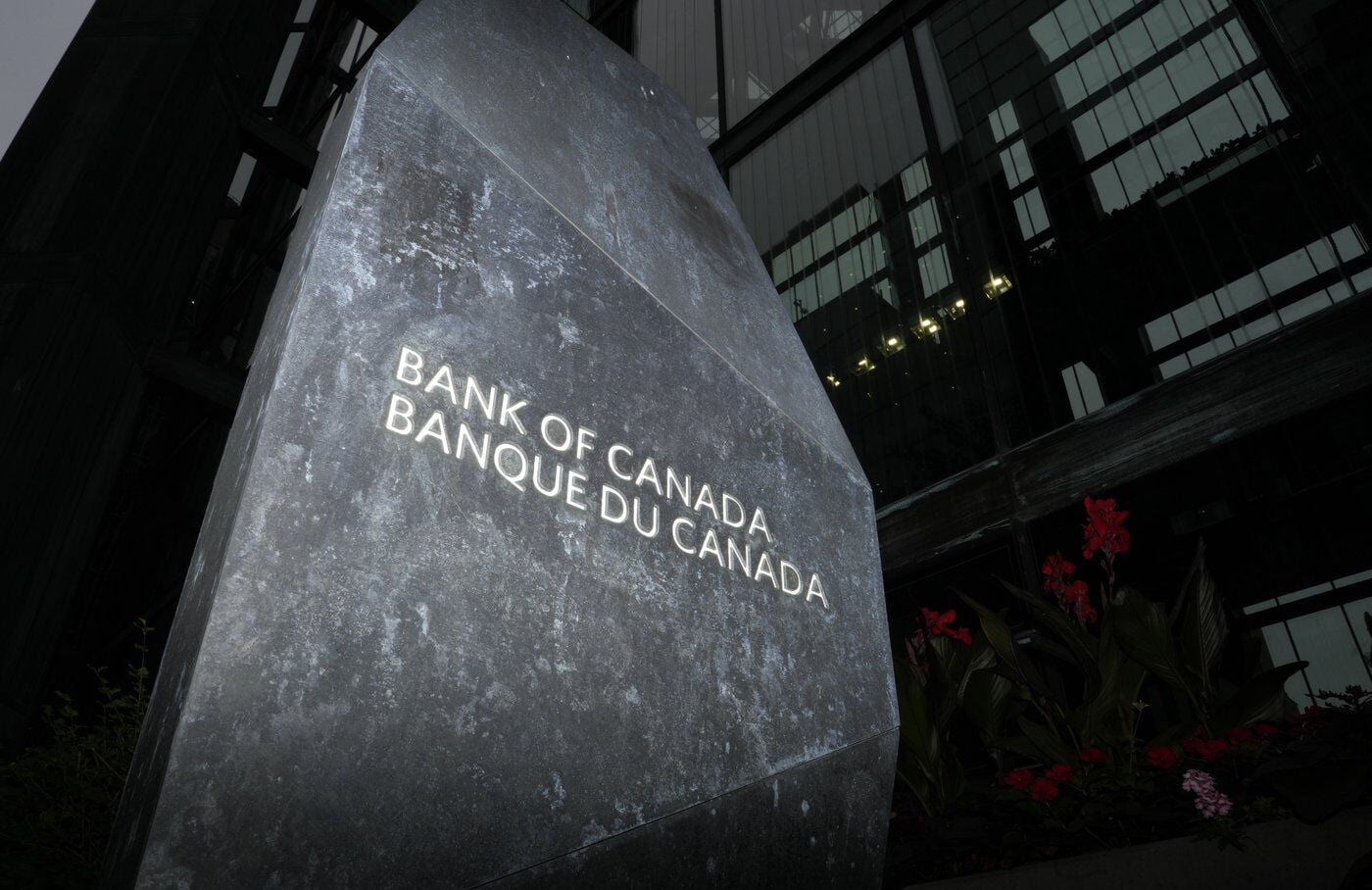
The Bank of Canada will announce its next interest rate decision at 9:45 a.m. Eastern time on Wednesday, Oct. 28, 2026, along with its quarterly Monetary Policy Report. The policy rate is now 2.25 per cent. Several big banks and most market pricing now point to a quarter-point increase to 2.5 per cent, though some economists still expect a hold.
Updated Oct. 22, 2026. This guide will be updated after the announcement.
The date and time come from the bank’s official announcement schedule, which says all rate announcements take place at 9:45 a.m. ET. The current rate and its history are on the bank’s policy interest rate page.
Key facts
| Item | Detail |
|---|---|
| Announcement | Wednesday, Oct. 28, 2026, 9:45 a.m. ET |
| Also released | October Monetary Policy Report (forecasts for growth and inflation) |
| Current policy rate | 2.25 per cent, unchanged since Oct. 29, 2025 |
| Bank Rate and deposit rate | 2.5 per cent and 2.20 per cent (Sept. 2 decision) |
| Big banks’ prime rate | 4.45 per cent (Bank of Canada posted rates table) |
| Latest inflation | 3.1 per cent in September 2026 (Statistics Canada, Oct. 19) |
| When a change takes effect | The day after the announcement |
| Next decision | Wednesday, Dec. 9, 2026 |
What time is the Bank of Canada announcement on Oct. 28?
The decision is released at 9:45 a.m. ET, which is 6:45 a.m. in Vancouver, 7:45 a.m. in Calgary, 8:45 a.m. in Winnipeg, 10:45 a.m. in Halifax and 11:15 a.m. in St. John’s. It is posted as a press release on bankofcanada.ca at the same moment the Monetary Policy Report goes online.
The bank publishes a report with four of its eight decisions each year, in January, April, July and October. The report sets out the bank’s forecasts for economic growth and inflation, and it usually gets as much attention from economists as the rate itself. The bank’s upcoming events page says media advisories with details such as news conference times are usually posted about three business days before an event.
What is the Bank of Canada’s interest rate now?
The target for the overnight rate, known as the policy rate, is 2.25 per cent. The bank cut it by a quarter point to that level on Oct. 29, 2025, and has held it at every decision since: Dec. 10, 2025, and Jan. 28, March 18, April 29, June 10, July 15 and Sept. 2, 2026.
In its Sept. 2 decision, the bank said high energy prices linked to the Middle East conflict and new U.S. tariffs had raised the upside risks to inflation. It said it “is prepared to adjust monetary policy as needed.”
Will the Bank of Canada raise rates on Oct. 28?
Forecasters are split, and the balance has shifted toward a hike in the past week. Bank of Montreal, Scotiabank and Desjardins were forecasting a quarter-point increase as of Oct. 19, The Globe and Mail reported, and CBC News reported on Oct. 21 that RBC Dominion Securities had also changed its call from a hold to a hike. TD Economics and RBC Economics said on Oct. 19 that they expected a hold.
Markets lean further toward an increase. Traders in the overnight swap market put the odds of a 25-basis-point hike at 87 per cent, according to Bloomberg data cited by CBC on Oct. 21. On Oct. 16 those odds were about 34 per cent, The Canadian Press reported, citing LSEG Data and Analytics. Market odds can change daily until the announcement.
Much of the shift followed Governor Tiff Macklem’s remarks on Oct. 17 that the bank’s inflation outlook would be “quite a bit higher” than its July forecast, The Canadian Press reported. Statistics Canada said on Oct. 19 that annual inflation rose to 3.1 per cent in September, driven by a 27.8 per cent jump in gasoline prices, as we reported in our coverage of the September inflation data. Our full roundup of the forecasts is in Several big banks now see Bank of Canada hike on Oct. 28.
The case for caution rests on jobs. Statistics Canada reported that the economy lost about 68,000 jobs in September and the unemployment rate rose to 6.5 per cent, as covered in our September jobs report story.
How would a quarter-point change affect my variable mortgage?
Lenders usually move their prime rates in step with the Bank of Canada, and variable-rate mortgages are priced off prime, so a change shows up quickly. The table below is Canada News Media’s own calculation, not a lender quote.
| Mortgage balance | Monthly payment at 4.00% | After a 0.25-point hike (4.25%) | Change per month | Change per year | After a 0.25-point cut (3.75%) |
|---|---|---|---|---|---|
| $300,000 | $1,583.51 | $1,625.21 | +$41.70 | +$500 | $1,542.39 |
| $500,000 | $2,639.18 | $2,708.69 | +$69.51 | +$834 | $2,570.66 |
| $750,000 | $3,958.78 | $4,063.04 | +$104.26 | +$1,251 | $3,855.98 |
Not every variable mortgage works the same way. With an adjustable-rate mortgage, the payment itself rises or falls. With a fixed-payment variable mortgage, the payment stays the same but the split changes. On a $500,000 balance at four per cent, the interest portion of the first payment is about $1,666.67; at 4.25 per cent it is about $1,770.83, so roughly $104 less goes toward principal each month. If rates keep rising, a fixed-payment borrower can reach the trigger rate, the point at which the payment no longer covers the interest, and the lender will contact them.
What happens to HELOCs and lines of credit?
Home equity lines of credit and most unsecured lines of credit are also tied to prime, so their rates usually change the day after the bank moves. Our calculation: on a $50,000 HELOC balance at prime plus 0.5 points, or 4.95 per cent, interest-only payments are about $206.25 a month. A quarter-point hike would raise that to about $216.67, an increase of about $10.42 a month or $125 a year. A cut would lower it by the same amount.
What does the decision mean for fixed mortgages, savings and GICs?
Fixed mortgage rates follow Government of Canada bond yields rather than the policy rate, and those yields have already risen in anticipation, as our report on recent fixed mortgage rate increases showed. The Bank of Canada’s weekly table of rates posted by the big banks listed the conventional five-year mortgage rate at 6.19 per cent on Oct. 21, though most borrowers are offered discounts from that posted rate.
Savers tend to gain when rates rise. High-interest savings accounts are often adjusted after a bank decision, while GIC rates move with bond yields. As a rule of thumb, each quarter point on $10,000 in savings is worth about $25 a year in interest before tax. Rates and timing vary by institution.
When is the next Bank of Canada rate decision?
The last decision of 2026 is on Dec. 9. The bank published its 2027 schedule on July 27, 2026, with eight dates, all at 9:45 a.m. ET.
| Date | Monetary Policy Report? |
|---|---|
| Wednesday, Oct. 28, 2026 | Yes |
| Wednesday, Dec. 9, 2026 | No |
| Wednesday, Jan. 27, 2027 | Yes |
| Wednesday, March 3, 2027 | No |
| Wednesday, April 28, 2027 | Yes |
| Wednesday, June 2, 2027 | No |
| Wednesday, July 21, 2027 | Yes |
| Wednesday, Sept. 8, 2027 | No |
| Wednesday, Oct. 27, 2027 | Yes |
| Wednesday, Dec. 8, 2027 | No |
The bank also publishes a summary of the Governing Council’s deliberations about two weeks after each decision. The summary for the Oct. 28 decision is scheduled for Nov. 10 at 1:30 p.m. ET, according to the bank’s events calendar.
Frequently asked questions about the Oct. 28 decision
What time is the Bank of Canada announcement on Oct. 28, 2026?
The decision is released at 9:45 a.m. Eastern time on Wednesday, Oct. 28, 2026, together with the October Monetary Policy Report.
Is the Bank of Canada expected to raise rates in October 2026?
Several big banks, including BMO, Scotiabank, Desjardins and RBC Dominion Securities, expect a quarter-point hike to 2.5 per cent, and swap markets priced the odds at 87 per cent on Oct. 21. TD Economics and RBC Economics expect a hold.
What is the prime rate in Canada right now?
The big banks’ prime rate is 4.45 per cent, according to the Bank of Canada’s table of posted rates. It usually moves by the same amount as the policy rate.
How much will my mortgage go up if rates rise by 0.25 points?
By our calculation, an adjustable-rate payment on a $500,000 mortgage with 25 years left would rise by about $70 a month, from about $2,639 to $2,709. On $300,000 it rises about $42 and on $750,000 about $104.
When does a Bank of Canada rate change take effect?
Since 2021, a change in the policy rate takes effect the day after the announcement, the bank says. Prime rates and variable loan rates tied to prime usually follow.
When is the next Bank of Canada meeting after October 2026?
The next decision is on Wednesday, Dec. 9, 2026. The first decision of 2027 is on Wednesday, Jan. 27, with a Monetary Policy Report.
What is the Monetary Policy Report?
It is the bank’s quarterly forecast of growth and inflation, published with the January, April, July and October decisions. It explains the reasoning behind the rate.
If you find reporting like this useful, consider supporting Canada News Media, an independent Canadian newsroom with no corporate parent.
Sources: Bank of Canada policy interest rate, 2027 announcement schedule, Sept. 2, 2026 decision, upcoming events, posted interest rates of the chartered banks and Monetary Policy Report; Statistics Canada The Daily. Forecasts and market odds as reported by The Globe and Mail, CBC News and The Canadian Press.
Follow Canada News Media
Get the day's top Canadian stories and our two daily 60-second news videos wherever you scroll.
X Threads Facebook Instagram LinkedIn TikTok YouTube Pinterest Reddit Substack Flipboard Newsletter RSS