





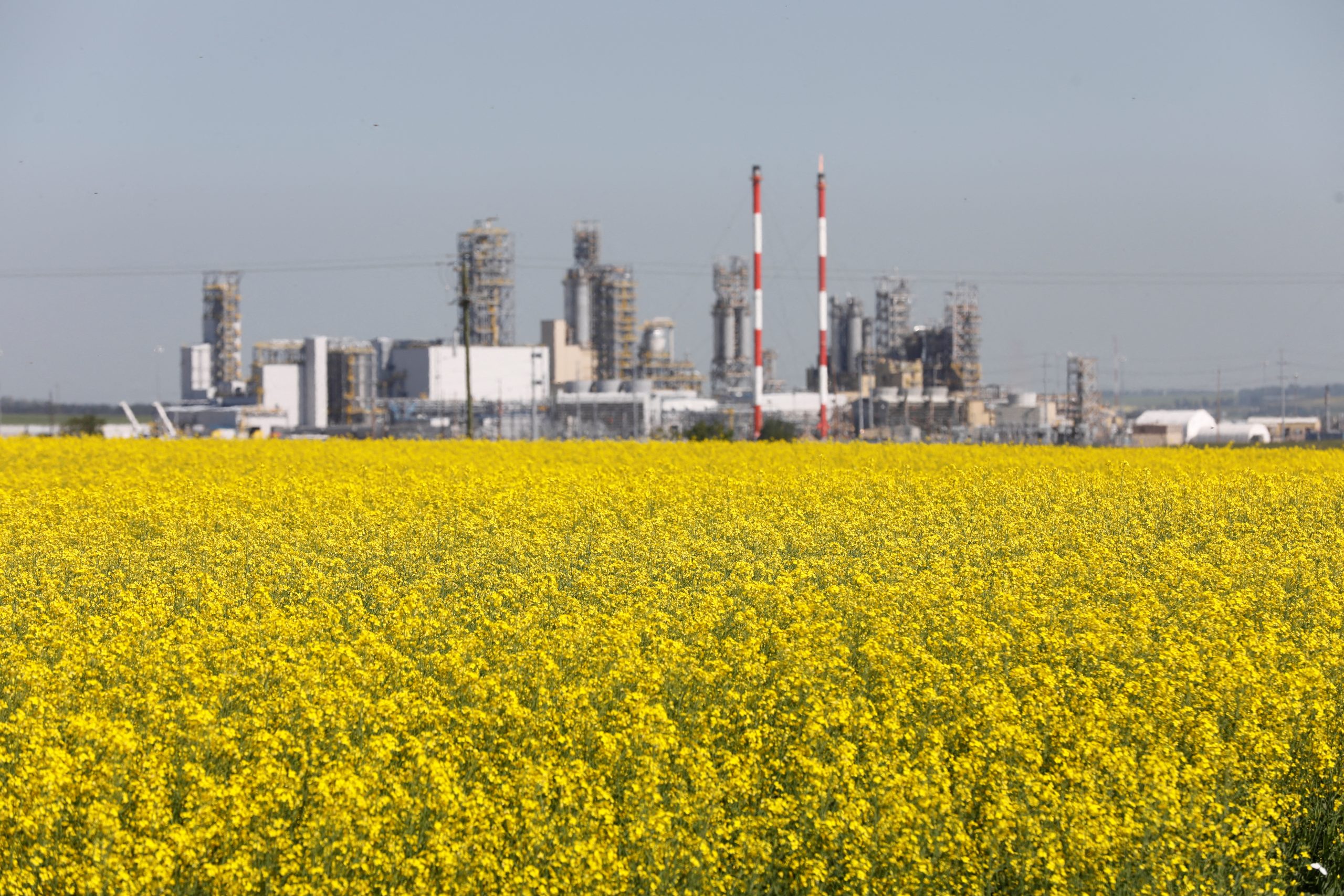
A three-litre jug of canola oil costs $11.16 across Canada, up 54.8 per cent from $7.21 in September 2019, and the increase has been steepest in the Prairie provinces where the crop is grown, according to a Canada News Media analysis of Statistics Canada average retail prices. Saskatchewan shoppers paid $10.91 in September, up 75.4 per cent from $6.22, while Prince Edward Island shoppers paid $12.41, up 22.5 per cent from $10.13.
In 2019, Saskatchewan had the cheapest canola oil in the country and Newfoundland and Labrador the dearest, at $10.25, a gap of $4.03. By September 2026 the cheapest was Ontario at $10.40 and the dearest Nova Scotia at $13.09, a gap of $2.69. Manitoba rose 74.2 per cent, to $10.89 from $6.25, and Alberta 71.7 per cent, to $11.21 from $6.53. British Columbia rose 69.0 per cent, to $11.44 from $6.77. Quebec rose 45.8 per cent, to $12.10 from $8.30, and Ontario 42.5 per cent, to $10.40 from $7.30. The four Atlantic provinces rose between 22.5 and 28.8 per cent: New Brunswick to $12.62 from $9.80, Newfoundland and Labrador to $12.71 from $10.25, Nova Scotia to $13.09 from $10.16, and Prince Edward Island to $12.41 from $10.13.
In dollars, a jug of canola oil costs between $4.64 and $4.69 more than in 2019 in each of the four western provinces, against $2.28 to $3.10 more in Ontario and the Atlantic provinces, and $3.80 more in Quebec. The national average rose $3.95.
The past year has been less uneven. Nationally, canola oil rose 13.1 per cent from $9.87 in September 2025. Saskatchewan rose 13.5 per cent, to $10.91 from $9.61, Alberta 13.3 per cent, Manitoba 12.6 per cent, Ontario 11.1 per cent, Quebec 17.7 per cent and Nova Scotia 8.4 per cent. Whitehorse, which has no 2019 figure, rose 16.2 per cent in the past year, to $11.89 from $10.23, and Yellowknife 8.7 per cent, to $12.47 from $11.47. A jug of generic vegetable oil, which Statistics Canada tracks separately, rose 81.5 per cent nationally since 2019, to $9.24 from $5.09, but fell in Alberta and Manitoba over the last year, to $9.94 and $9.77 from $11.12 and $11.01, so the two products have not moved together. Our earlier report on beef prices noted the national oil figures; this analysis adds the provincial comparison.
The records do not say why the Prairie provinces saw the biggest percentage increases. Statistics Canada reports what the average price was, not what it cost to make or ship, and the table does not name any grocer, brand, processor or supplier. Competing explanations include the cost of crushing and refining, packaging and freight, how much each province buys under store-brand or discount formats, and the fact that the Prairie prices started 2019 from a lower base, so the same dollar rise looks larger in percentage terms. The data measure none of these, and no company or government is accused of anything here. Shoppers can compare the unit price printed on the shelf tag, which is usually shown per 100 millilitres, because a larger or smaller bottle can cost less per litre than the three-litre jug used in the survey.
How we checked: We downloaded Statistics Canada’s table 18-10-0245-01 (monthly average retail prices for selected products) on Nov. 21, 2026. The latest month in the file was September 2026. We took the prices for “Canola oil, 3 litres” and “Vegetable oil, 3 litres” for Canada and the ten provinces in September 2019, September 2025 and September 2026, and calculated the dollar and percentage changes from the published values. Figures are rounded to the nearest cent and one decimal place. The table gives averages for the sizes and types Statistics Canada describes and has no September 2019 canola oil price for Whitehorse or Yellowknife, so the two territorial capitals are left out of the comparison since 2019. The source file is saved in our investigations data folder. No right of reply was needed because the story reports a statistical pattern and makes no allegation.
Follow Canada News Media
Get the day's top Canadian stories and our two daily 60-second news videos wherever you scroll.
X Threads Facebook Instagram LinkedIn TikTok YouTube Pinterest Reddit Substack Flipboard Newsletter RSS