


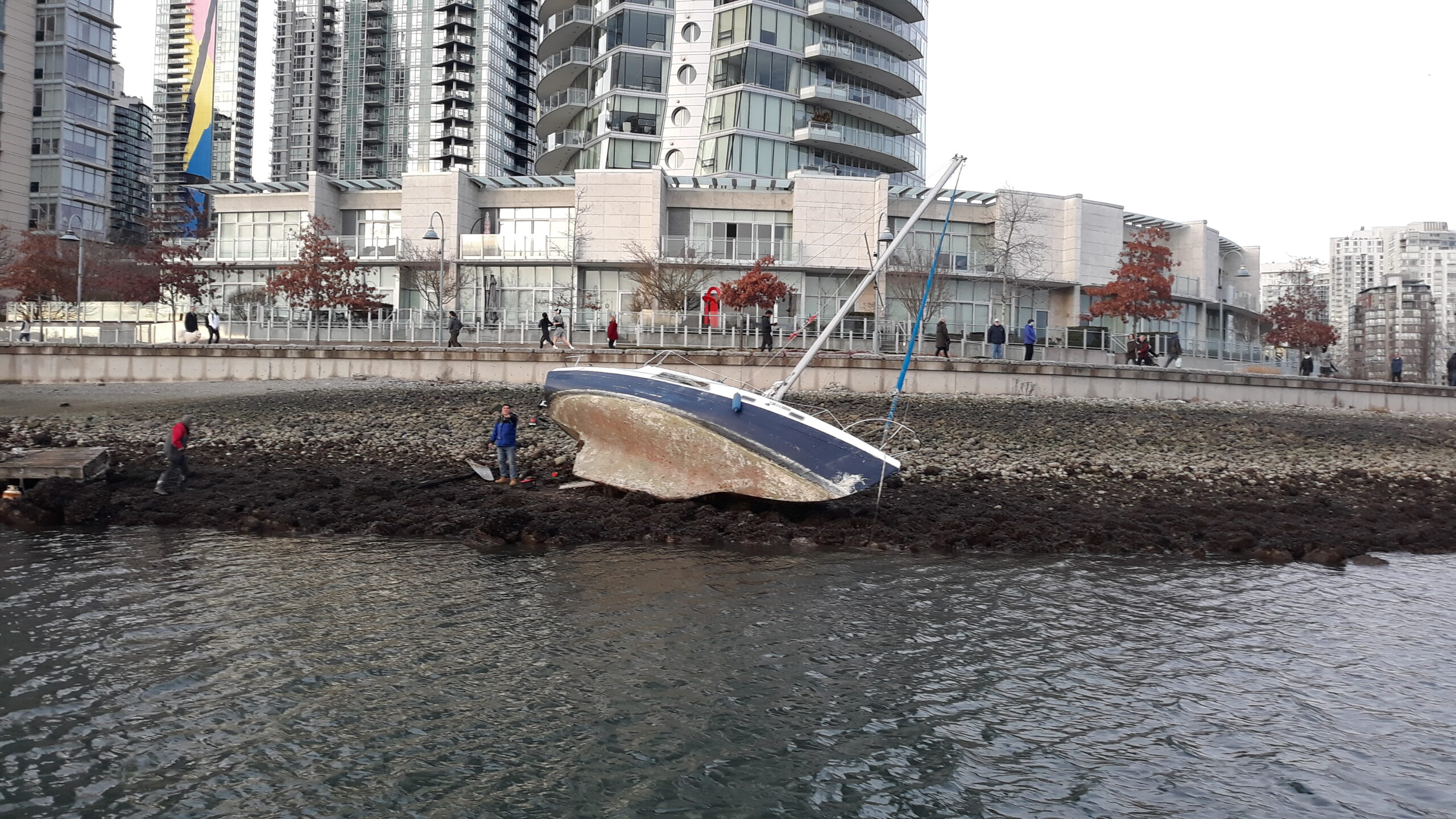
Seven years after Ottawa’s law on wrecked and abandoned boats came into force, the two federal agencies that enforce it have published a combined 13 penalties against vessel owners, worth $250,600 in all, according to a Canada News Media count of both agencies’ public records.
The Wrecked, Abandoned or Hazardous Vessels Act took effect on July 30, 2019. It made it illegal to abandon a vessel or to leave a dilapidated one stranded, grounded or moored in the same place for 60 days or more, and it gave Transport Canada and the Canadian Coast Guard the power to issue administrative monetary penalties. Transport Canada’s own explanation of the law says fines range from $5,000 to $50,000 for a person and up to $250,000 for a business, with court fines of up to $1 million for a person and $6 million for a business in the most serious cases.
Transport Canada’s Navigation Protection Program, which handles abandoned and dilapidated vessels, lists three notices of violation in the public record the Act requires it to keep. Two are in British Columbia and one is in Nova Scotia, all against individuals: $26,600 for abandoning a 70-foot paddlewheeler, $22,500 for leaving a dilapidated sailboat in one spot near Powell River, B.C., for more than 60 days, and $5,000 for the same offence in Nova Scotia. Together they total $54,100. Transport Canada has said its first penalty under the law was issued in the fall of 2020.
The Coast Guard, which deals with vessels that pose a hazard, such as a pollution risk, lists 10 penalties on its public fines page, dated June 27, 2023 to April 2, 2026. All 10 are for the same violation, failing to comply with a Coast Guard direction under section 36 of the Act, and they total $196,500. Nine went to individuals, at $12,000 to $15,000 each. The largest, $75,000 on April 2, 2026, went to an organization, the Ocean Breeze Conservation Society, over a vessel named Breeze in British Columbia. One owner in Quebec was penalized twice, in 2024 and 2025.
British Columbia accounts for seven of the 13 penalties across the two lists. Newfoundland and Labrador and Quebec have two each, and Nova Scotia has two. No penalty in either record is from Ontario, the Prairies or the North.
The scale of the problem is far larger than the penalty count. A Transport Canada briefing page on the Vessel Remediation Fund, last updated in 2022, says the national inventory of wrecked, abandoned and hazardous vessels had identified “over 1,800 vessels so far, and growing.” Transport Canada’s separate vessels of concern bulletin board, where it posts boats it plans to act on or whose owners it is trying to find, listed 11 vessels on Nov. 23, 10 of them in the Pacific region and most with no name or owner information available.
That last point is one reason penalties are rare. A penalty needs an owner, and in a 2021 consultation on a proposed vessel remediation fund, Transport Canada wrote that many problem vessels in Canadian waters “do not have an owner that can be identified or located in order to hold them to account.” The same document said the costs of addressing problem vessels “to date have been absorbed exclusively by taxpayers more broadly.”
What the records do not show is how many owners were warned, how many removed their boats after a direction without needing a penalty, whether any of the 13 penalties were paid or reduced on review, or whether anyone has been prosecuted in court under the Act. Neither public record shows how many vessels the agencies have removed. The Transport Canada record does not give the dates its three notices were issued, and its file numbers begin with 2020 for two of them and 2023 for the third.
For boaters, the rules are simple even if enforcement is rare. Owners are responsible for the full cost of dealing with a vessel they abandon or leave to deteriorate, and anyone who spots an abandoned or wrecked boat can report it to Transport Canada’s regional Navigation Protection Program office, or to the Coast Guard if it is leaking fuel or other pollutants.
How we checked: On Nov. 23, 2026, we read every entry in Transport Canada’s public record of notices of violation and default under the Wrecked, Abandoned or Hazardous Vessels Act (three entries) and the Canadian Coast Guard’s public fines issued for problem vessels table (10 entries), and added the penalty amounts and provinces. Penalty ranges are from Transport Canada’s page About the Wrecked, Abandoned or Hazardous Vessels Act. The inventory figure and the date of the first penalty are from Transport Canada’s Vessels Remediation Fund briefing page, last modified in 2022, so the current inventory may differ. The ownership quotations are from Transport Canada’s 2021 vessel remediation fund consultation. We did not name the individual vessel owners listed in the records.
Follow Canada News Media
Get the day's top Canadian stories and our two daily 60-second news videos wherever you scroll.
X Threads Facebook Instagram LinkedIn TikTok YouTube Pinterest Reddit Substack Flipboard Newsletter RSS