


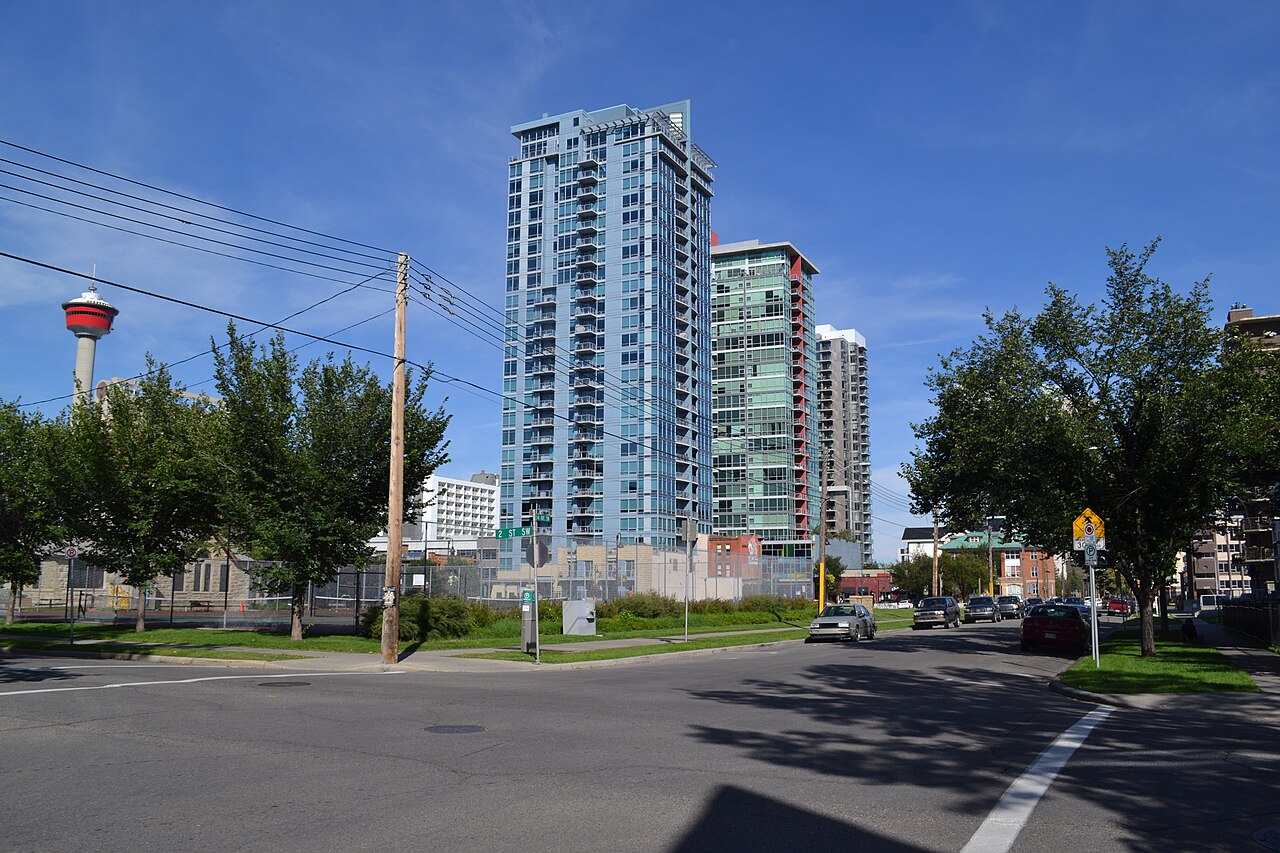
Calgary was the only one of 18 large metro areas where the Canada Mortgage and Housing Corporation could not show that rents on the same apartments rose at all last year. CMHC’s 2025 Rental Market Survey marks the Calgary metro’s same-sample rent change for October 2024 to October 2025 as “not statistically significant,” for every bedroom size it could report. A year earlier, the same measure showed rents on those apartments up 8.4 per cent.
The other 17 metros all show a measurable all-bedroom change for 2025, ranging from 1.4 per cent in Hamilton to 7.4 per cent in Montréal. Edmonton, Calgary’s neighbour, came in at 3.5 per cent, down from 7.2 per cent. Nine of those 17 metros saw smaller increases than in 2024 and eight saw larger ones, so Calgary’s result is the sharpest break from last year in the table, not the only slowdown.
CMHC’s table, Table 1.1.5, measures the percentage change in average rent for private apartments that were in its survey sample in both years, which keeps new buildings and changes in the unit mix from distorting the result. For Calgary, the one-, two- and three-bedroom columns for 2025 all carry the “++” code, which CMHC defines as a change in rent that is “not statistically different than zero.” Studio rents, which were up 12.0 per cent in the previous year, are suppressed for 2025. The Calgary city zones (Zones 1 to 9) show the same pattern, 8.2 per cent a year earlier and “++” this year.
The code does not mean rents fell. It means the survey could not tell the 2025 change apart from zero. CMHC’s separate table of average rents, which is not a same-sample measure, shows the Calgary metro’s average apartment rent at $1,761 in October 2025, up 1.7 per cent from $1,732 a year earlier. By bedroom size the average was $1,441 for a studio (from $1,362), $1,582 for a one-bedroom (from $1,585), $1,914 for a two-bedroom (from $1,882) and $2,171 for three bedrooms or more (from $1,975). Averages move with the mix of units, so a jump in three-bedroom rents can reflect which units were counted as much as what existing tenants paid.
The same tables show a larger rental stock. CMHC counted 62,657 private apartments in the Calgary metro’s survey universe in October 2025, up 6,216 or 11.0 per cent from 56,441 a year earlier. The overall vacancy rate in the tables was 5.0 per cent, compared with 4.8 per cent in 2024. The tables do not say why the rent measure flattened, and we cannot attribute it to new supply, higher vacancy or anything else. Other factors, including migration and incomes, may also play a part.
For Calgary tenants, the figures describe the market as a whole and not any one lease. Alberta’s rules on rent increases apply to individual tenancies, and the survey does not show what any landlord charged any tenant.
How we checked: We opened CMHC’s 2025 Rental Market Survey data workbooks for the 18 metros we track and read Table 1.1.5 (estimate of percentage change of average rent, by zone and bedroom type, October 2023 to October 2024 and October 2024 to October 2025), taking each metro’s “CMA” row and its all-bedroom “Total” columns. We read CMHC’s own legend for “++” in the same workbook. We took Calgary’s average rents, universe and vacancy from Tables 1.1.2, 1.1.3 and 1.1.1 of the Calgary workbook and calculated the percentage changes ourselves. Quality ratings in the tables range from “excellent” to “poor, use with caution,” and several 2025 figures in other metros carry lower ratings. The data tables are on CMHC’s rental market report data tables page, and CMHC’s rental market reports page carries the full report. We searched our own archive for the past 12 months and found no earlier story on this measure.
Follow Canada News Media
Get the day's top Canadian stories and our two daily 60-second news videos wherever you scroll.
X Threads Facebook Instagram LinkedIn TikTok YouTube Pinterest Reddit Substack Flipboard Newsletter RSS