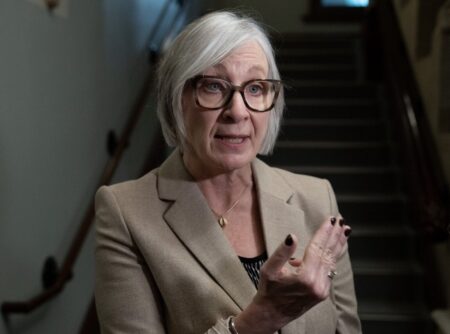



Bank of Canada governor Tiff Macklem said Tuesday, Nov. 24, that businesses have largely absorbed higher costs from the oil shock so far, but more of them are likely to be passed on to consumer prices in the year ahead.
“This second-round effect of the oil shock will add to inflation persistence,” Macklem said in a speech to the Economic Club of Canada in Toronto. He said that outlook rests on historical lags and the bank’s own business surveys.
He offered some near-term relief. Inflation has been around three per cent since April, and the bank forecast in October that it would rise to about 3.5 per cent by the end of the year. Oil prices and refinery margins have since fallen, “suggesting inflation may not be quite as high,” he said.
At a news conference, Macklem said the inflation forecast was a bit lower, although the costs that built up over the previous eight months were still there, The Canadian Press reported.
Macklem said greater inflation persistence, along with a modestly better economy, supported the decision to raise the policy rate to 2.5 per cent in October. Monetary policy cannot lower global energy prices but can limit how much they spill over into other prices, he said.
The speech also set out a change in how the bank will read underlying inflation. It will rely a little more on two core measures: CPI-trim, which removes the most extreme price changes each month, and CPIX, which excludes a fixed set of items.
The bank’s earlier approach, adopted in 2016, put more emphasis on statistical measures including CPI-trim, CPI-median and CPI-common. Macklem said the bank was not as clear as it had hoped during the post-pandemic inflation surge, when it stressed different core measures at different times.
The two per cent target applies to total inflation, he said, and core measures help shape the outlook but are not targets themselves. The bank also said it was launching an online dashboard with a wider range of inflation indicators, including how broadly price pressures are spreading.
Macklem acknowledged the bank could have done better after the pandemic. “We were too slow to recognize the persistence of inflationary pressures and how broadly they were spreading through the economy,” he said, while adding that most of the surge was unavoidable.
The speech accompanied the bank’s research on the monetary policy framework that it and Ottawa renewed this month, keeping the two per cent target to 2031.
The next rate decision is Dec. 9. Macklem said the bank will weigh third-quarter gross domestic product and November labour data first, The Canadian Press reported.
Market odds of a quarter-point increase stood at 79 per cent Tuesday, up from nearly 63 per cent Monday, according to LSEG Data and Analytics figures cited by the news agency. CIBC chief economist Avery Shenfeld said in a client note that the speech’s focus on lingering inflation risk suggested the bank could be preparing for a second straight increase.
Our guide to the Dec. 9 decision and the calendar of upcoming economic releases set out what comes next.
Sources: Bank of Canada speech text, Nov. 24, 2026; The Canadian Press.
If you find reporting like this useful, consider supporting Canada News Media, an independently owned Canadian newsroom.
Follow Canada News Media
Get the day's top Canadian stories and our two daily 60-second news videos wherever you scroll.
X Threads Facebook Instagram LinkedIn TikTok YouTube Pinterest Reddit Substack Flipboard Newsletter RSS