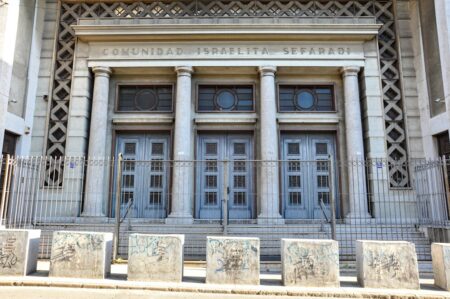


In November 1860, Osgoode Hall in Toronto looked less like a courthouse than a garrison. Police ringed the building, bayonets fixed, in the first armed fortification of the Law Society of Upper Canada’s headquarters since the Rebellion of 1837, according to the Law Society of Ontario’s own account of the case. The man at the centre of it had already escaped slavery once. Now Canada’s courts would decide whether to send him back.
His name was John Anderson. He had been born around 1831 in Missouri, enslaved under the name Jack Burton by a tobacco farmer named Moses Burton, according to the Dictionary of Canadian Biography, published by the Government of Canada. In 1853 he was sold to a farmer near Glasgow, Missouri, and separated from his wife, Maria Tomlin, and their child. He fled to see them, and on the road a local farmer, Seneca T.P. Diggs, confronted him and tried to force him back. Anderson stabbed Diggs with a knife in the struggle; Diggs died of the wound two weeks later, the Canadian Encyclopedia reports. Anderson kept running, crossing from Michigan into Windsor, Canada West, in the fall of 1853.
He built a free life there under a new name. He worked for the Great Western Railway between Windsor and Chatham, then as a plasterer and labourer in Hamilton and Caledonia, the Dictionary of Canadian Biography states. The United States had already tried once to get him back: an 1854 extradition request was refused by Lord Elgin, then governor general. For six years, that seemed to settle it.
It did not. In 1860 an acquaintance identified only in the historical record as Wynne betrayed Anderson’s whereabouts, and a Brantford magistrate had him arrested that spring, then released for lack of evidence. A Detroit detective built a stronger case, producing Diggs’s own sons as witnesses, and Anderson was arrested again that autumn and jailed in Brantford. Washington’s extradition request, filed within days, described him only as a “man of colour,” omitting that he had been enslaved, the Canadian Encyclopedia notes. He was brought before the Court of Queen’s Bench at Osgoode Hall on Nov. 24, 1860.
His lawyer, Samuel B. Freeman, argued that a man fleeing bondage could not be bound by the laws that had enslaved him. It did not carry the day. On Dec. 15, 1860, the court ruled 2 to 1 that Anderson should be extradited under the Webster-Ashburton Treaty of 1842, with Chief Justice John Beverley Robinson writing for the majority. Justice Archibald McLean dissented, arguing, in the Law Society of Ontario’s summary of his reasoning, that Canadian courts could not recognize slavery’s authority over a man’s actions in a British province. The ruling triggered what the Canadian Encyclopedia describes as public outcry across the colony, the kind of reaction that reflected how directly the case tested Canada West’s standing as a refuge for people who had escaped slavery in the United States.
Before the ruling could be carried out, Canadian and British abolitionists petitioned the Court of Queen’s Bench in Westminster, which on Jan. 14, 1861 ordered Anderson released, an unprecedented reach by a British court into a colonial judicial matter. Canadian officials bristled at the precedent even as they welcomed the outcome. The final resolution came from Toronto’s own Court of Common Pleas, where Anderson’s lawyers won his discharge on a technicality on Feb. 16, 1861: the original warrant had not properly charged murder, and Brantford’s magistrate had lacked jurisdiction in the first place, according to both the Canadian Encyclopedia and the Dictionary of Canadian Biography.
Toronto celebrated in the streets. Anderson spent the following months giving speeches across Canada West and Canada East. In the spring he sailed to Britain, where he addressed more than two dozen anti-slavery meetings that summer and had his life story published by the English abolitionist Harper Twelvetrees in 1863. On Dec. 24, 1862, he left Liverpool for Liberia. No records of his life after that date have surfaced.
The Anderson case reshaped how Canadian institutions guarded their independence. Britain moved in 1862 to curb its courts’ interference in colonial judiciaries, and Canada West shifted extradition cases to its superior courts the following year, changes the Law Society of Ontario credits directly to the fallout from Anderson’s ordeal. It remains a rare instance in which a fight over one formerly enslaved man’s freedom became, for a few months, a constitutional argument about who had the final word over Canadian law: London or Toronto.
What the case does not offer is a tidy ending. Anderson survived two escapes, first from a Missouri farm and then from a Brantford jail cell, only to vanish from the historical record entirely once he reached West Africa. Nearly everything known about him comes from the machinery that tried to send him back: court filings, newspaper accounts of his trial, and the abolitionist pamphlet built around his testimony. His own account of what came after is one that history, so far, has not recovered.
If you find reporting like this useful, consider supporting Canada News Media, an independent Canadian newsroom with no corporate parent.