


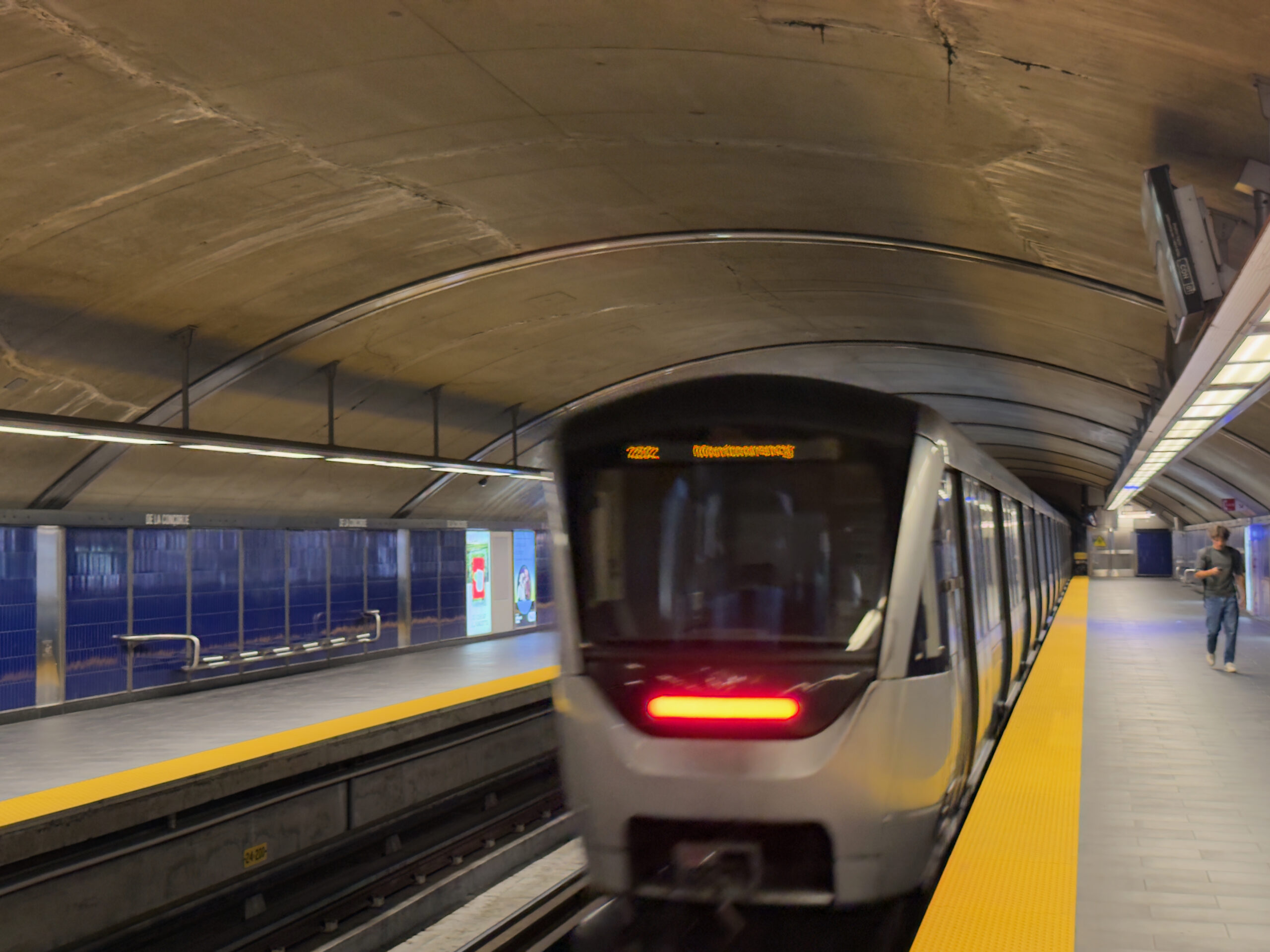
Montreal metro riders are losing more time to stoppages caused by other people than they were before the pandemic, even though the system records fewer incidents overall, according to the Société de transport de Montréal’s own incident log.
From January to September 2026, the STM recorded 819 train incidents that stopped or slowed service for five minutes or more. That is up 24 per cent from 661 in the same nine months of 2019. Over the same period the total number of train incidents, including the many that lasted two minutes or less, fell 16 per cent, from 3,755 to 3,148.
Almost all of the increase in longer stoppages comes from incidents the STM classes as caused by customers. Those reached 545 in the first nine months of 2026, up 73 per cent from 315 in 2019. Customer causes now account for two in every three stoppages of five minutes or more, up from fewer than half in 2019.
Within that group, the biggest single cause is what the STM’s file calls “méfait volontaire”, or deliberate mischief. It was behind 266 stoppages of five minutes or more from January to September 2026, compared with 139 in the same months of 2019, an increase of 91 per cent. The count climbed to 230 in 2022, peaked at 298 in 2023, and has stayed between 266 and 298 every year since. Incidents the file lists as unintentional nuisance rose from 54 to 129, and those involving an injured or ill passenger rose from 122 to 150.
Problems with the system itself moved less. Stoppages of five minutes or more blamed on rolling stock fell from 167 in the first nine months of 2019 to 121 this year, and those blamed on equipment and infrastructure went from 73 to 89, after a spike to 185 in 2024. Stoppages of 30 minutes or more were nearly unchanged, at 48 this year against 47 in 2019.
By line, the green line had the most stoppages of five minutes or more this year, at 344, up from 274 in the same months of 2019. The orange line had 305, up from 252. The blue line had 105, up from 84, and the yellow line 48, up from 40.
For riders, the file suggests that the delays most likely to strand them for five minutes or more are now less often breakdowns and more often events on platforms and in trains.
The records have limits. The STM’s file gives the cause categories it assigned at the time, and does not say what each deliberate mischief incident involved, so it cannot show whether the rise reflects more vandalism, more people entering the tracks, more misuse of emergency equipment, or a change in how staff code incidents. It also records incident length in bands rather than exact minutes, so total delay time cannot be calculated. The file does not include ridership, which fell sharply during the pandemic and has been recovering, so it cannot show whether stoppages per rider have risen. No individual or organization is accused of wrongdoing in this analysis.
How we checked: We downloaded the STM’s metro network incidents dataset (51,471 incidents from Jan. 1, 2019, to Sept. 30, 2026, CSV file) on Nov. 23, 2026. We kept train incidents (type T) and set aside station incidents (type S), which the STM says do not affect metro service. We counted incidents in the bands of five minutes or more, using the STM’s own primary cause (“Cause primaire”) and secondary cause (“Cause secondaire”) fields, and compared January to September of each year because the file ends on Sept. 30, 2026. Line counts include only incidents assigned to a single named line. All figures were counted twice.
Follow Canada News Media
Get the day's top Canadian stories and our two daily 60-second news videos wherever you scroll.
X Threads Facebook Instagram LinkedIn TikTok YouTube Pinterest Reddit Substack Flipboard Newsletter RSS