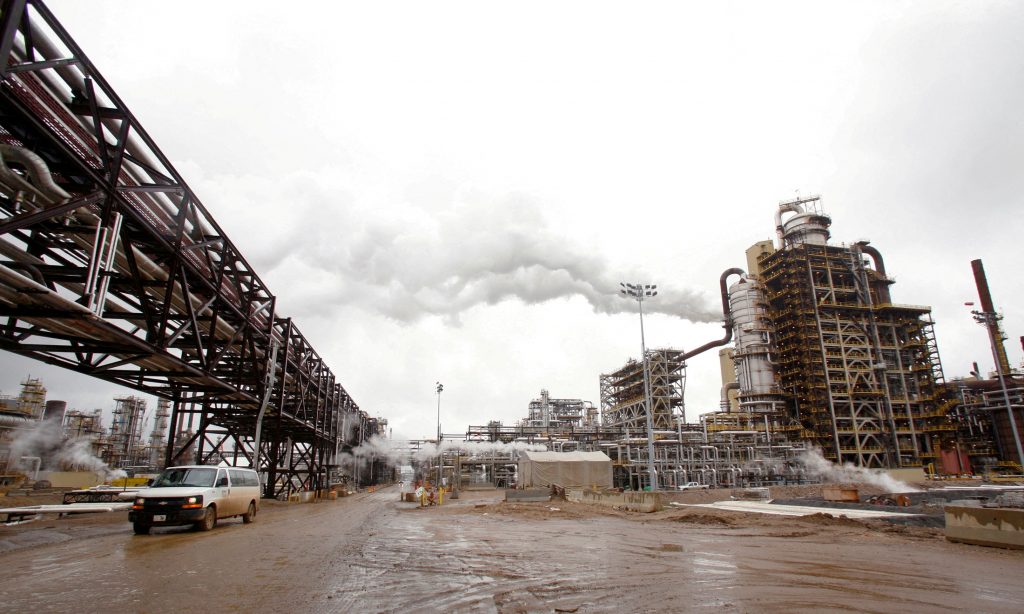



Alberta had 103,353 payroll employees in mining, quarrying and oil and gas extraction in September, 23 per cent fewer than in September 2014 even after a gain over the past year, a Canada News Media comparison of Statistics Canada payroll data released Thursday shows.
The count was up 3,061, or 3.1 per cent, from September 2025. That was faster than the 2.4 per cent increase across all Alberta industries. The sector did slip by 860 employees, or 0.8 per cent, from August.
Employees in the sector earned an average of $2,804.13 a week, including overtime. That was nearly double the Alberta all-industry average of $1,409.70. Their average weekly pay rose 4.1 per cent in a year, compared with 3.1 per cent for Alberta employees as a whole.
The longer view shows how much the national picture has shifted. Across Canada, the sector had 227,953 payroll employees in September, only 2.5 per cent fewer than in September 2014. Alberta was down 31,231, or 23.2 per cent, over the same span, while the combined total for the rest of the country rose by 25,407, or 25.6 per cent.
Alberta held 45.3 per cent of the country’s jobs in the sector this September, down from 57.6 per cent 12 years earlier.
The category covers more than oil and gas. It also takes in mining, quarrying and related support work, so the gains elsewhere cannot be read as oilpatch hiring.
Over the past year, Canada added 9,888 payroll employees in the sector, a 4.5 per cent increase. Among provinces with published figures, Ontario added the most, up 3,513, or 12.3 per cent. Alberta’s gain of 3,061 was next, ahead of Saskatchewan at 1,179 and Quebec at 1,098. British Columbia was nearly flat at 104.
Pay in the Alberta sector has also grown faster than the provincial average over 12 years. It rose 28.7 per cent from September 2014, compared with 22.1 per cent for all industries. Those figures are not adjusted for inflation, and our earlier analysis found that average Alberta weekly pay has fallen behind prices since 2019.
Statistics Canada also reported that job vacancies in Alberta, counting all industries, edged up by 4,500, or 6.4 per cent, in September. The province’s vacancy rate was 3.3 per cent, up 0.6 percentage points from a year earlier.
Hiring could get harder in the oilfield services business. Enserva, an industry trade group, said this week it expects about four per cent more wells to be drilled next year in British Columbia, Alberta and Saskatchewan, but warned that labour shortages could arise as early as next year, The Canadian Press reported.
The Alberta government has recently moved to draw new oilsands investment, including a plan that offers a two per cent royalty to new oil sands projects.
If you find reporting like this useful, consider supporting Canada News Media, an independently owned Canadian newsroom.
Sources: Statistics Canada, table 14-10-0223-01, seasonally adjusted, and The Daily, Nov. 26, 2026. Changes and shares are Canada News Media calculations for September of each year. The payroll survey counts employees, not the self-employed, and recent months can be revised.
Follow Canada News Media
Get the day's top Canadian stories and our two daily 60-second news videos wherever you scroll.
X Threads Facebook Instagram LinkedIn TikTok YouTube Pinterest Reddit Substack Flipboard Newsletter RSS