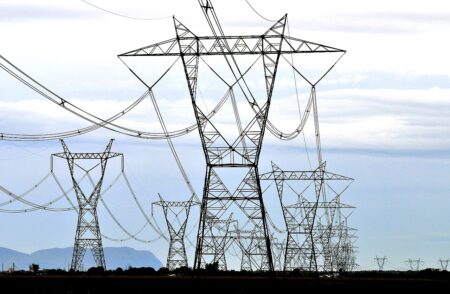



Canada traded about 21 per cent more electricity with the United States than its provinces moved among themselves in 2025, Statistics Canada figures show, a gap Energy Minister Tim Hodgson wants new east-west power lines to help change.
Exports to and imports from the U.S. totalled 57.4 terawatt-hours last year, compared with 47.5 terawatt-hours delivered from one province or territory to another, according to our calculation from the agency’s annual electricity supply and disposition table, released Oct. 16. One terawatt-hour is one million megawatt-hours.
Hodgson told an Electricity Canada conference in Ottawa on Wednesday that the country has separate grids, planned and run independently, that generally trade more with the U.S. than with one another, according to the prepared text of his speech.
The national gap is much wider without Newfoundland and Labrador, home of the Churchill Falls station that supplies Quebec. That province accounted for 24.7 terawatt-hours, or 52 per cent, of all interprovincial deliveries. Without its outgoing power, the other deliveries came to 22.8 terawatt-hours, and U.S. trade was about 2.5 times as large.
The picture changes province by province. Counting power in both directions, only three of the 10 provinces traded more with the U.S. than with the rest of Canada: British Columbia, at 16.8 terawatt-hours against 2.6; Manitoba, at 8.4 against 2.0; and Ontario, at 14.3 against 11.4.
Alberta went the other way. It traded 2.8 terawatt-hours with other provinces and 1.3 with the U.S. Even so, its interprovincial trade equalled only about three per cent of the 91.7 terawatt-hours it generated.
The direction of Alberta’s flows has also shifted. In 2021 it received 4.9 terawatt-hours from other provinces and delivered 1.4. Last year it delivered 2.4 and received 0.4.
Nationally, both kinds of trade have shrunk since 2021. Two-way U.S. trade fell 22 per cent from 73.4 terawatt-hours, while interprovincial deliveries dropped 17 per cent from 57.3 terawatt-hours. The figures measure how much power moved in a year, not how much the transmission lines could carry.
Hodgson said Ottawa will work with provinces, territories, utilities, regulators and Indigenous partners on new and expanded links between provinces. He said projects must show value for customers, split costs and benefits in a credible way and rest on durable agreements between the participating jurisdictions. Provinces and territories have primary responsibility for their electricity systems, he said.
The measures he listed include extending the clean technology and clean electricity investment tax credits to the end of 2040, widening the electricity credit to some high-voltage transmission within provinces and drawing on funding such as the Canada Infrastructure Bank’s $20-billion allocation for clean energy. Ottawa will also support cost-benefit analysis of proposed interties, he said.
The Nov. 4 federal budget included more than $50 billion for a national electricity strategy that aims to double grid capacity by 2050. Hodgson said that brings Ottawa’s total commitment over 15 years to $115 billion.
He also said electricity-hungry projects such as data centres must not raise costs for ratepayers. The growth of those projects is already a live issue in Alberta, where the government has introduced a bill to keep big data centres away from homes. On the price side, we reported last week that Alberta’s wholesale power price hit a nine-year low while the default household rate stayed at 12 cents a kilowatt-hour.
In Quebec, the largest receiver of power from other provinces, Hydro-Québec has warned of power deficits as early as 2029.
Sources: Statistics Canada, table 25-10-0021-01, 2025 data and earlier years. Our figures add U.S. exports and imports; interprovincial totals count each delivery between provinces and territories once, and each province’s figure adds its deliveries and receipts. Natural Resources Canada, prepared text of Hodgson’s speech, Nov. 25, 2026.
If you find reporting like this useful, consider supporting Canada News Media, an independently owned Canadian newsroom.
Follow Canada News Media
Get the day's top Canadian stories and our two daily 60-second news videos wherever you scroll.
X Threads Facebook Instagram LinkedIn TikTok YouTube Pinterest Reddit Substack Flipboard Newsletter RSS