

I must start by making a clarification, when I say that Mars is closer than ever, I’m not talking about the distance between the earth and the red planet and that can be measured in kilometers, miles, light seconds, and so on. Yes, the one that is constantly changing (after all we are talking about two bodies orbiting in space), sometimes getting closer and sometimes moving away. No, I’m talking about how close or far we can, as humanity, feel from Mars. And this February it is undoubted that we will be closer than ever.
The reason? In July of last year, there was a rapprochement between Earth and Mars, providing the most favorable circumstances for launches to be made to the red planet. And without a doubt the moment was well used, since there were no less than three missions: NASA’s Mars Perseverance, China’s Tianwen-1 and the United Arab Emirates’ ope Mars, launched respectively on July 30, 23 and 19 from last year.
Although there are obviously technological differences between the three ships, the distance to travel has been the same and, consequently, throughout this month of February Mars will be visited by the three missions, thus making the human presence on the red planet the largest, simultaneously, seen so far.
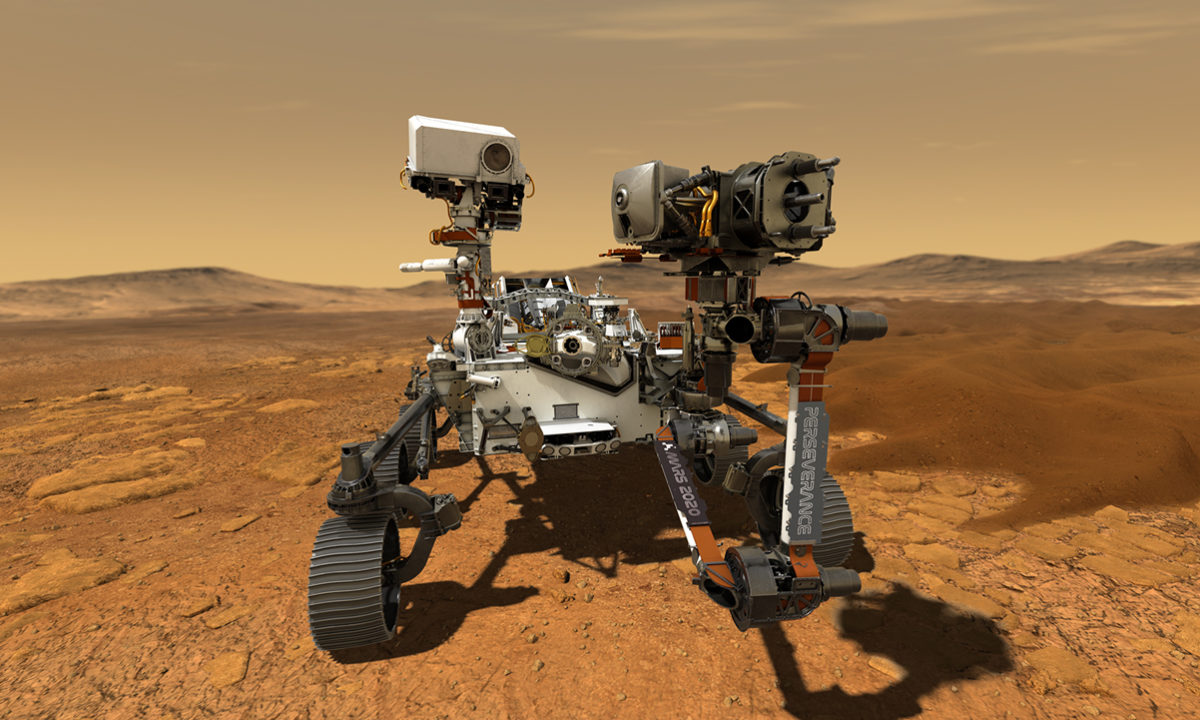
We have already been talking to you about Mars Perseverance these months. Its planned landing date is February 18, and for a few weeks now we have known part of what the approach, entry and contact procedure with the surface will be like. A critical phase of the mission in which the spacecraft will have to pass a speed of 19,300 kilometers per hour, at 0.83 meters per second (just over three kilometers / hour). Once on Mars, both the rover and the Ingenuity drone will begin gathering information on possible microscopic life remnants there.
The Tianwen-1, meanwhile, will reach the orbit of Mars also this month, although both its lander and the exploration vehicle that go on it will not be deployed until sometime in May. Like NASA’s mission, one of Tianwn-1’s high priorities is to find signs of life, both current and ancient, as well as to conduct an exploration of the planet’s surface conditions, materials and topography.
And regarding the Tianwen-1 of the United Arab Emirates, consists of an orbiter (This mission will not touch the surface of Mars) which, if the plans are fulfilled, will begin its orbital insertion on the next day 9. Unlike its mission companions, who will focus their activities on the surface, Hope Mars will focus its efforts on analyzing the atmosphere of the red planet, in order to try to answer questions like the cause of the climatic changes of Mars and the reason why oxygen and hydrogen are being lost, according to the measurements.
Thus, in July of last year Mars was very close, in distance, to Earth, and this February, although the distance has increased, science has placed us closer than ever. There are still many things that can go wrong, and if simply an altitude test can end in flames, what about something as complex as the critical phases of these three missions. And yet, only having reached the current point, it is already a success that should make us proud, and closer than ever to Mars.
With information from Wikipedia 1, 2, 3