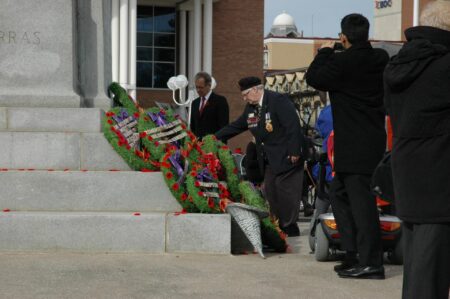




Ceremonies were held from Parliament Hill to Fort Edmonton Park to Iqaluit on Wednesday as Canadians marked the sixth annual National Day for Truth and Reconciliation, a day set aside to honour residential school survivors and the children who never made it home.
Why Sept. 30 matters
Between 1857 and 1996, more than 150,000 First Nations, Inuit and Métis children attended church-run, government-funded residential schools, according to The Canadian Press. The Truth and Reconciliation Commission documented about 3,200 deaths at the schools, though experts believe the true number is substantially higher. The commission’s 2015 final report concluded the system amounted to cultural genocide.
The national day exists because survivors asked for it. The commission’s Call to Action 80 urged the federal government to work with Indigenous Peoples to create a statutory holiday honouring survivors, their families and communities, and to ensure the history and legacy of residential schools remain part of public commemoration. Parliament answered with Bill C-5, which received royal assent on June 3, 2021, making Sept. 30 a federal statutory holiday. Whether it is also a provincial holiday still varies across the country.
The date was already known to many Canadians as Orange Shirt Day. The movement began with Phyllis (Jack) Webstad, who was six years old when she was sent to St. Joseph Mission Residential School near Williams Lake, B.C. Her grandmother had given her a new orange shirt for her first day, and it was taken from her at the school. Webstad shared her story at a St. Joseph Mission commemoration event in Williams Lake in May 2013, and the first Orange Shirt Day was held on Sept. 30 that year. The orange shirt has since become a national symbol of the message that every child matters.
Carney in Edmonton: “We owe them action”
Prime Minister Mark Carney spent the morning at Fort Edmonton Park, where he joined First Nations leaders, families and federal Conservative Leader Pierre Poilievre at a commemorative gathering, The Canadian Press reported.
“We owe Survivors more than remembrance. We owe them action,” Carney said, adding that the commission’s 94 Calls to Action “remain a roadmap for that work.” He said the federal government “established and sustained this system, and Canada bears responsibility for the profound and enduring harm it caused,” according to Global News.
“Reconciliation is a journey, not a destination. It’s an attitude, not an achievement,” Carney said, according to The Canadian Press.
Poilievre described the residential school system as a “massive intrusion of government coercion imposed on Indigenous families,” Global News reported.
Treaty 6 Grand Chief George Arcand Jr. told the gathering there can be no reconciliation without truth, a truth he said First Nations know can be difficult. Andrea Sandmaier, president of the Otipemisiwak Métis Government, urged people to confront residential school denialism: “Do not let misinformation and racism spread unchecked through our communities.”
Remembering the Children on Parliament Hill
In Ottawa, APTN, CBC/Radio-Canada and the National Centre for Truth and Reconciliation (NCTR), together with the Algonquin Nation, hosted Remembering the Children, a 90-minute multilingual gathering on the West Block lawn that was broadcast live nationally. The program featured reflections from survivors and Elders and performances by Tia Wood, Soleil Launière, Silla and Adrian Sutherland.
“Honouring these children means facing our history with unwavering honesty,” said Stephanie Scott, executive director of the NCTR.
Governor General Louise Arbour said: “We cannot change the past, but we can choose how we move forward.”
Gatherings, walks and sunrise ceremonies were also held in Toronto, Vancouver, Calgary and Iqaluit, as well as at universities, museums and community centres across the country.
Slow progress on the 94 Calls to Action
More than a decade after the commission issued its final report, progress remains slow. According to tracking by Indigenous Watchdog, cited by The Canadian Press, only 14 of the 94 Calls to Action have been completed. Another 41 are in progress, 24 are stalled and 15 have not been started.
Survivors and Indigenous leaders have long said the day must mean more than a day off. As Carney put it in Edmonton, Canadians should not “hear the truth of residential schools and fail to act on it.”
Support is available
The day and the coverage around it can bring up painful memories. Former residential school students and their families can call the 24-hour Indian Residential Schools Crisis Line at 1-866-925-4419 for emotional and crisis support. The Hope for Wellness Help Line (1-855-242-3310) is also available 24 hours a day to Indigenous people across Canada.
If you find reporting like this useful, consider supporting Canada News Media, an independent Canadian newsroom with no corporate parent.
Sources: The Canadian Press via CP24 and paNOW; Global News; Prime Minister’s Office; National Centre for Truth and Reconciliation; Canadian Heritage; Orange Shirt Society.
Follow Canada News Media
Get the day's top Canadian stories and our two daily 60-second news videos wherever you scroll.
X Threads Facebook Instagram LinkedIn TikTok YouTube Pinterest Reddit Substack Flipboard Newsletter RSS