

Alberta’s wholesale electricity price averaged about $11 a megawatt-hour over the 23 hours ending Monday afternoon, roughly 70 per cent below the grid operator’s 30-day average of $37.67, and fell to $0.00 for five of those hours, according to figures published by the Alberta Electric System Operator.
The Canada News Media calculation covers the hours ending 4 p.m. on Sunday, Nov. 15, through 2 p.m. on Monday, Nov. 16, taken from the AESO’s published hourly pool price report. The pool price is the wholesale price generators are paid for power sold into Alberta’s market. It is not what a household sees on a bill, which depends on the customer’s retail plan.
The price was $0.00 in the hour ending 4 p.m. Sunday and in each of the hours ending 2 a.m. through 5 a.m. Monday. It stayed under $2 in the hours ending 1 a.m. and 6 a.m., then climbed through the morning to $26.80 in the hour ending 2 p.m., the highest in the 23-hour window. Adding the 23 hourly prices and dividing by 23 gives an average of $11.01. The AESO’s own 30-day rolling average was $37.67 at the same point.
Demand moved in a narrow band. Alberta internal load, the grid operator’s measure of the electricity Albertans use, peaked at 11,356 megawatts in the hour ending 7 p.m. Sunday and bottomed out at 10,041 megawatts in the hour ending 4 a.m. Monday, according to the same report.
The AESO’s current supply and demand report, last updated at 2:53 p.m. Monday, shows where the power was coming from. Alberta generated 11,595 megawatts net while internal load was 10,973 megawatts. That 622-megawatt gap matches the report’s net actual interchange, which it splits into 404 megawatts with British Columbia, 218 with Montana and none with Saskatchewan.
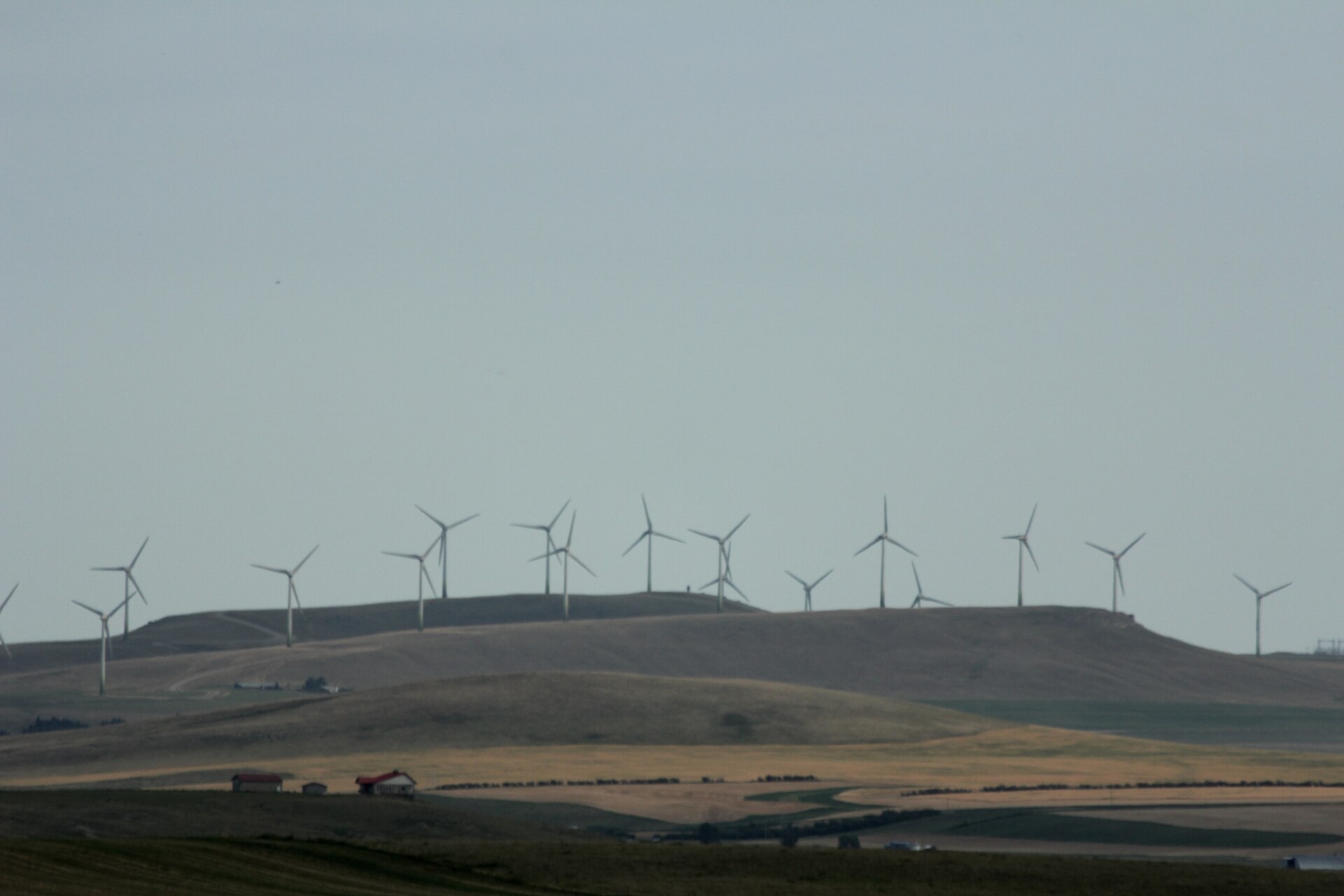
Natural gas supplied about 79 per cent of that generation. Cogeneration plants, many of them tied to oilsands and industrial sites, produced 5,144 megawatts, combined-cycle plants 3,195, gas-fired steam units 646 and simple-cycle peakers 163, for 9,148 megawatts in all. Wind produced 1,201 megawatts, about 10 per cent of the total, from 5,684 megawatts of maximum capability, or about 21 per cent. Solar produced 818 megawatts from 1,892 megawatts of capability, about 43 per cent. Hydro added 195 megawatts, other sources 233 and energy storage none.
The snapshot cannot say why prices were so low, and the AESO’s report does not give a cause. Prices at or near zero generally show that supply offered into the market exceeded what was needed at that hour. A single day also says little about the month: the 30-day average of $37.67 includes higher-priced stretches earlier in the period.
The figures come as Alberta weighs how much new generation the grid should carry. As Canada News Media reported on Oct. 19, the AESO has proposed limiting data centre grid hookups to gas power, and Artificial Intelligence Minister Evan Solomon has said Ottawa is not responsible for AI data centre power. On the oil side, Alberta unveiled a 10-year royalty program for new oilsands projects on Friday, and the heavy-oil discount has been wide, as we reported when the WCS discount topped US$31.
Method: pool prices and Alberta internal load come from the AESO’s hourly Pool Price Report, and generation, capability and interchange figures from its Current Supply Demand Report, both at ets.aeso.ca. The percentages are Canada News Media’s own calculations from those figures.
If you find reporting like this useful, consider supporting Canada News Media, an independently owned Canadian newsroom.
Follow Canada News Media
Get the day's top Canadian stories and our two daily 60-second news videos wherever you scroll.
X Threads Facebook Instagram LinkedIn TikTok YouTube Pinterest Reddit Substack Flipboard Newsletter RSS