
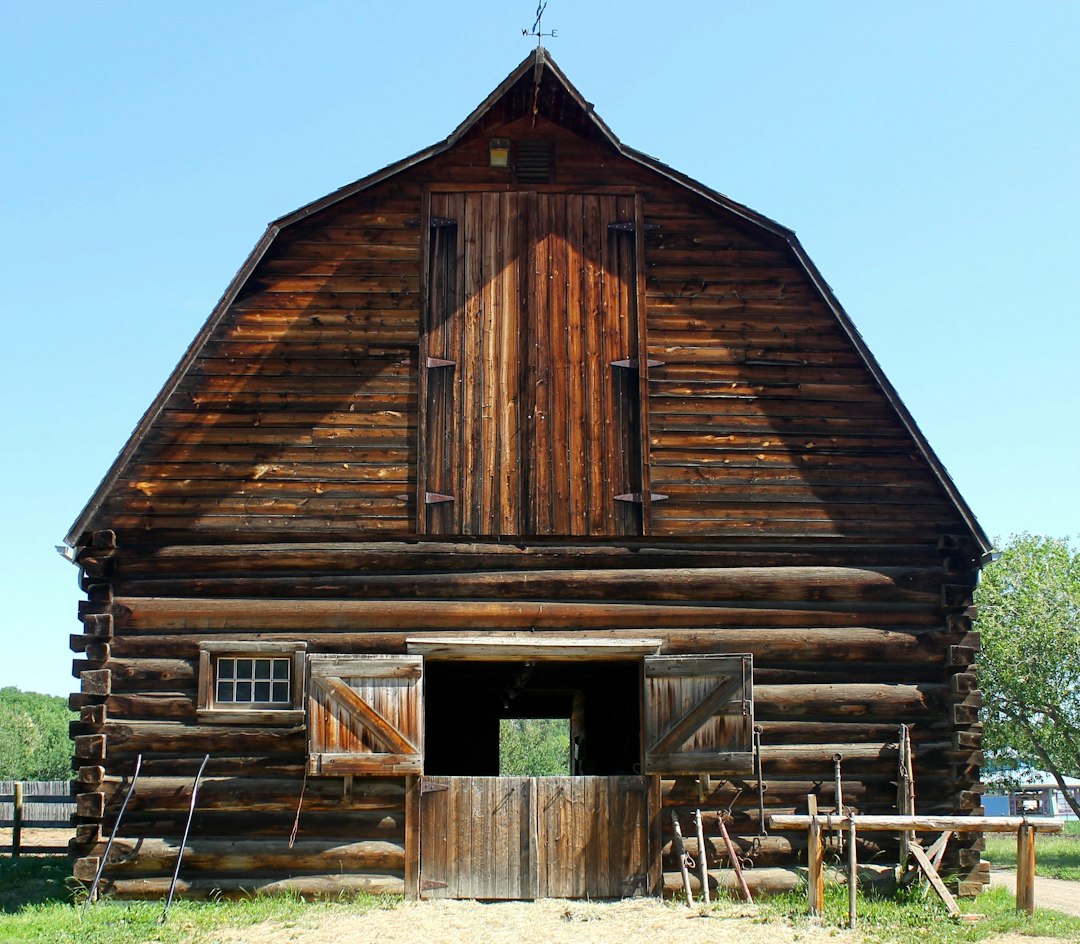
File photo of a log barn, not a photo of Amber Valley. Photo: Darin Wicentowich/Unsplash.
Amber Valley, Alta., about 170 kilometres north of Edmonton and 24 kilometres east of Athabasca, was founded in 1910 by African American families from Oklahoma, Texas and nearby states, according to The Canadian Encyclopedia. It was the northernmost of several Black farming settlements in Alberta, and by the account of Library and Archives Canada it became the largest and most resilient of them.
The encyclopedia says roughly 1,000 African American men, women and children came north to Canada between 1909 and 1911, seeking land and a life away from Jim Crow laws and racial violence. About 300 of them had settled in the Amber Valley area by 1910. The Royal Alberta Museum records that the migration was drawn by Ottawa’s “Last Best West” campaign, and that the government later responded with what the museum calls a disinformation campaign aimed at prospective Black American settlers. That response is part of the background to the cabinet order examined in our earlier report on the 1911 proposal to ban Black immigration.
Library and Archives Canada says the 1911 gathering of settlers at the site, a hamlet near a U-shaped bend in the Athabasca River, followed the leadership of clergyman and Freemason Parson H. Sneed, and that the Masonic network had spread word of Canada among Black Americans. The Canadian Encyclopedia adds that Sneed first came to Alberta in 1905 to survey land, then returned to Oklahoma to promote it. The founding families included the Bowen, Sneed, Murphy and Edwards families.
One settler family explained its reasons in writing. The museum quotes Willa Dallard, daughter of Willis Bowen, writing that the family moved to Canada in the summer of 1909 to live where “every man was accepted on his merit or demerit, regardless of race, colour or creed.” The Bowens first lived in Vancouver, where Willis chartered a railway car for five families and a couple of bachelors, according to the museum, before reaching Amber Valley in 1912.
The early years were hard. Library and Archives Canada says repeated crop failures forced settlers to rely on wild plants and animals, yet more than three-quarters of them stayed long enough to receive patents for their homesteads. The community then built the institutions that made it a town in all but name. The archives say a school began in 1913 and a nondenominational church in 1914, and that the Amber Valley picnic was an established and popular event after 1915. The Canadian Encyclopedia says the school, named for Nimrod Toles, taught up to Grade 8 and doubled as a space for church services and other gatherings.
Sport became part of the community’s identity. The encyclopedia says J.D. Edwards founded the Amber Valley baseball team in 1926, with his son Kenny as pitcher, and that the team played Lac La Biche each year around Canada Day. Library and Archives Canada says the team eventually became known throughout the north. Edwards, who came from Oklahoma in 1910 at age 21 with his wife, Martha, raised 10 children and died in 1979 at 90, according to the encyclopedia.
Pine Creek, as the settlement was first called, took the name Amber Valley in 1931, when it got its own post office. The Royal Alberta Museum says Willis Bowen was appointed first postmaster on Sept. 5, 1931. Sources differ on who held the first postal permit granted to a Black man in Alberta: the encyclopedia credits Bowen, while the museum credits Samuel Carothers of nearby Donatville, and both attribute the claim to the same historian, Myrna Wisdom.
Decline followed through the mid-20th century. The Canadian Encyclopedia says the school closed in the 1950s and was later demolished, and the post office closed in the fall of 1968. Library and Archives Canada says the settlement remained a major Black community in Alberta until the 1930s. Today it is no longer an active community, the encyclopedia says, though a community hall with a small museum remains.
Some of its buildings carried the story forward. Obadiah Bowen, Willis’s son and a pastor, replaced the family’s log cabin with a house in 1938, and the Province of Alberta recognized that house, known as Obadiah Place, as a historic site in 1999. The Royal Alberta Museum reports it was destroyed by fire on Dec. 29, 2020, and that its phone booth survives in the museum’s collection. Canada Post marked the settlement with a stamp for Black History Month in 2021, according to the encyclopedia.
Amber Valley sits alongside earlier Black communities in Canada’s story of self-built settlement, among them the Buxton Settlement in Southwestern Ontario and Josiah Henson’s Dawn school. Its record is one of achievement under pressure: families farmed the land, proved up their claims and built a community that Library and Archives Canada calls the largest and most resilient Black settlement in Alberta.
If you find reporting like this useful, consider supporting Canada News Media, an independent Canadian newsroom with no corporate parent.
Follow Canada News Media
Get the day's top Canadian stories and our two daily 60-second news videos wherever you scroll.
X Threads Facebook Instagram LinkedIn TikTok YouTube Pinterest Reddit Substack Flipboard Newsletter RSS