


Canada tariffs are in force in both directions as of Nov. 4, 2026. The U.S. charges 50 per cent on a list of Canadian goods under Section 338, plus separate sector tariffs, while Canada’s Department of Finance applies surtaxes of 15, 25 or 50 per cent on certain U.S.-made goods. No trade deal has been signed.
Updated Nov. 4, 2026. Both lists have changed several times since August, so every rate here is dated. This page will be revised when Ottawa or Washington changes a measure.
The tariffs are targeted rather than universal. The Bank of Canada said in October that trade between the two countries “remains mostly tariff-free.” Whether a product is caught depends on its tariff classification and where it was made. This page is general information, not legal or customs advice. For a specific product, check with the Canada Border Services Agency (CBSA) or a customs broker.
What are the key facts on Canada-U.S. tariffs?
| Measure (as of Nov. 4, 2026) | Rate | In effect since |
|---|---|---|
| U.S. Section 338 list of Canadian goods | 50 per cent, even if CUSMA-compliant | Aug. 22, 2026; list changed Sept. 15 and Oct. 30 |
| U.S. import bans (most alcohol, whey protein, molasses, motorcycles and others) | Banned | Sept. 29, 2026 |
| U.S. Section 232 steel, aluminum, copper | 50 per cent on metal articles; 10 to 25 per cent on many derivative goods | April 6, 2026; revised June 8 |
| U.S. Section 232 autos, trucks and parts | 25 per cent; CUSMA-qualifying cars and light trucks pay only on non-U.S. content | April 3, 2025 |
| U.S. softwood lumber | 10 per cent Section 232, plus company-specific anti-dumping and countervailing duties | Oct. 14, 2025 for the 10 per cent |
| U.S. Section 301 forced-labour tariff | 10 per cent; CUSMA-compliant goods exempt | July 24, 2026 |
| Canada’s United States Surtax Order (2026) | 15, 25 or 50 per cent on listed U.S. goods worth $27.6 billion in imports | Sept. 8, 2026 |
| Canada’s surtax on U.S. autos | 25 per cent on non-CUSMA vehicles and on the non-Canadian, non-Mexican content of CUSMA vehicles | April 9, 2025 |
What does the U.S. charge on Canadian goods right now?
The broadest U.S. measure is Section 338 of the Tariff Act of 1930. President Donald Trump signed three proclamations on July 20, each setting an extra 50 per cent duty on a set of Canadian goods, tied to Washington’s complaints about Canada’s auto, alcohol and dairy policies. After a brief suspension, the duties applied from Aug. 22, according to U.S. Customs and Border Protection (CBP). Finance Canada valued the goods hit at $27.6 billion.
CUSMA does not shelter these goods. The White House said the tariffs apply whether or not a product originates under the trade agreement, and that they apply on top of Section 232 tariffs. The original July order excluded goods already under Section 232, but CBP says that since Sept. 15 only goods on the dairy list can claim that carve-out. Energy, potash, fish and critical minerals were among the exclusions in the July fact sheet.
On Sept. 8 the White House also announced import bans that began Sept. 29. The Canadian Federation of Independent Business (CFIB) lists the banned goods as motorcycles, whey protein, molasses, non-alcoholic beer and most alcoholic beverages.
Sector tariffs under Section 232 sit alongside that list. CBP guidance from June sets 50 per cent on articles of steel, aluminum and copper, with lower rates for many derivative goods. CUSMA-eligible derivative steel articles pay 25 per cent on their non-U.S. content.
Vehicles and parts pay 25 per cent. A CUSMA-qualifying car or light truck pays that rate only on its non-U.S. content. The April 2025 order left CUSMA-qualifying parts out until Washington set up a way to tax their non-U.S. content, and a parts importer should confirm the current treatment with a broker. The law firm Osler also lists 25 per cent on upholstered furniture, kitchen cabinets and vanities, 25 per cent on certain semiconductors and 10 per cent on buses.
Softwood lumber has the most layers. It pays the 10 per cent Section 232 tariff plus anti-dumping and countervailing duties. Global Affairs Canada reports that the U.S. Commerce Department’s Oct. 14 final review results set combined duties of 24.75 per cent for most companies, 31.11 per cent for Canfor, 25.55 per cent for Resolute and 20.02 per cent for West Fraser. Those rates were published in the Federal Register on Oct. 19. For most companies that means 34.75 per cent in total.
A separate 10 per cent Section 301 tariff, citing forced labour in supply chains, has applied since July 24 to Canadian goods that do not comply with CUSMA, The Canadian Press reported. It replaced an expiring 10 per cent global duty that followed the U.S. Supreme Court’s February ruling against Trump’s earlier tariffs.
Small sellers should also note that the U.S. no longer waives duty on low-value parcels. CFIB says goods valued at US$800 or less have been subject to all applicable duties since Aug. 29, 2025.
What changed on Oct. 30, 2026?
The U.S. took 22 tariff classifications off the 50 per cent list and added 100, CBP said, for goods entered on or after 12:01 a.m. ET on Oct. 30. The White House said the removals include plywood sheets, some paper products, certain machinery and refrigeration equipment, and certain packing crates and boxes. Additions include certain valves, carpets and waste products. The trade-services firm Flexport also named cocoa powder, paints, MDF wood, air conditioners and canoes among the additions.
Some goods now pay twice. Flexport’s example is chest freezers, which paid only Section 232 steel duties before Oct. 30 and now also pay Section 338 duties. Our report on the 100 lines added and 22 dropped goes through the annex, and our Oct. 23 story has the announcement. CBP takes questions on Section 338 entries at [email protected].
What do Canada’s Sept. 8 counter-tariffs cover?
Canada’s surtaxes took effect at 12:01 a.m. on Sept. 8 under CBSA Customs Notice 26-23, which was last updated Oct. 23. Each rate generally matches the corresponding U.S. rate. Only goods eligible to be marked as U.S. goods are caught, and goods already in transit to Canada on Sept. 8 were exempt.
We counted the tariff lines on Finance Canada’s complete list, dated Aug. 26, on Nov. 3. The table holds 648 lines. Of the 413 lines at 50 per cent, 245 are iron and steel in chapters 72 and 73. This differs from the 629 lines reported elsewhere, including by The Hub, and we could not explain the gap. The product examples below come from the list and from a summary by the law firm Blakes.
| Surtax rate | Lines on list (our count) | Examples, if U.S.-made |
|---|---|---|
| 50 per cent (surtax code 26186C) | 413 | Steel and aluminum products, cotton T-shirts, trousers, wooden bedroom furniture, lip and eye make-up, smartphones, video game consoles, golf clubs |
| 25 per cent (surtax code 26186B) | 214 | Cheese, toilet paper, household refrigerators, wooden kitchen furniture, softwood lumber, carpets |
| 15 per cent (surtax code 26186A) | 21 | Fork-lift trucks, industrial robots, moulds, certain mowers, air conditioners |
The list moved before it took effect. Fish and seafood were on the first version and dropped on Aug. 26, as we reported when the tariffs began. The current list has no chapter 3 fish lines, although a federal Innovation department release in September still named fish and seafood at 25 per cent. Our September story on clothing and furniture explains the 50 per cent tier.
Older measures continue. Finance Canada said existing counter-tariffs, including those on U.S. autos, still apply, and that steel and aluminum rates rose from 25 to 50 per cent. A good caught by both this order and the Steel Derivative Goods Surtax Order pays only this order’s surtax, the CBSA said.
What do you pay on an order from the U.S.?
You pay the surtax if the item is on the list and is a U.S. good, even on a small order. The CBSA notice says the surtax applies to casual goods and to shipments under the low-value thresholds. That matters because the usual courier rules say goods from the U.S. up to $40 pay no duty or tax, and goods above $40 to $150 pay tax but no duty. Mail has a lower $20 line. The surtax comes on top of those rules.
Origin decides it, not the store’s address. A list item shipped from a third country is still caught if it is marked as a U.S. good. An item made elsewhere and bought from a U.S. store is not a U.S. good under this test, although ordinary duty rules may apply. When you carry goods home, anything within your personal exemption is free of the surtax, and anything above or outside it is not, the CBSA said.
Here is a worked example, for illustration only. You live in Alberta and have a U.S.-made jacket delivered by courier, valued for duty at C$200, with no regular customs duty. The surtax is the rate times the value for duty, and the 5 per cent GST is charged on the value plus the surtax. This follows the CBSA’s published method. The price is invented, and the 15 and 25 per cent rows simply show how the math changes. Clothing is at 50 per cent.
| Surtax rate | Surtax | GST | Added at the border | Total with item |
|---|---|---|---|---|
| None | $0 | $10.00 | $10.00 | $210.00 |
| 15 per cent | $30.00 | $11.50 | $41.50 | $241.50 |
| 25 per cent | $50.00 | $12.50 | $62.50 | $262.50 |
| 50 per cent | $100.00 | $15.00 | $115.00 | $315.00 |
So the 50 per cent surtax adds $105 to the tax-only cost. Where HST applies, the tax line is higher, and a courier may add a brokerage fee. The CBSA’s own examples on a $150 good show $46.88 in surtax and GST at 25 per cent, and $86.25 at 50 per cent. For more on shopping rules, see our Black Friday guide.
How are tariffs affecting prices in Canada?
We found no official figure for how much the counter-tariffs add to shelf prices. The surtax is accounted for by the importer at the Canadian border, and how much reaches shoppers depends on each seller. U.S. duties, in turn, are collected from the importer at the American border.
The Bank of Canada’s Oct. 28 rate statement said inflation has been around 3 per cent since April and should reach about 3.5 per cent by year-end. The bank tied its concern mainly to energy prices. Inflation excluding gasoline was 2.2 per cent in September, it said, and new U.S. tariffs are expected to slow growth in the fourth quarter. The bank raised its policy rate to 2.5 per cent that day.
What help is there for workers?
Federal regulations published Oct. 7 renewed temporary Employment Insurance measures. They are not limited to tariff layoffs. The government’s analysis describes them as sector-agnostic. Service Canada handles claims.
| EI measure | Benefit periods that start |
|---|---|
| No one-week waiting period | Oct. 11, 2026 to Oct. 9, 2027 |
| Severance and similar separation money not counted as earnings | Oct. 11, 2026 to Oct. 9, 2027 |
| 20 extra weeks for long-tenured workers, up to 65 weeks in total | Oct. 11, 2026 to June 12, 2027 |
| Only the most recent job separation is examined, if it was through no fault of the worker | Oct. 11, 2026 to Oct. 9, 2027 |
A long-tenured worker is someone who received fewer than 36 weeks of regular benefits in the prior 156 weeks and paid at least 30 per cent of the maximum annual premium in seven of the past 10 years. These Gazette dates differ from the Oct. 10, 2027, and May 10, 2027, dates in law-firm summaries and in our October report, which was written before we had read the regulations and has since been corrected. The Gazette text is the one to use.
Ottawa also announced a Workforce Retention and Retraining Program to help employers keep staff. The law firm Siskinds said it combines Work-Sharing and the Worker Retention Grant, with up to $1,000 per participant for training and administrative costs. Siskinds said in August that rollout details had not been announced, and we did not find them published.
How can a business apply for relief?
A Canadian-registered company can ask for the surtax to be waived through Finance Canada’s remission process. There is no form and no stated deadline. You email one request to [email protected] with “U.S. Remission” in the subject line, including your 15-digit business number, eight-digit tariff items, annual import volumes and values, and evidence that you cannot source the goods from Canadian or non-U.S. suppliers.
Finance calls remission an exception. It considers inputs that cannot be sourced domestically or reasonably from outside the U.S., and other exceptional cases with severe adverse effects on the economy. Approval needs an order in council. The Hub reported more than 1,800 requests since March 2025, and that about one in three of the listed lines appears in a remission order.
Some relief needs no application of its own. The law firm Bennett Jones said general remissions run until June 30, 2027, for goods used by health-care, public safety and national security bodies, for steel used in auto and aerospace manufacturing, and for goods used in Canadian manufacturing, processing, food and beverage packaging and agricultural production. We did not find that date on Finance’s process page, so confirm it with the CBSA or a broker. The CBSA also lists duties relief and drawback programs for re-exported goods.
The surtax itself cannot be appealed under the Customs Act, the CBSA said, though a re-determination can be challenged within 90 days. The agency’s Border Information Service is at 1-800-461-9999.
For money rather than relief, the $7.5-billion package from Aug. 25 includes $1.5 billion more for the Regional Tariff Response Initiative, through regional development agencies, and a $500-million liquidity stream at the Business Development Bank of Canada, whose tariff programs now have a $1-million minimum revenue requirement. It also includes a $2-billion Canada Strong Diversification Fund and $3.5 billion for workers and employers. Finance’s general line is 1-833-712-2292.
What is coming next?
The next dated threat concerns autos and steel. Trump wrote on Truth Social on Aug. 24 that tariffs on Canadian cars, trucks, auto parts and steel would rise to 50 per cent on Jan. 1, 2027, Fox Business reported. We found no proclamation carrying that out as of Nov. 3, and steel is already at 50 per cent on many products. Global Affairs Canada also lists Jan. 1, 2027, as the delayed date for an increase on upholstered furniture, kitchen cabinets and vanities.
Talks have restarted. Prime Minister Mark Carney said on Nov. 3 in Antigua that the U.S. is “asking less” and “offering more,” but “we’re not quite there,” CBC reported. Trump told Fox News the same day that a deal was near. CBC said autos are expected to be a sticking point and Carney plans to meet Trump at the APEC summit in China this month. The Canadian Press reported Trump also tied the Keystone XL pipeline to the talks. Earlier coverage is in our stories on a possible steel and auto deal and on U.S. Trade Representative Jamieson Greer’s comments on zero tariffs.
CUSMA itself stays in force. The U.S. declined to renew it at the July 1 review, which moves the deal to annual reviews, and it runs until 2036 unless extended. Dominic LeBlanc, the minister responsible for Canada-U.S. trade, said in July that he had no answer on how those reviews would work.
Two other tracks could change U.S. rates. A U.S. food importer sued on Oct. 20 at the Court of International Trade to strike down the Section 338 duties, and we found no ruling. And NBC projected on Nov. 3 that Democrats will win the U.S. House, a call The Associated Press had not made at our last check early Nov. 4. The AP and NBC both reported that Democrats won control of the Senate. A new House sits Jan. 3, and any tariff bill would still need the president’s signature.
How did the tariffs get here? A short timeline
| Date | What happened |
|---|---|
| April 3, 2025 | U.S. Section 232 tariff of 25 per cent on autos begins |
| April 9, 2025 | Canada’s 25 per cent surtax on U.S. vehicles begins |
| Sept. 1, 2025 | Canada removes its 25 per cent counter-tariffs on other goods, keeping those on steel, aluminum and autos |
| February 2026 | U.S. Supreme Court strikes down the tariff tool behind Trump’s earlier duties |
| April 6 and June 8, 2026 | U.S. resets its metals tariffs |
| July 1, 2026 | U.S. declines to renew CUSMA; annual reviews follow |
| July 20, 2026 | Trump signs three Section 338 proclamations |
| July 24, 2026 | U.S. 10 per cent forced-labour tariff on non-CUSMA goods begins |
| Aug. 22, 2026 | U.S. 50 per cent Section 338 duties take effect |
| Aug. 24, 2026 | Trump threatens 50 per cent on autos and steel for Jan. 1, 2027 |
| Aug. 25 and 26, 2026 | Canada announces its counter-tariffs, then revises the list |
| Sept. 8, 2026 | Canada’s surtaxes take effect; U.S. announces import bans |
| Sept. 15 and 29, 2026 | U.S. list changes begin, then bans begin |
| Oct. 11, 2026 | Renewed EI measures begin |
| Oct. 20, 2026 | First court challenge to Section 338 filed |
| Oct. 30, 2026 | U.S. drops 22 lines and adds 100 |
| Nov. 3, 2026 | Carney says talks have progressed but are not finished |
Our explainer on the 1930s law behind Section 338 has more background, though it predates later changes.
What don’t we know yet?
As of Nov. 4, no deal text or signing date has been released, and we do not know whether the January auto and steel threat will be carried out, what a deal would do to either side’s tariffs, or when the court will rule. No official estimate of the price effect on Canadian shoppers turned up in our search, and the official line count of Canada’s list remains unclear.
Frequently asked questions
What are the Canada tariffs right now?
As of Nov. 4, 2026, the U.S. charges 50 per cent on a list of Canadian goods under Section 338, plus sector tariffs on metals, autos and lumber. Canada charges surtaxes of 15, 25 or 50 per cent on listed U.S. goods, plus 25 per cent on certain U.S. autos.
Do I pay the Canadian surtax on a U.S. order under $150?
Yes, if the item is on Finance Canada’s list and is a U.S. good. The CBSA said the surtax applies to shipments under the low-value thresholds, even where regular duty and tax would be waived.
Does the surtax apply to something made in China and sold by a U.S. store?
Not as a rule. The CBSA said the surtax applies only to goods eligible to be marked as U.S. goods. Other duties may still apply, so check the item’s origin and classification.
Does CUSMA protect Canadian goods from U.S. tariffs?
Only in part. CUSMA-compliant goods are exempt from the 10 per cent Section 301 tariff, but the White House said the 50 per cent Section 338 tariffs apply regardless of CUSMA origin.
Will U.S. auto tariffs on Canada rise to 50 per cent in January 2027?
Trump said on Aug. 24 that they would on Jan. 1, 2027. We found no proclamation carrying that out as of Nov. 3, 2026, and talks are continuing.
Can a business get the surtax waived?
Possibly. A company registered in Canada can email a request to Finance Canada at [email protected]. Finance treats relief as an exception, mainly for inputs that cannot reasonably be sourced outside the U.S.
When do the tariff-related EI measures end?
The waiting-period waiver and the severance rule cover benefit periods that start up to Oct. 9, 2027. The 20 extra weeks for long-tenured workers cover benefit periods that start up to June 12, 2027, according to the Canada Gazette.
If you find reporting like this useful, consider supporting Canada News Media, an independent Canadian newsroom with no corporate parent.
Sources: CBSA Customs Notice 26-23; Finance Canada product list and archived counter-tariff page; SOR/2026-203, Canada Gazette; CBP CSMS 70314289; White House fact sheets of July, September and October; Global Affairs Canada; Bank of Canada; CFIB; Osler, Blakes, Bennett Jones, Siskinds, Flexport, The Hub, CBC, Fox Business, National Observer and The Canadian Press, as linked above. All rates as of Nov. 4, 2026.
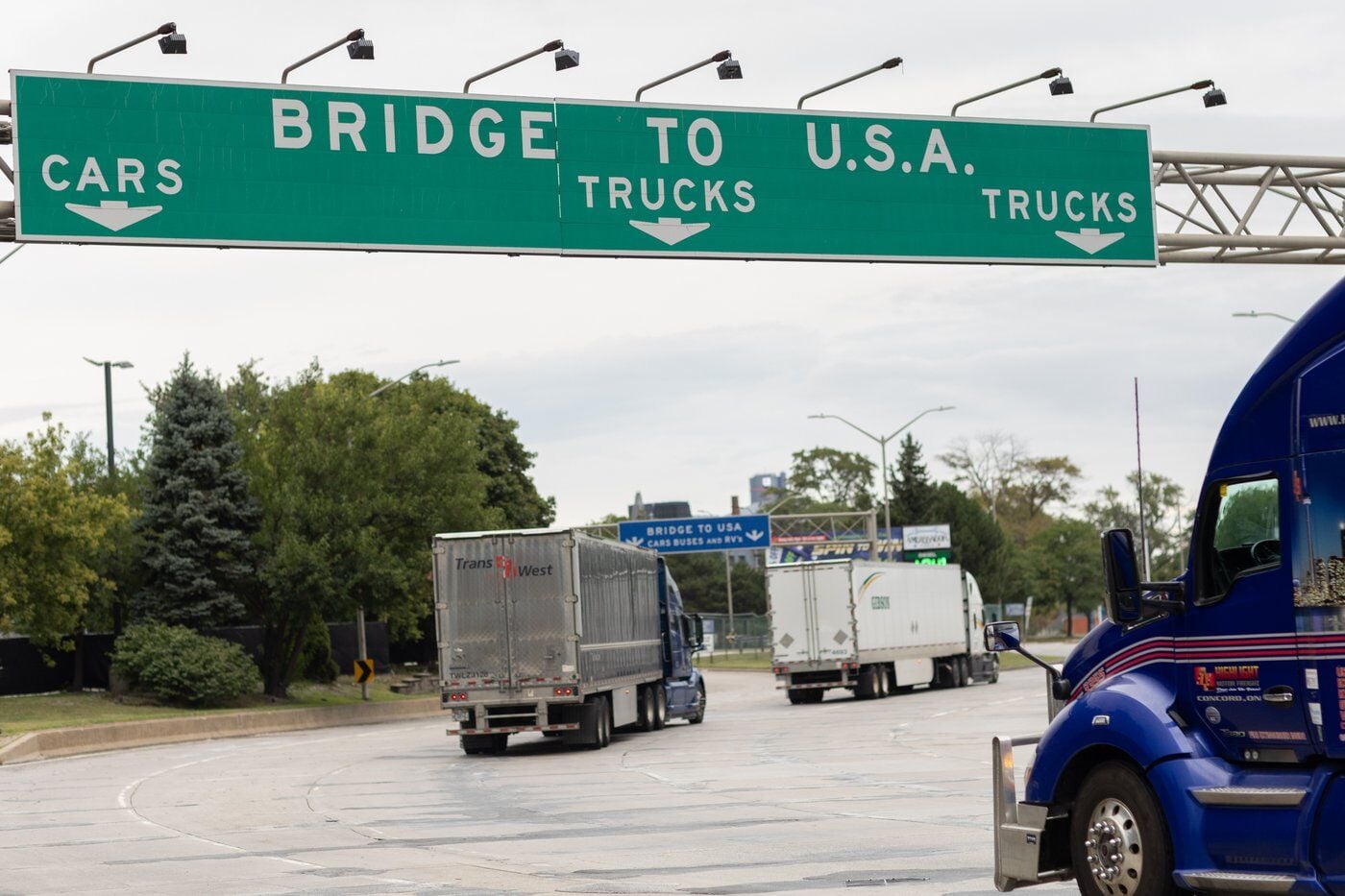
Photo: Transport trucks cross the Ambassador Bridge into the United States of America, in Windsor, Ont., Saturday, Aug. 22, 2026. THE CANADIAN PRESS/Dax Melmer
Follow Canada News Media
Get the day's top Canadian stories and our two daily 60-second news videos wherever you scroll.
X Threads Facebook Instagram LinkedIn TikTok YouTube Pinterest Reddit Substack Flipboard Newsletter RSS