



Italian inflation jumped to 5.4 per cent in October from 4.2 per cent in September, Italy’s statistics agency Istat said Friday, as France reported a shrinking economy and Fitch Ratings moved its outlook on France’s debt to negative.
The readings point to what some economists call stagflation in parts of the euro zone, and they raise the odds that the European Central Bank (ECB) will raise interest rates again in December.
Istat said the increase was driven mainly by higher energy, food and transport prices, according to Euronews. The figure was well above the 4.6 per cent economists had expected. Energy prices rose 31.4 per cent from a year earlier, and regulated energy prices rose 59.5 per cent, Euronews reported.
Spain’s inflation held at 4.9 per cent. Germany’s fell to 2.8 per cent from 3.3 per cent, helped by a fuel tax cut that runs from Oct. 1 to the end of the year. The ECB’s target is two per cent.
In France, inflation rose to 3.4 per cent from 3.1 per cent, the highest since January 2024, the national statistics office Insee said. Insee also reported that the economy shrank 0.1 per cent in the third quarter, after stagnating in the second quarter and falling 0.2 per cent in the first.
Economy and Finance Minister Roland Lescure told Franceinfo the economy is “at a standstill” and that the country “will hit the wall” if the government’s budget is not adopted. Jérémie Peloso of BCA Research said France is “highly likely to experience a technical recession over the coming quarters.”
Late Friday, Fitch kept France’s rating at A+ but changed the outlook to negative from stable. The agency cited weaker growth, higher borrowing costs and a larger deficit than when it last assessed France in August, as well as “the persistence of political fragmentation” and “a difficult social climate.” Fitch’s rating action said it expects the budget to pass using constitutional mechanisms despite the lack of a parliamentary majority.
Lescure said the decision confirms the need to adopt a budget by the end of the year that cuts the deficit to 5 per cent. He said the government is determined to stay on a path of fiscal consolidation. The government has not ruled out using Article 49.3, which lets it pass a bill without a vote unless a no-confidence motion succeeds. As of Friday, France’s 10-year bond yield was 4.9 per cent, Euronews reported, as we covered when yields topped 4.8 per cent earlier this month.
The ECB held its deposit rate at 2.5 per cent on Thursday after a rate hike in September. President Christine Lagarde said policymakers discussed another increase but agreed unanimously to wait, and that she will step down in February. Euro-zone inflation reached a three-year high of 3.8 per cent in September. Pantheon Macroeconomics raised its October forecast to four per cent.
Matthew Ryan of Ebury said a December hike is “very much ‘live’.” Oxford Economics expects two more increases. Eurozone growth in the third quarter was 0.4 per cent, but Euronews noted that Ireland’s 5.5 per cent expansion skewed the figure and growth was 0.2 per cent without it. Bert Colijn of ING said higher gas prices mean Europe “will see an additional growth challenge” this winter.
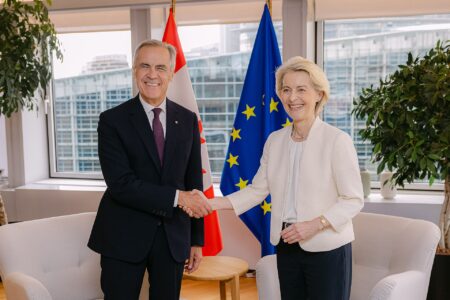
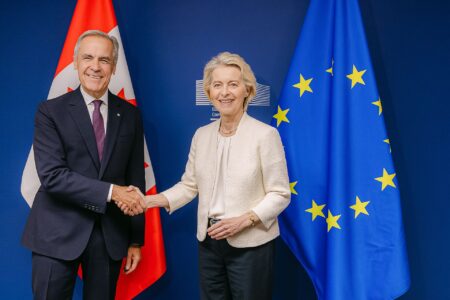
Energy costs are a common thread. Canada News Media has reported on oil prices near US$116 a barrel amid fears over the Strait of Hormuz. Canada is also seeking closer ties with the bloc, with Prime Minister Mark Carney targeting a deal on EU associate membership.
The ECB’s next rate decision is in December. France’s government faces a year-end deadline for its 2027 budget.
If you find reporting like this useful, consider supporting Canada News Media, an independent Canadian newsroom with no corporate parent.
Via Euronews, Insee, Istat and Fitch Ratings.
Follow Canada News Media
Get the day's top Canadian stories and our two daily 60-second news videos wherever you scroll.
X Threads Facebook Instagram LinkedIn TikTok YouTube Pinterest Reddit Substack Flipboard Newsletter RSS