

A grading complaint filed by six Caribbean students at Sir George Williams University in Montreal grew into a 13-day occupation of the school’s computer centre that ended in a fire and 97 arrests on Feb. 11, 1969, in one of the largest student protests in Canadian history.
The dispute began in the spring of 1968, when six West Indian students accused a biology professor of grading them unfairly because of their race, according to CBC reporting and the university’s archival record. The students wanted the complaint heard by a body they could trust. Rodney John, one of the people involved at the time, wrote in a CBC essay marking the 50th anniversary that the complainants never received a hearing before an impartial body.
The university did set up a committee, and hearings were held in the Hall Building auditorium. By late January 1969 the students had walked out of them. Most accounts date the occupation to Jan. 29, 1969, when the six complainants and several hundred supporters took over the computer centre on the building’s ninth floor. John’s essay gives Jan. 27 as the start, one of several small differences between accounts of the same events. CBC reported that the sit-in lasted 13 days, ending on Feb. 11.
The students were not all Black, and not all were from the Caribbean. CBC’s reporting, citing Concordia University Archives, noted that more than half of the 97 people eventually arrested were white. That detail matters because the protest has often been remembered as a Black student action alone. It is better understood as a coalition that formed around a complaint of racism that the Black students at its centre felt the institution would not take seriously.
Negotiations reached an agreement in principle on Feb. 10, CBC reported. The deal would have ended the occupation in exchange for a new committee to hear the complaint. Some students left on the strength of it, but fewer than 100 remained when talks fell apart. The next day riot police entered the computer centre. A fire broke out during the confrontation. Accounts differ on how it started, and the university and the students have long given different versions of that day.
Damage was estimated at $2 million in 1969 dollars, according to Concordia University Archives, as cited by CBC. Those arrested faced a large number of charges. John wrote in his essay that some people received prison sentences ranging from two weeks to three years, and that bail ranged from $1,500 to $15,000. Some of those who were not Canadian citizens faced deportation, according to histories of the affair, though the sources reviewed for this article do not give a count.
The professor at the centre of the complaint was suspended while the occupation lasted and reinstated the day after the fire. A hearing committee later concluded, on June 30, 1969, that the evidence before it did not substantiate a general charge of racism. CBC described him as having been found not guilty of racism. The students and their supporters have long disputed how the complaint was handled, and that disagreement is part of why the episode stayed alive in Black Montreal’s memory for decades.
The affair changed how the university handled grievances. CBC reported that it was followed by a policy overhaul and the creation of an ombuds office. Sir George Williams merged with Loyola College in 1974 to form Concordia University.
It took more than half a century for Concordia to formally apologize. On Oct. 28, 2022, president Graham Carr announced the apology at a ceremony on the downtown campus, where a task force on anti-Black racism also released its final report, the Canadian Press reported. The apology acknowledged what the university described as the violent nature of some of those arrests and the lasting consequences for many of the people involved.
“We must be committed to ensure that institutional racism is confronted so that events such as those of 1969 are not repeated,” the university said in the statement quoted by the Canadian Press. Concordia also committed to hiring a faculty member to lead program development in Black and African diaspora studies in the Canadian context, promoting Black perspectives and researchers, and building new relationships with Black communities, among other recommendations.
The 1969 occupation sits within a longer record of Black Canadians pressing institutions to act on discrimination. Earlier reporting on this site has traced the 1911 attempt to bar Black immigrants, a 1950 ruling that voided deeds barring Black buyers and a Black delegation that confronted Ottawa on immigration in 1954.
Sources: CBC News, “A look back at Montreal’s race-related 1969 Computer Riot” and “The Sir George Williams affair 50 years later: Was it worth it?” (Rodney John); CBC News, “You can’t just step on us”; Canadian Press, Oct. 28, 2022, on Concordia’s apology; Concordia University Archives.
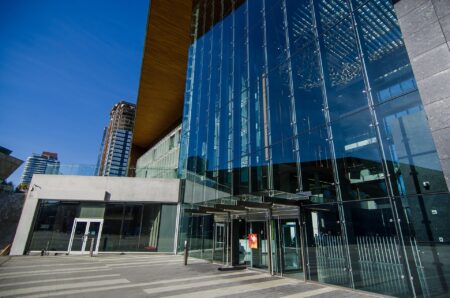
Photo: file photo of the Montreal skyline.
If you find reporting like this useful, consider supporting Canada News Media, an independent Canadian newsroom with no corporate parent.
Follow Canada News Media
Get the day's top Canadian stories and our two daily 60-second news videos wherever you scroll.
X Threads Facebook Instagram LinkedIn TikTok YouTube Pinterest Reddit Substack Flipboard Newsletter RSS