

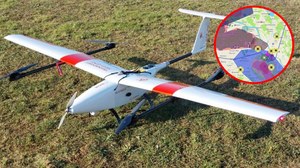
NASA is thrilled with the enormous possibilities of a drone as small as it is Ingenuity, the first such device that has been exploring Mars for a year and helps the large Perseverance rover in its mission to search for traces of life. The Americans, however, did not rest on their laurels. American Space Agency is getting ready to launch its first drone into the brand new but equally fascinating world of Titan, the moon of Saturn. Engineers have been testing a bit larger for some time a drone called Dragonfly.
Videos of experiments conducted on California desert. We can see the drone skeleton itself there. At first glance, it looks like a normal device, but nothing could be further from the truth. The vehicle is the most advanced of its kind in the world today. It was created to fly in the extraterrestrial atmosphere of a celestial body that is alien to us.
Dragonfly will have to survive extreme conditions of Titan. On a daily basis, the temperature is minus 179 degrees Celsius, the atmospheric pressure at the surface is about 1.5 times greater than the earth’s air pressure at sea level, and the density of the atmosphere is about 4.5 times greater than that of the Earth’s air at sea level.
The aircraft will travel in full standalone mode. This is related to Titan’s distance from Earth. The data transfer time varies from 1 to 1.5 hours one way, which excludes control from Earth. – Titan is a space laboratory. A kitchen where the ingredients of the primal soup of life are brewed. That’s why we want to go there. More specifically, flying over it, thanks to the drone and the possibilities of augmented reality, said Dr. Elizabeth “Zibi” Turtle of Johns Hopkins University.
Scientists test the drone over Imperial Sand Dunes in California. Ultimately, the drone will be equipped with two cameras. One will be installed at the front and will be used to observe the space in front of the vehicle, while the other will be facing downwards. In addition to them, there will be a drill on board for retrieving and analyzing soil samples and a seismometer. The latter will collect valuable information about tectonic activity and help determine the thickness of the ice covering the moon.
Interestingly, Dragonfly will not be equipped with solar panels or batteries. Engineers from NASA decided to use a nuclear propulsionor actually a radioisotope thermoelectric generator. The launch is to take place in 2027, and in 2034 the drone will land on the surface of the facility. The mission will take place as part of the New Frontiers program, which aims to study alien worlds in the solar system.
When the mission is carried out, the entire drone fleet is to work on Mars, and the first human colonies may even be established there. Titanium is one of the most interesting objects known to us. The surface temperatures are very low, there are natural reservoirs of liquid hydrocarbons, and the atmosphere is dominated by nitrogen, which is similar to Earth. Astrobiologists believe that there are ideal conditions for the emergence and flourishing of various forms of life. Recently, an unusual molecule that was involved in the creation of human DNA was discovered there. Saturn’s moon in its present form resembles the Earth from billions of years ago.
According to the plan, the mission will be carried out in an area known as Shangri-La. It is located on the moon’s equator and abounds in sand dunes. They bring to mind views from African Namibia. The Selk crater will also be thoroughly explored. There are signs of water that once existed there, as well as complex organic molecules based on carbon.
Scientists plan that the scientific mission is to last 2.5 years. During its duration, the drone will travel about 175 kilometers of sandy areas and fly over methane and ethane tanks. The device will also examine the condition of the atmosphere. Scientists plan to take thousands of photos of the entire globe, and then use them to look for traces of life and interesting formations that can tell us the story of the evolution of this moon.