


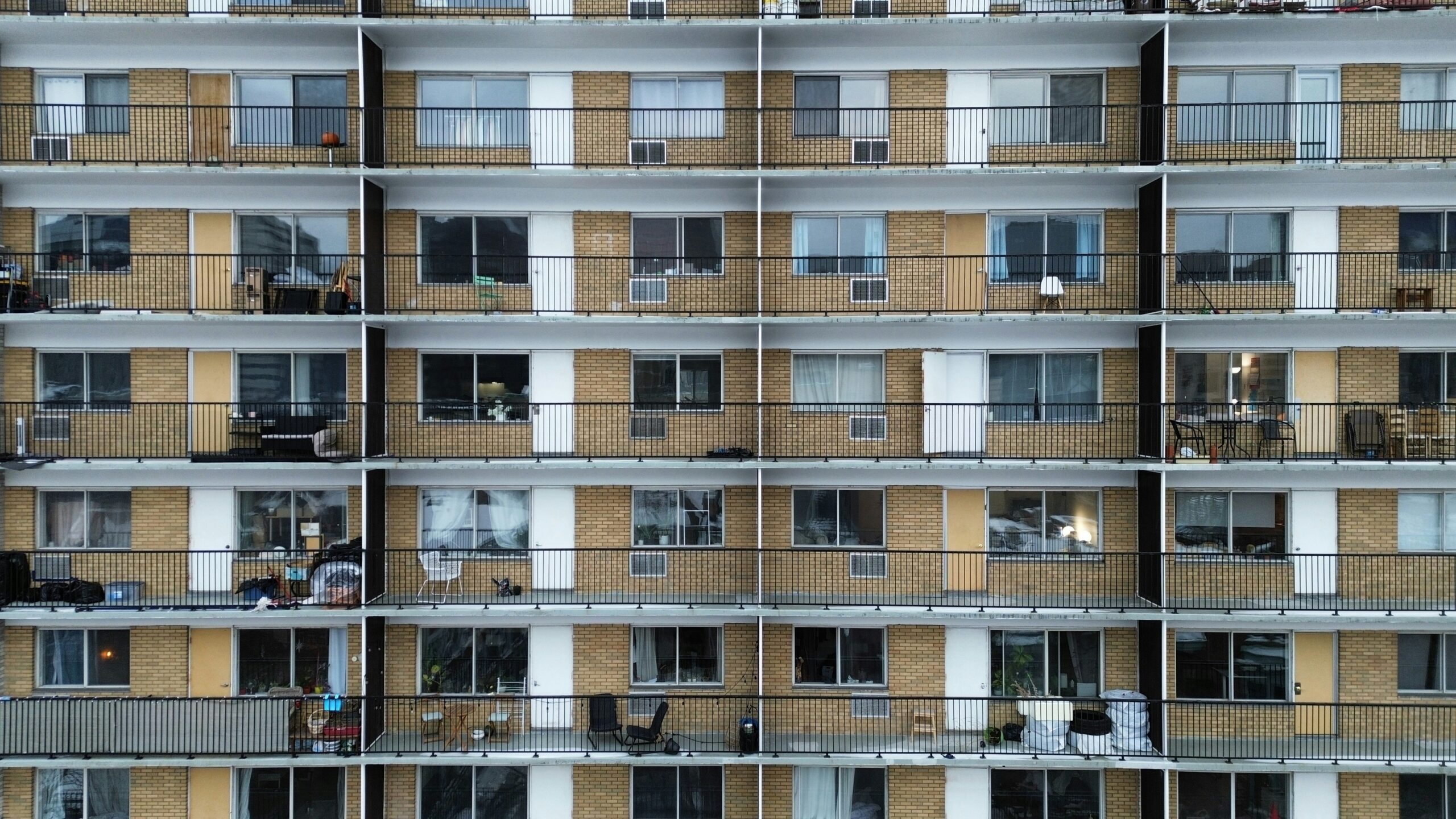
The average asking rent for a two-bedroom apartment across Canada’s census metropolitan areas was $2,130 a month in the second quarter of 2026, down 3.6 per cent from the same quarter a year earlier, Statistics Canada said Wednesday.
The figure, published through the agency’s Quarterly Rent Statistics program, marks a sharp acceleration in a decline that was barely visible three months ago. In its previous release on June 9, Statistics Canada reported an average asking rent of $2,150 for the first quarter of 2026, down 0.9 per cent year over year. The annual rate of decline has steepened roughly fourfold between the two quarters, while the headline figure itself slipped $20 over the same three months.
The national average conceals a widening split between cities. Asking rent for a two-bedroom fell 6.4 per cent year over year in both Abbotsford-Mission and Calgary, 5.2 per cent in Montreal and 4.1 per cent in Vancouver. Over the same period it rose 6.5 per cent in Thunder Bay, 5.7 per cent in Sherbrooke, 5.3 per cent in Halifax and 5.2 per cent in Saskatoon. Vancouver remained the most expensive market at an average asking rent of $3,030, followed by Toronto at $2,650, Victoria at $2,640 and Halifax at $2,400.
The more consequential change in this release is methodological. Statistics Canada said it has added a measure of paid rent to the series, running back to the first quarter of 2019. Asking rent is the price advertised on major rental listing platforms. Paid rent, the agency said, reflects what existing renters are actually handing over under a signed lease, including any subsequent increases. Paid rent estimates for the second quarter are available for 18 census metropolitan areas.
In almost every one of those markets the advertised price sits above what current tenants pay, which is the arithmetic of the turnover penalty facing anyone who moves. In Vancouver the average asking rent of $3,030 exceeded the average paid rent of $2,470, a gap of $560 a month. In Toronto, where paid rent averaged $2,160, the gap was $490.
Three markets ran the other way. In Calgary, asking rent averaged $1,890 while paid rent averaged $1,930, meaning the typical sitting tenant was paying $40 a month more than the going advertised rate. In Regina the reversal was wider, with asking rent at $1,480 against paid rent of $1,580, a difference of $100 a month, or $1,200 over a year. In Edmonton the two measures were identical at $1,570.
Calgary is the clearest case of the two findings meeting. It recorded one of the steepest asking-rent declines in the country at 6.4 per cent, having posted a drop of just 1.0 per cent in the first quarter, and it is now a market where a lease signed earlier can cost more than a comparable unit advertised today.
Statistics Canada attributed the general gap between the two measures to existing lease agreements signed in the past and subject to price controls in some provinces, and to differences between the apartments that are available and those that are occupied, including building age, location and what is included in the rent.
The agency cautioned that the figures are experimental and subject to revision, and that some asking-rent estimates should be used with caution because of missing data from one provider. Modelling was used to adjust estimates for the second quarter of 2025, the comparison base for the current year-over-year figures. The paid rent estimates are drawn from the rent component of the Labour Force Survey and exclude households living in social and affordable housing. The program is conducted with the Canada Mortgage and Housing Corporation.
Statistics Canada also noted that its consumer price index measures rent separately, using a model that adjusts for changes in the quality of units over time, and that CMHC’s Rental Market Survey uses a different method again, sampling units every October. The three sets of numbers are not interchangeable, and the agency’s asking rent series excludes subsidized housing, collective dwellings, vacation homes and mobile homes.