


The first person of African descent known to have lived permanently in what is now Canada left almost no words of his own. What survives of Olivier Le Jeune is a sale price, a baptism, a punishment and a burial, each written down by someone else. For most of the last six decades, one of those someone elses, Canada’s leading historian of New France, read that thin file and concluded the record could not prove he had been enslaved. In 2022, the federal government concluded the opposite.
How the same handful of documents produced two different answers says a great deal about how Canada has told, and avoided telling, the story of slavery on its own soil.
A child sold in an occupied colony
According to his entry in the Dictionary of Canadian Biography, written by historian Marcel Trudel, the boy came from Madagascar or Guinea and was brought to Quebec “when still very young” by one of the Kirke brothers, privateers sailing for England. The Canadian Encyclopedia identifies the owner as Sir David Kirke and dates the arrival to 1629, the year the English seized Champlain’s settlement. Parks Canada places his arrival during that English occupation, which lasted until 1632.
The Kirkes did not keep him. The biography records that he was sold for 50 écus to a French clerk named Le Baillif, who had gone into English service. In July 1632, as Quebec was being handed back to France, Le Baillif gave the child to Guillaume Couillard, one of the colony’s founding settlers.
That sequence matters. Before he had a name in any surviving record, the boy had been transported across an ocean, sold for a price and passed between men as property. Parks Canada’s designation describes him as sold into slavery as a child and forcibly brought to the Americas.
A name taken from two other men
On May 14, 1633, he was baptized at Quebec. The Dictionary of Canadian Biography explains that his Christian name, Olivier, honoured Olivier Letardif, the colony’s head clerk. His surname came later and from a different man: by the time of his burial he was recorded under the name of Paul Le Jeune, the Jesuit priest who had taught him French and the catechism. Even his identity, in other words, was assembled from the names of the colonists around him.
The next document is harsher. In 1638, according to the same biography, he was “chained up for 24 hours” for slandering the interpreter Nicolas Marsolet, and he signed his confession with an X. It is the closest the archive comes to preserving his voice, and it is the voice of a man accused, punished and made to sign with a mark.
He died at Quebec on May 10, 1654, and was buried the same day. Parks Canada notes he was in his thirties. The burial register lists him as a servant.
“No text certifies that he was a slave”
That single word, servant, carried enormous weight for Trudel. His biography, first published in 1966 and revised in 1979, states plainly that historians do not know whether Couillard treated Le Jeune as a slave or set him free, adding: “No text certifies that he was a slave.” Trudel suggested his situation might have resembled that of two Indigenous girls Couillard had adopted.
Yet the same entry contains the counterweight to its own doubt. Trudel notes that slavery was not formally legalized in New France until Intendant Jacques Raudot’s ordinance of April 13, 1709, but that it plainly existed in practice through the 17th century. And he reminds readers of what he calls the international principle in force at the time: a Black man was considered a slave wherever he was unless he had been emancipated. No record of any emancipation for Le Jeune has been cited.
Read today, the biography is a study in how archival silence can be mistaken for evidence. The absence of the word “slave” in a parish register did not mean the absence of slavery. The documents that do exist record a sale, a gift from one owner to another, and a public punishment in chains. Those are the facts of a person held as property, even when the clerk recording his death chose a gentler word.
A wider system, and a later reckoning
Le Jeune was not an isolated case, though he came decades before New France joined the Atlantic slave trade in earnest. Trudel’s research, as summarized by the City of Montreal’s MEM, Centre des mémoires montréalaises, estimated that a little more than 4,000 people were enslaved in New France and the Province of Quebec, roughly one third of them of African origin and the majority Indigenous people known to the French as “panis.” The same source says about 1,500 of those enslaved people lived in Montreal.
Le Jeune was also not the first Black person in New France’s wider orbit. Trudel’s biography notes an unnamed Black man who died of scurvy at Port-Royal in the winter of 1606 to 1607, and Mathieu Da Costa, who was engaged by Pierre Dugua de Mons and is believed to have served in Acadia around 1608. What sets Le Jeune apart is permanence: he lived and died in the St. Lawrence Valley.
In 2022, on the recommendation of the Historic Sites and Monuments Board of Canada, the federal government designated him a national historic person. Parks Canada’s designation calls him the first documented person of African descent to live permanently in Canada and the first known enslaved person of African descent in the colony. The commemorative plaque was unveiled on Oct. 13, 2023, at Cartier-Brébeuf National Historic Site in Quebec City.
The nomination came from Aly Ndiaye. In the government’s announcement, Ndiaye said Le Jeune “enables us to understand the plurality of our past, from the beginnings of the French colony.” Rosemary Sadlier, former president of the Ontario Black History Society, was quoted in the same release noting that slavery existed on these lands for almost 200 years.
The shift from Trudel’s caution to Parks Canada’s certainty was not the discovery of a new document. It was a change in how Canadians are willing to read the old ones. The record of Olivier Le Jeune is short, but it is not ambiguous about the central fact of his life: a child was bought and sold before he was ever given a name, and Canada’s own archives have held that truth for nearly four centuries.
If you find reporting like this useful, consider supporting Canada News Media, an independent Canadian newsroom with no corporate parent.
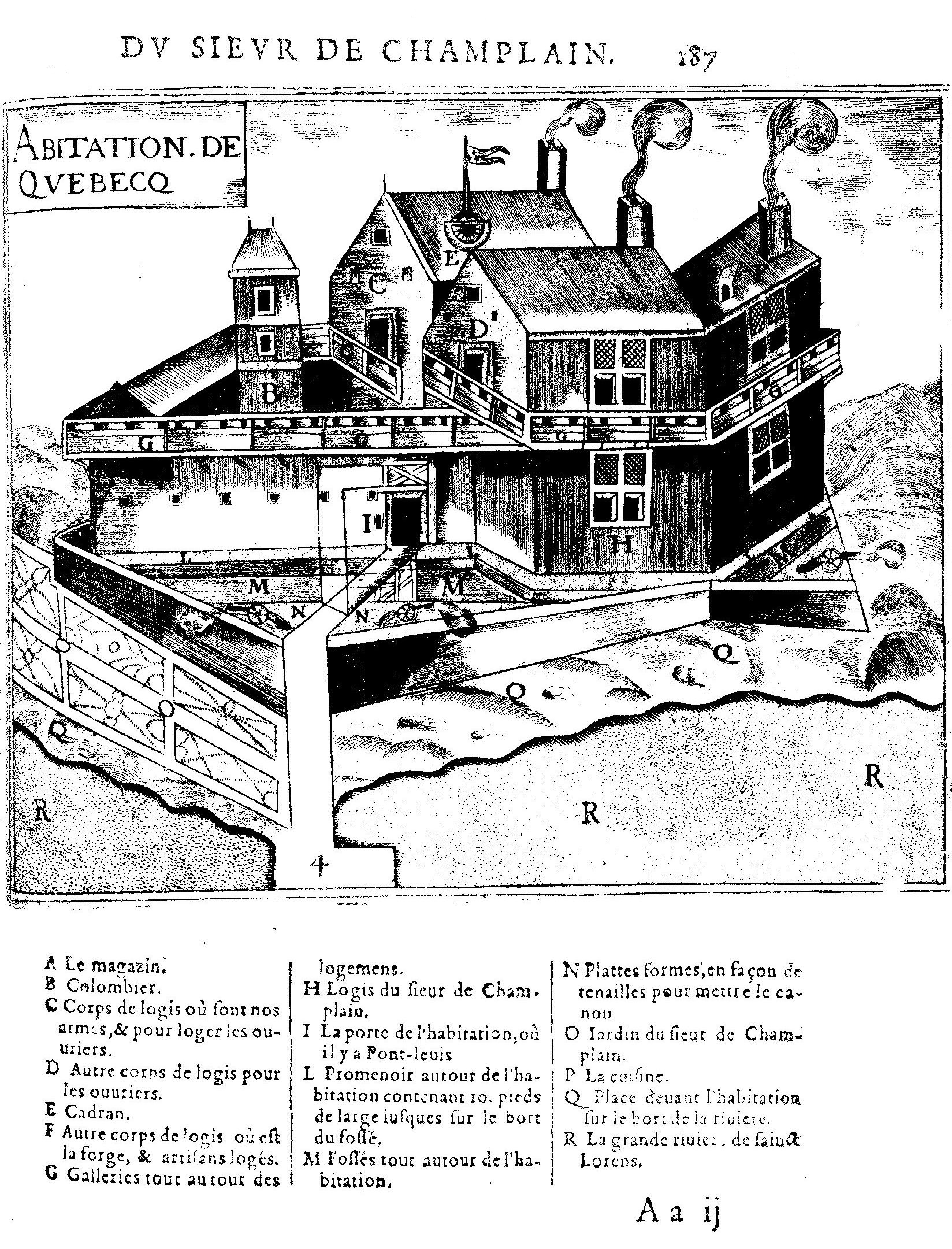
Sources: Marcel Trudel, “Le Jeune, Olivier,” Dictionary of Canadian Biography, vol. 1, University of Toronto/Université Laval (biographi.ca); Parks Canada, “Olivier Le Jeune National Historic Person” (parks.canada.ca); Government of Canada news release, Oct. 13, 2023 (canada.ca); The Canadian Encyclopedia, “Olivier Le Jeune” (thecanadianencyclopedia.ca); MEM, Centre des mémoires montréalaises, “Des esclaves à Montréal?” (ville.montreal.qc.ca). Image: Samuel de Champlain, “Abitation de Quebecq,” engraving from Les Voyages du sieur de Champlain (1613), public domain, via Wikimedia Commons.