

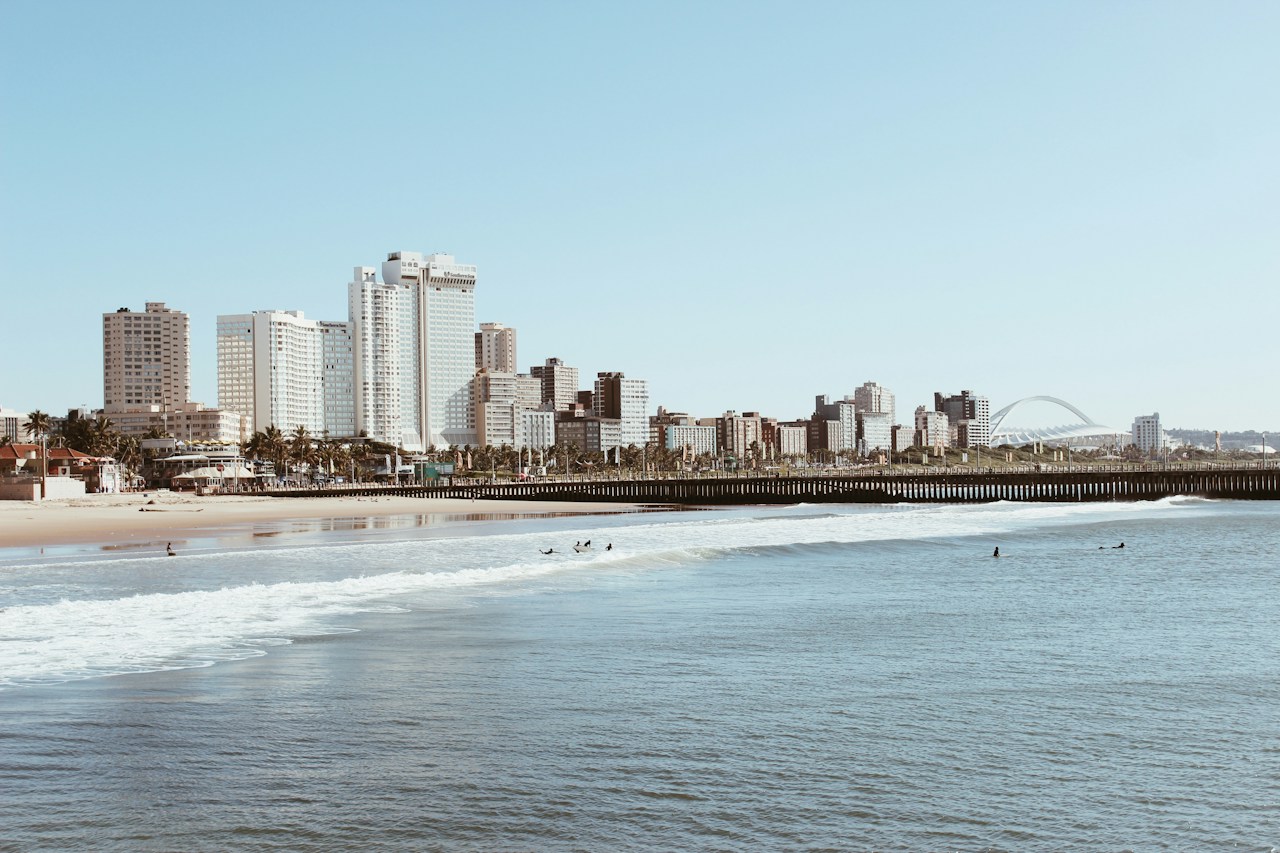
File photo of the Durban skyline, not from the protests. Photo by Weyland Swart via Unsplash (Unsplash licence).
South Africa’s Department of Home Affairs withdrew a directive on the intake of asylum applications on Friday, Oct. 9, 2026, after anti-immigration protests in Durban and Soweto turned violent and refugee offices were overwhelmed.
The directive was issued on Sept. 28, according to allAfrica, which republished a report from South Africa’s Eyewitness News (EWN). Within days, a line of about 1,000 foreign nationals had formed at the Durban Refugee Reception Centre alone, EWN reported on Oct. 7.
The department said the directive was an operational measure meant to put a July Constitutional Court order into effect, according to the allAfrica report. It said it withdrew the directive because of the pressure on Refugee Reception Offices and concerns about the safety of its officials and about public order. Home Affairs said it will develop a revised operational approach but has not yet given details.
The allAfrica report said the directive was issued by the department’s director-general without the knowledge of the minister or other political office-bearers. The director-general was not named in that report.
The court ruling itself is not affected. In the case brought by the Scalabrini Centre of Cape Town, the Constitutional Court struck down provisions of the Refugees Act that stopped some asylum seekers from entering the application process on procedural grounds before their claims were assessed on the merits. People can now apply regardless of how they entered South Africa. The ruling does not automatically grant refugee status or permanent residence, and each claim must still be assessed individually.
On Oct. 7, groups carrying sticks and sjamboks, a type of leather whip, arrived at the Durban centre on Che Guevara Road and foreign nationals left out of fear, EWN reported. A heavy contingent of armed police was present. Nkosikhona Ndabandaba, who leads a group called Insizwa Nobunsizwa, said: “What we came here for firstly is to protect our people who are marching and secondly to protect the foreigners.” The demonstrators dispersed and said they would return the next day if foreign nationals showed up, EWN reported.
Protests in Soweto and Durban then turned violent. The allAfrica press review of Oct. 9 said at least 24 vehicles were burned and foreign-owned businesses were looted. Police were investigating vandalism, assault and public violence, it said. We were unable to confirm that figure or any arrest numbers from a second source, so the toll should be treated as preliminary.
Gauteng Premier Panyaza Lesufi welcomed the withdrawal, according to the allAfrica report, which described it as a relief that leaves room for further consultation. That report did not give a direct quote.
The unrest is the latest flare-up of anti-immigrant tension in South Africa. Ahead of this week’s protests, President Cyril Ramaphosa said on Aug. 25 that there would be arrests of people fuelling anti-immigrant violence, according to TimesLIVE.
For Canadians, the story matters mainly for travel and for diaspora communities with family in South Africa. Canadians planning trips can check the current advisory for the country on travel.gc.ca, and local news and municipal alerts for Durban and Johannesburg-area gatherings. This article does not report any Canadian citizens as affected.
What happens next depends on the revised approach Home Affairs has promised. The department has not given a date. The anti-immigration group in Durban had said it would return to the centre if foreign nationals came back.
This is a developing story and figures may change. Via allAfrica (republishing EWN) and EWN, with background from TimesLIVE.
If you find reporting like this useful, consider supporting Canada News Media, an independent Canadian newsroom with no corporate parent.