


Ottawa’s public register of contracts over $10,000 carries a note on 57,079 rows saying the contract “was omitted from a previous public disclosure” or “previous proactive publication”, and 40,866 of those rows, 72 per cent, belong to National Defence. Defence’s own entries carry the note on 11.0 per cent of its 371,744 rows. Across the other 98 organizations in the file, the note appears on 1.7 per cent of 964,440 rows (16,213).
The register is the Treasury Board’s proactive disclosure of contracts, published on open.canada.ca. We downloaded the full file on Nov. 16, 2026: 1,336,184 rows going back to 2004. We searched both comment fields for the standard wording, which departments add when a contract appears in a later quarter than the one it belongs to. Seventy-two of the 99 organizations in the file have at least one flagged row, so the note is a routine part of how the register is kept, not a rarity. After Defence, the largest counts are Correctional Service Canada (3,006 rows, 5.0 per cent of its rows), Shared Services Canada (2,779, 9.4 per cent) and Parks Canada (2,045, 3.3 per cent).
The gap between Defence and everyone else has persisted. Defence reported only 0 to 101 contract rows a year in the register before 2016-17, then 3,126 in 2016-17 and 14,822 in 2017-18. Its flagged rows peaked at 8,984 in 2018-19, 43 per cent of the 20,684 rows it reported that year, then fell to 1,972 in 2024-25. They rose again to 3,550 in 2025-26 (12.4 per cent of 28,724 rows) and to 3,035 in the first two quarters of 2026-27 (16.4 per cent of 18,455 rows). In those same two years the rest of the government flagged about 1.9 per cent of its rows: 1,153 of 62,053 in 2025-26 and 533 of 27,583 so far in 2026-27.
Most of the recent Defence notes point to short delays rather than long ones. Of the 6,585 Defence rows with the note reported in 2025-26 and 2026-27, 5,973 (91 per cent) have a contract date in the same calendar year the reporting fiscal year began or the year after, and 612 (9 per cent) are dated in an earlier calendar year. The largest delays in the file are a handful of rows dated 10 to 22 years before the quarter they appear in.
The note does not say why a contract was left out of the first publication, how long it was missing, or whether the original omission was an error, a reporting-system issue, a late approval or a security or process reason. A flagged row is also not evidence of wrongdoing, and the same row can reappear when a contract is amended, so the counts above are rows, not distinct contracts. We have not asked National Defence about the pattern; any response from the department will be added to this story as a dated update. The question it raises is whether the register’s totals for Defence, the largest buyer in the file, change meaningfully when late-added contracts arrive, which matters to anyone using the data to track spending quarter by quarter.
How we checked: We downloaded the contracts file from the Proactive Disclosure of Contracts dataset on open.canada.ca on Nov. 16, 2026 and loaded it into a database (1,336,184 rows, 99 organizations). A row was counted as flagged if the English comments or additional-comments field contained the phrase “omitted from a previous”. We assigned each row to its reporting fiscal year from the reporting period or, where that was blank (older rows), from the quarter in the reference number, and to an organization by the English owner name. Shares are flagged rows divided by all rows for the same organization and year. We did not net out amended or repeated rows and did not use dollar values. Results can differ slightly if the department edits the file after our download.
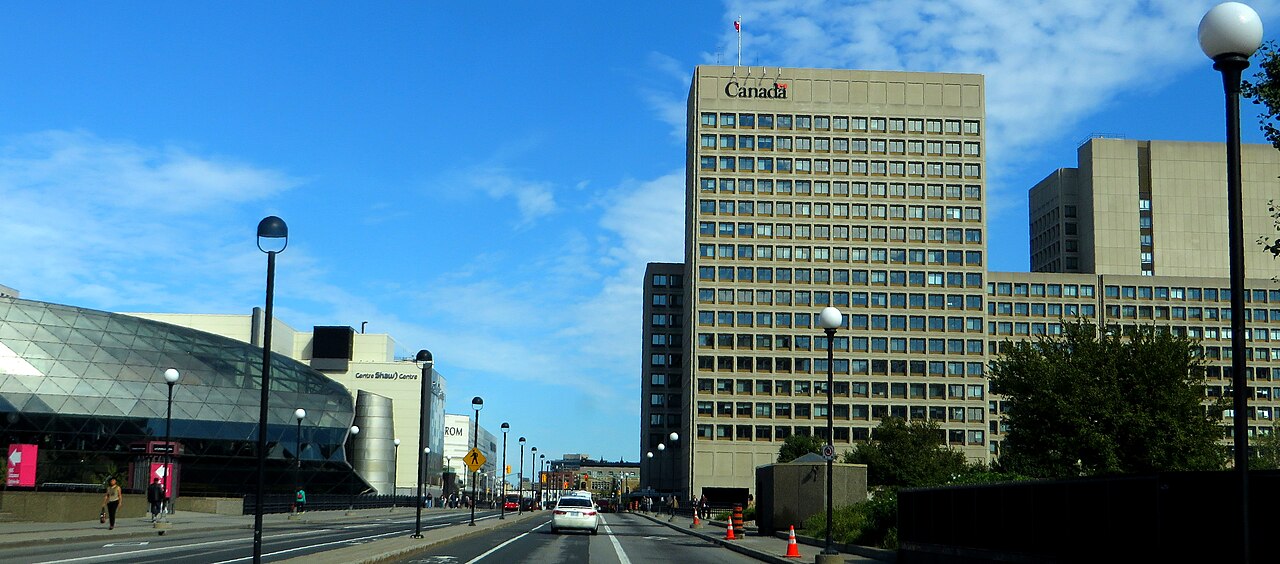
File photo: the Major-General George R. Pearkes Building, National Defence Headquarters, Ottawa. Photo by Ken Lund, CC BY-SA 2.0, via Wikimedia Commons.
Follow Canada News Media
Get the day's top Canadian stories and our two daily 60-second news videos wherever you scroll.
X Threads Facebook Instagram LinkedIn TikTok YouTube Pinterest Reddit Substack Flipboard Newsletter RSS