
Fires on board Canadian trains are running well ahead of last year. Railways reported 45 fires on locomotives, freight cars and passenger cars from January to September 2026, up from 29 in the same months of 2025, an increase of 55 per cent, according to a Canada News Media count of federal Transportation Safety Board records.
That is the second-highest January-to-September total since 2019, behind only that year’s 51. The 45 fires already recorded this year are one short of the 46 reported in all of 2025, with three months of the year left to count.
Most of the fires started in the locomotives themselves. Our reading of the board’s own occurrence summaries for all 45 fires found that 29 were on locomotives, including traction motor fires, engine compartment fires and fires in exhaust and electrical compartments. Eleven involved freight cars or the cargo they were carrying, and five of those were loaded gondola cars of sulphur in British Columbia and Alberta. Three were on VIA Rail passenger cars, two of them caused by overheating brake shoes, and two were on track maintenance machines, a snow broom and a spike puller.
Five of the fires involved passenger services. Besides the three VIA Rail cars, a GO Transit locomotive caught fire at the Mount Pleasant station in Brampton, Ont., on June 29, with no passengers on board, and an Exo commuter locomotive caught fire during a station stop at Mont-Saint-Hilaire, Que., on Sept. 17. In the Feb. 16 VIA Rail fire near Drummondville, Que., smoke reached a coach and passengers were moved to other cars before the train went on to its destination.
The records show no deaths. One fire, on a CN train near Redditt, Ont., on March 19, left a railway employee with minor injuries, according to the board’s summary. None of the 45 records shows dangerous goods released from a tank car or an evacuation. Local fire services were called to 16 of the fires; train crews put out many of the others themselves.
Ontario had the most fires this year with 11, followed by British Columbia with nine, Saskatchewan with eight, and Alberta and Manitoba with six each. Quebec had four and Newfoundland and Labrador one. The records name the railway that owns each stretch of track, and they show fires on trains run by CN, CPKC, VIA Rail, GO Transit, Exo, the Quebec North Shore and Labrador Railway and Hudson Bay Railway. The data count fires by occurrence, not by kilometres travelled, so they cannot show whether any one railway’s rate of fires changed.
The board classed all 45 fires in its lowest category, occurrences it records for statistics but does not investigate. That means there is no official finding on why the number rose this year. The summaries give an immediate cause for some fires, such as a traction motor or a brake shoe, but not the underlying reason, such as the age of the equipment, maintenance or weather. They also do not show whether the same locomotives caught fire more than once.
The rise in fires stands out against other parts of the rail safety record. Crossing accidents fell to 93 from January to September 2026, from 119 a year earlier, the board’s data show. Main-track derailments, which we reported on Nov. 21, were up by about a third, and trespasser deaths are at their highest since 1995.
Anyone who sees smoke or fire on a passing train should call 911 and, where it is posted, the railway’s emergency number on the crossing sign. Transport Canada regulates railway equipment and safety, and the Transportation Safety Board publishes its rail occurrence data and monthly statistics on its website.
How we checked: We downloaded the Transportation Safety Board’s rail occurrence data (64,424 occurrences from 1983 to Oct. 10, 2026), kept one row per occurrence and counted occurrences of the type “fire on-board rolling stock” for January to September of each year and for full years. The yearly count jumped in 2019, from between 13 and 26 in each January-to-September period from 2012 to 2018 to 51 in 2019, for reasons the data do not explain, and fires beside the track jumped at the same time; for that reason we compare only years from 2019 on. We sorted the 45 fires of 2026 into locomotives, freight cars and cargo, passenger cars and track units by reading each occurrence summary. Counts of injuries, dangerous goods, evacuations, class and province come from the fields in the same records. Figures can change as the board updates its data; the board’s monthly rail statistics for September 2026 give its own preliminary totals. No railway is accused of wrongdoing in this analysis.
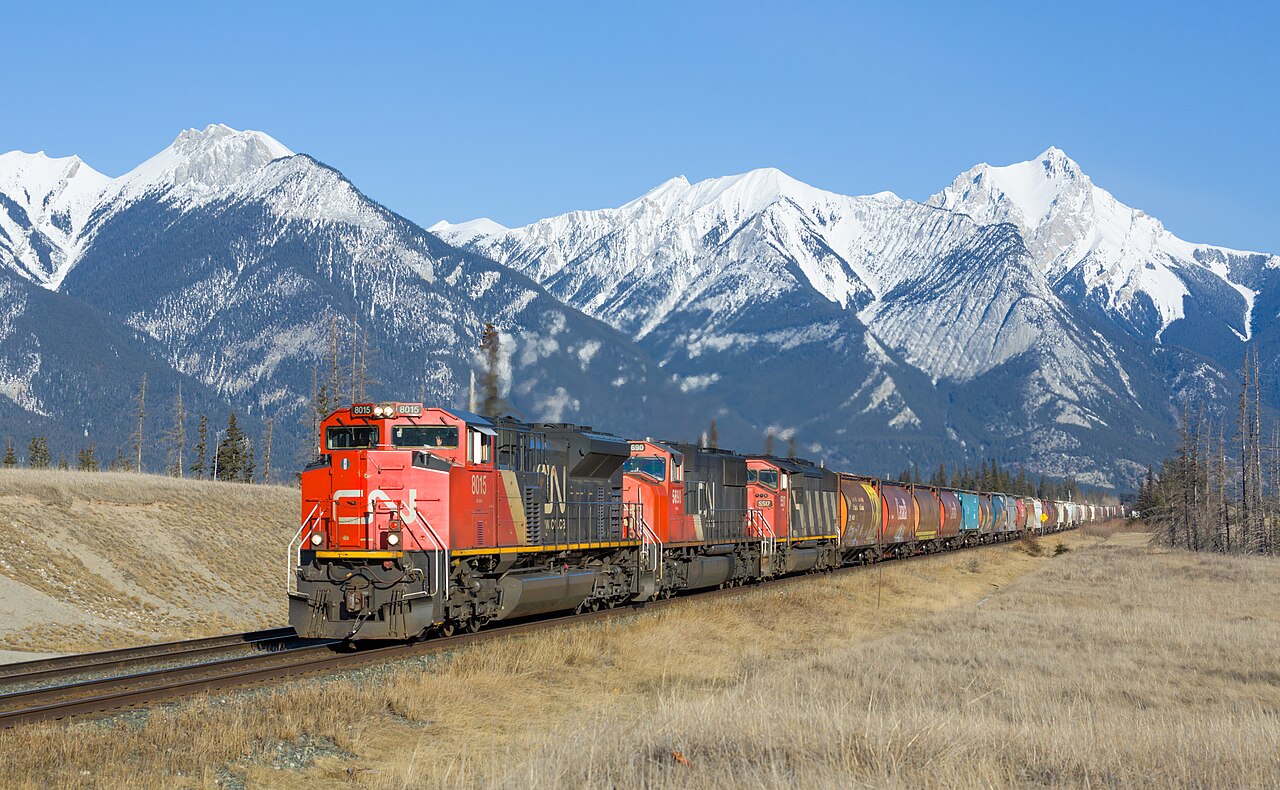
File photo: a CN freight train on the main line between Hinton and Jasper, Alta., March 3, 2015. It does not show any of the fires in this story.
Follow Canada News Media
Get the day's top Canadian stories and our two daily 60-second news videos wherever you scroll.
X Threads Facebook Instagram LinkedIn TikTok YouTube Pinterest Reddit Substack Flipboard Newsletter RSS