



Updated Nov. 25, 2026
The mortgage stress test requires a borrower to show they could handle payments at a qualifying interest rate, which for banks is the higher of 5.25 per cent or the contract rate plus two percentage points, according to the Financial Consumer Agency of Canada (FCAC).
The test is about qualifying. The FCAC says borrowers must prove they can afford payments at a qualifying rate that is typically higher than the actual rate in their mortgage contract.
The same formula applies to insured and uninsured mortgages, the agency says. Federally regulated lenders, such as banks, require borrowers to pass the test. Lenders that are not federally regulated may also ask for it, so anyone dealing with a credit union, caisse populaire or other lender should ask what standard it uses.
For uninsured mortgages, the rule comes from the Office of the Superintendent of Financial Institutions (OSFI), which obliges federally regulated lenders to apply it. OSFI calls the two parts the buffer, now two per cent, and the floor, now 5.25 per cent, on its minimum qualifying rate page, last modified Jan. 29, 2026. The regulator says it reviews both at least once a year, weighing data from financial institutions and signs of weakness in the housing market and economy, and consulting the Department of Finance and the Bank of Canada.
For insured mortgages, the minimum qualifying rate is set by the federal government. In a December 2023 statement, the finance minister at the time confirmed it as the greater of the contract rate plus two per cent or 5.25 per cent.
In practice, the floor matters when contract rates are low, and the buffer takes over once the contract rate is above 3.25 per cent. The rates in the table below are examples to show the math, not current lender offers.
| Example contract rate | Contract rate plus 2 points | Qualifying rate |
|---|---|---|
| 3.00% | 5.00% | 5.25% |
| 3.25% | 5.25% | 5.25% |
| 4.50% | 6.50% | 6.50% |
| 5.50% | 7.50% | 7.50% |
OSFI says the point is to help make sure borrowers can keep paying if they run into a financial shock, such as lower income, higher household expenses or a rise in mortgage rates. It also says qualifying people at a higher rate reduces the risk of delinquency and default.
The qualifying rate is only one part of an application. The FCAC says lenders and brokers look at income before taxes, expenses, the amount being borrowed, debts, credit history and the amortization period. Its guidance says total monthly housing costs should not be more than 39 per cent of gross household income. That is known as the gross debt service ratio, and it counts mortgage payments, property taxes, heating and half of any condo fees.
Total debt, meaning those housing costs plus payments such as car loans, student loans, credit cards, lines of credit and support payments, should not be more than 44 per cent of gross income. The FCAC says a borrower may still qualify with slightly higher ratios but takes on a greater risk of too much debt. Canada Mortgage and Housing Corporation (CMHC) lists the same 39 and 44 per cent figures in its requirements for homeowner mortgage insurance.
As an illustration, for a household earning $100,000 before taxes, 39 per cent works out to $3,250 a month for housing costs and 44 per cent to about $3,667 a month for all debts. Under the stress test, the mortgage payment used to check affordability reflects the higher qualifying rate. Our recent look at how the income needed to buy a home has changed shows how much qualifying requirements can move even when prices fall.
Insurance depends mainly on the down payment. A buyer putting down less than 20 per cent will typically need mortgage loan insurance, which protects the lender and not the borrower, according to the FCAC. For loans insured by CMHC, the property value must be below $1.5 million for a homeowner loan. Our explainer on what CMHC does covers the agency’s wider role. Buyers still saving for a down payment can also read how the First Home Savings Account works.
The test can come up again for people who already own a home. The FCAC says those with a mortgage must pass it if they refinance or take out a home equity line of credit.
Switching lenders at renewal is treated differently in some cases. OSFI says it does not expect lenders to apply the uninsured qualifying rate to a straight switch at renewal, meaning a borrower moves an uninsured mortgage from one federally regulated lender to another without increasing the loan amount or the amortization period. For insured mortgages, the 2023 federal statement said borrowers are not required under the regulations to requalify at the minimum qualifying rate when they switch lenders at renewal.
Passing the test, or getting a preapproval, does not guarantee a loan. The FCAC says a lender can refuse an application even after preapproval, and the approved amount depends on the property’s value and the down payment. Each lender also sets its own lending guidelines.
This explains how the rules work and is not financial or legal advice. Check your own situation with a qualified adviser, your lender or the agency concerned.
If you find reporting like this useful, consider supporting Canada News Media, an independently owned Canadian newsroom.
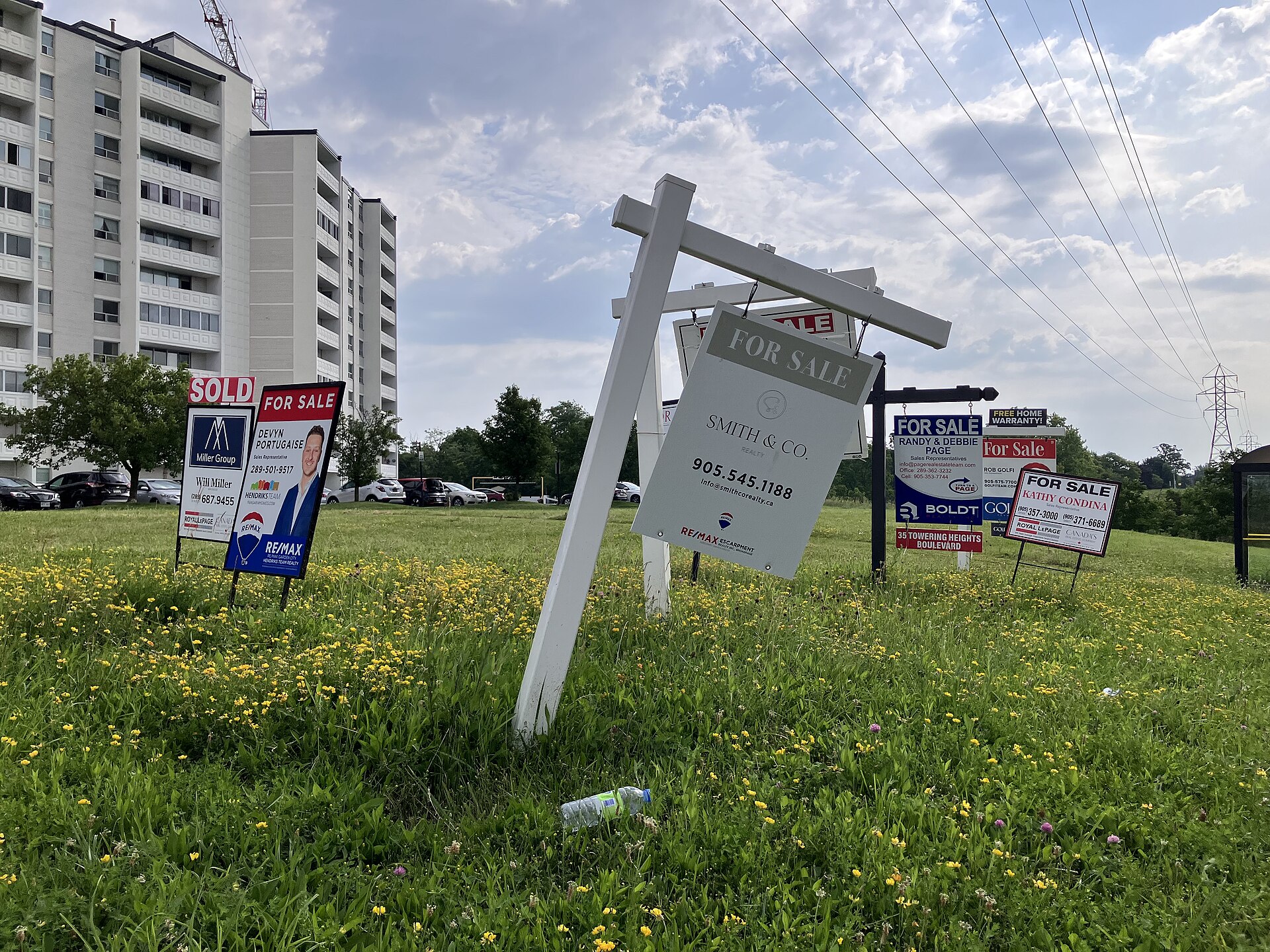
File photo: For-sale signs in St. Catharines, Ont., in June 2026. Photo by Gogerr, Wikimedia Commons, CC BY-SA 4.0.
Follow Canada News Media
Get the day's top Canadian stories and our two daily 60-second news videos wherever you scroll.
X Threads Facebook Instagram LinkedIn TikTok YouTube Pinterest Reddit Substack Flipboard Newsletter RSS