
City of Toronto finance staff are recommending a $2 monthly 911 fee on cellphone lines starting Oct. 1, 2027, according to a report from the chief financial officer that goes to the executive committee on Dec. 1.
City council is scheduled to consider it Dec. 9 and 10, subject to what the committee does. The fee would come to $24 a year for each line, or $96 for a household with four phones, by Canada News Media’s calculation.
The report says the charge would apply to wireless lines only. Staff expect it would be assigned using an attribute such as the postal code on a customer’s billing address, with details still to be worked out with carriers.
The $2 would include an amount that telecom companies keep for collecting and sending the money to the city. The recommendation depends on the city reaching agreements with them, and staff said this would be the first time such a fee is applied by a municipality.
Staff estimate the fee could raise up to about $65 million a year. The report gives the figure as $65.1 million in one section and $65.3 million in another. Because of the planned October start, the city expects $16.3 million in 2027 and an additional $48.8 million in 2028.
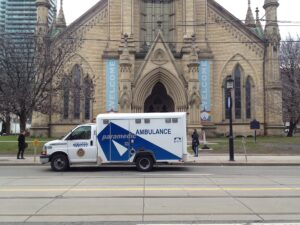
The money would help pay for police, fire and paramedic costs tied to Next Generation 911, including equipment, technology, training, call answering and dispatch. The report says it would support existing investments, not new initiatives.
The net operating budget for those three emergency services totals $2.2 billion in 2026, the report says. The higher revenue estimate of $65.3 million equals about three per cent of that amount, by our calculation. Staff said it is equivalent to a 1.23 per cent property tax increase.
The report says most provinces already charge a monthly 911 fee, with Ontario, British Columbia and Manitoba the exceptions. Provincial charges range from 55 cents to $2.59 a month, so Toronto’s proposed fee would fall within that range, 59 cents below the top figure.
Staff said the city would welcome a province-wide fee applied to every Ontario municipality, but they understand the province is not planning one.
The Canadian Radio-television and Telecommunications Commission ordered the move to Next Generation 911 in 2017. The internet-based system is meant to support features such as real-time text and more accurate caller location. Toronto finished moving its police, fire and paramedic communication services to the new network in November 2025, according to the report.
Staff are not recommending a charge on landlines for now. They estimate that adding them could raise as much as $17.2 million more a year, a sum expected to shrink as people give up landlines. They cited concerns about charging households twice, as well as effects on older residents and on businesses such as hotels and health providers that still use landlines.
The same report recommends raising the Municipal Accommodation Tax on short stays to 8.5 per cent from six per cent on March 1, 2027, and adding a levy on commercial parking space starting Jan. 1, 2029. It estimates the three measures together could bring in $272.6 million a year once all are in place.
The reliability of 911 service has drawn attention this year. Canada News Media reported that Bell’s own filings list a series of 911 disruptions, that Bell blamed a software bug for an outage affecting six provinces and that new outage reporting rules had stalled.
Canada News Media did not contact the city or wireless carriers for this story.
If you find reporting like this useful, consider supporting Canada News Media, an independently owned Canadian newsroom.
Sources: City of Toronto, agenda item 2027.EX1.3 and the staff report. Annual, household, budget-share and fee-gap figures are Canada News Media calculations.
Follow Canada News Media
Get the day's top Canadian stories and our two daily 60-second news videos wherever you scroll.
X Threads Facebook Instagram LinkedIn TikTok YouTube Pinterest Reddit Substack Flipboard Newsletter RSS