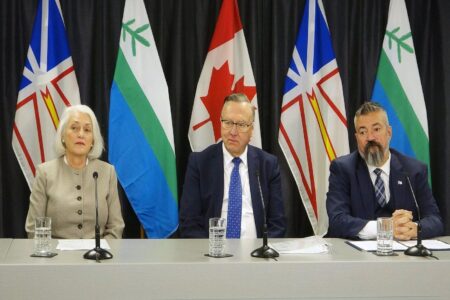


Canada is joining the NATO Innovation Fund with a commitment of about $100 million, the federal government and the fund announced Saturday at the Halifax International Security Forum, as the annual gathering of defence officials continued under a cloud of strained relations with Washington.
The federal government is committing 64.59 million euros, roughly $100 million, to the venture fund, which backs early-stage defence and dual-use technology companies in NATO countries, according to the announcement released from Halifax. The Business Development Bank of Canada will hold and manage Canada’s stake. Canada becomes the 25th allied country in the fund, which says total commitments now top 1.1 billion euros. By a Canada News Media calculation, Canada’s share is a little under six per cent of that total.
“Canada has the talent, the innovation, and the ambition to be a global leader in defence and security,” McGuinty said in the release, adding that membership is about “strengthening our defence industrial base” and supporting the next generation of Canadian companies. BDC president and chief executive Isabelle Hudon said the investment would give Canadian entrepreneurs more access to capital, customers and supply chains across the alliance. The fund said two of its more than 30 portfolio companies have already moved into Canada: German launch firm Isar Aerospace, selected to develop a launch pad and provide launch services for Canadian satellites, and Finnish autonomous airship company Kelluu.
The announcement came on the second day of a forum where Canada’s relationship with the United States has dominated the hallway talk. Forum president Peter Van Praagh opened the event Friday by warning that the U.S. can no longer be counted on as a predictable leader of the democratic world. “Without the United States as a predictable leader, people, institutions and countries are looking for a new course. A North Star,” he said, according to The Associated Press. “No single country can replace the heft of the United States, but maintaining those ideals are up to us.”
Now in its 18th year, the forum draws about 300 military officials, U.S. lawmakers, diplomats and scholars to the Westin Nova Scotian hotel each November, AP reported. For the second year running, no Pentagon officials are attending after the Trump administration restricted their participation in think-tank events in 2025. A bipartisan congressional delegation is there, including Democratic Sen. Chris Coons of Delaware, who criticized U.S. President Donald Trump’s appearance alongside Chinese leader Xi Jinping and Russian President Vladimir Putin at a summit in China this week.
McGuinty used his Friday remarks to echo Prime Minister Mark Carney’s warning that the international order is shifting. “Institutions like NATO have always been vital to our collective security. They just can’t be our only way of working together. Those days are over,” he said, according to AP. The minister also told reporters on the sidelines that Russia is waging a “deliberate” and “sophisticated” hybrid war campaign in eastern Europe after Poland reported two suspected cruise missiles and a drone entered its airspace, The Canadian Press reported. He said the few hundred Canadian Armed Forces members in Europe under Operation Unifier, which trains Ukrainian forces, are safe.
On Saturday, McGuinty was pressed about a Washington Post report that U.S. War Secretary Pete Hegseth signed a classified memo restricting defence co-operation with Canada. He said he had not seen the memo and that it is “business as usual” between the two militaries. “I’ve seen no evidence of (a change). I’ve checked with our top military folks, they’ve seen no evidence of change. We continue to cooperate,” he said, according to CP. Canada News Media’s story on the Hegseth memo has the Pentagon’s response.
The minister also faced questions in Halifax about the military’s decision to pause most weekend cadet activities until March. He said core weekly programming will continue and that cadet enrolment has risen 59 per cent in three years, which he called a sign the program is “a victim of its own success.” Our cadet story has the details.
Canada says it now meets NATO’s two per cent of GDP defence spending benchmark and has committed to the alliance’s new target of five per cent by 2035. The forum runs through Sunday.
With files from The Canadian Press and The Associated Press.
If you find reporting like this useful, consider supporting Canada News Media, an independently owned Canadian newsroom.
Follow Canada News Media
Get the day's top Canadian stories and our two daily 60-second news videos wherever you scroll.
X Threads Facebook Instagram LinkedIn TikTok YouTube Pinterest Reddit Substack Flipboard Newsletter RSS