

The Statistics Canada price index for air transportation rose 34.5% from November to December 2025, from 158.3 to 212.9, the largest November-to-December jump in a series that starts in 1961, our analysis of the agency’s consumer price index shows. The index then fell 23.4% in January 2026, to 163.1.
The swing is not a one-off. In seven of the eight years from 2018 to 2025 the December index was between 20.0% and 34.5% above November’s; the exception was 2020 (+7.4%), when the pandemic and special treatment of the air index make comparison unreliable. In the eight years from 2010 to 2017 the November-to-December change averaged -0.8% and never exceeded +3.5%.
We took the monthly consumer price index for air transportation for Canada (table 18-10-0004-01), which is not seasonally adjusted, and compared each November with the following December. The December gains were 21.7% in 2018, 23.4% in 2019, 24.7% in 2021, 20.0% in 2022, 31.1% in 2023, 27.5% in 2024 and 34.5% in 2025. January then gave back much of each gain. After the Decembers of 2018 to 2025 the index fell 16.0%, 13.8%, 4.8%, 18.0%, 19.6%, 23.7%, 22.6% and 23.4% in the following January.
The data do not say why December looks like this, and we have not tested the reason. An index that moves this much in one month may reflect higher fares for holiday travel dates, the timing of when tickets are bought, or both, and the table does not separate them. It also does not explain why the pattern appears from 2018 and not before. The table’s footnotes say price movements for the air index were estimated using special approaches from April 2020 to July 2021, but they do not describe a change in 2018. The index tracks prices across all air travel Canadians buy, not any one airline or route, so it cannot show what a particular ticket costs.
Fares were also well above last year before the holidays. The index stood at 189.9 in September 2026, 19.4% above September 2025 (159.1) and 18.3% above September 2019 (160.5). That was the largest year-over-year increase of any month in 2026 so far: the index was down 1.9% in January, down 0.6% in February, up 2.9% in March, down 1.7% in April, and up 7.4%, 9.6%, 12.0%, 15.0% and 19.4% from May to September. Over the same twelve months all items rose 3.1%. The index peaked at 260.1 in August 2022.
We previously reported on airfares rising as jet fuel prices climbed. This analysis does not test whether fuel costs, demand or airline pricing practices explain the 2026 increase, and no airline is accused of anything in it.
How we checked: We downloaded table 18-10-0004-01 on Nov. 17, 2026 and pulled the “Air transportation” series for Canada (2002=100), January 1961 to September 2026. For each year from 1962 to 2025 we divided the December index by the November index; the next-largest jump after 2025 is 31.1% in 2023, and before 2018 the largest was 12.4% in 1987. For example, 212.9 ÷ 158.3 − 1 = 34.5%. The all-items comparison uses the same table (170.0 in September 2026, 164.9 in September 2025). Figures are Statistics Canada’s published index values and are subject to revision. The calendar-year percentages are our calculations. No organization is accused of wrongdoing in this analysis.
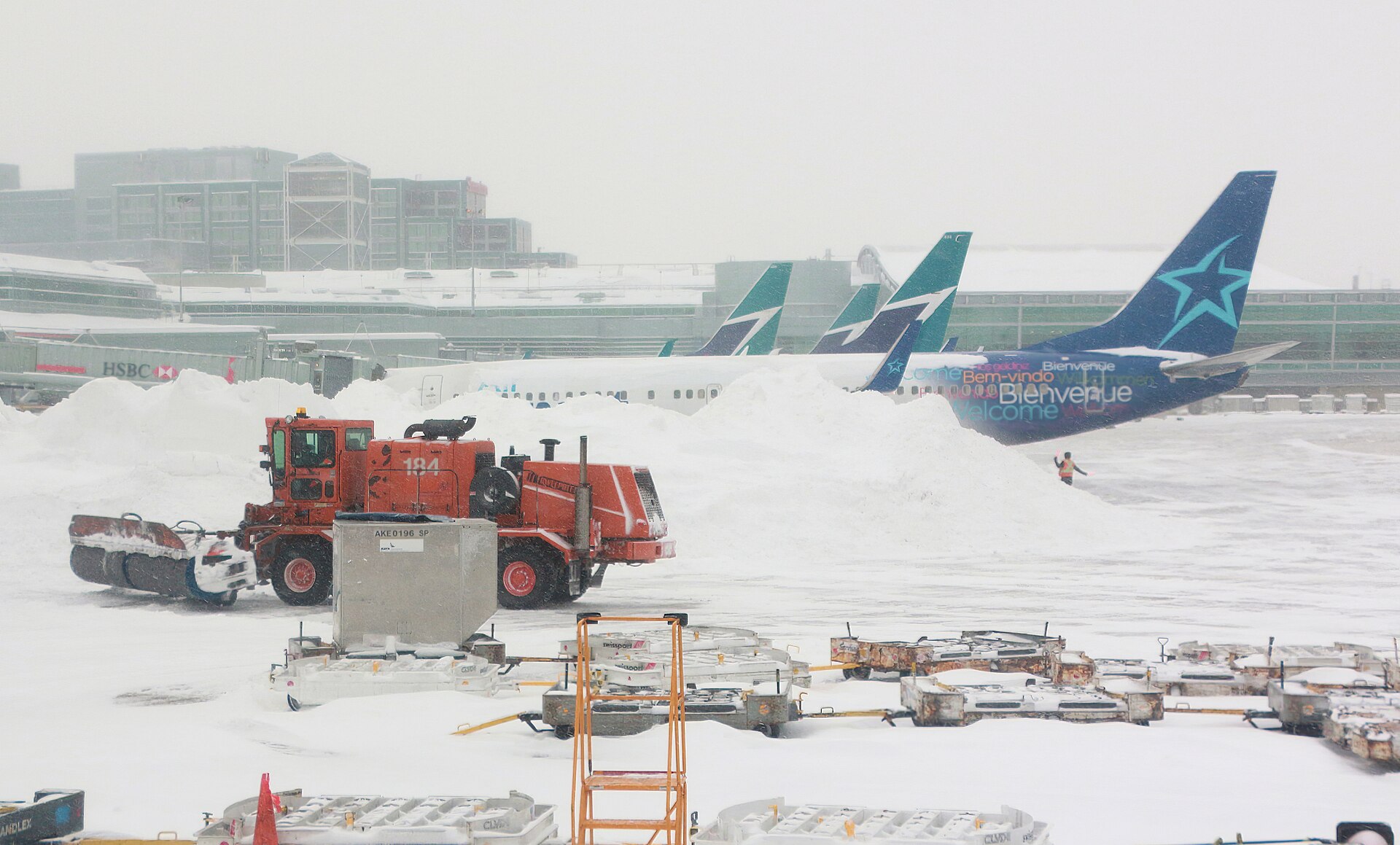
File photo: Toronto Pearson International Airport in winter (ImagePerson, CC BY 4.0, Wikimedia Commons). The airport is not the subject of this story.
Follow Canada News Media
Get the day's top Canadian stories and our two daily 60-second news videos wherever you scroll.
X Threads Facebook Instagram LinkedIn TikTok YouTube Pinterest Reddit Substack Flipboard Newsletter RSS