



The European Central Bank held its deposit rate at 2.5 per cent on Thursday, Oct. 29, 2026, and left the door open to another increase in December as French borrowing costs climbed to their highest level since 2002.
The decision came with euro-zone inflation at 3.8 per cent in September, almost double the bank’s 2 per cent target, up from 3.2 per cent in August, Euronews reported.
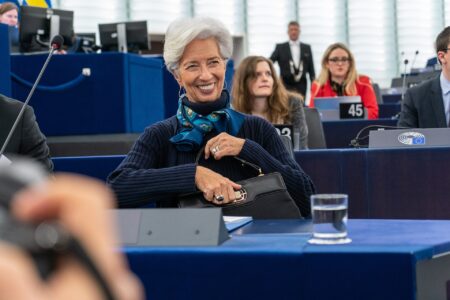
The Governing Council debated whether a rate increase was appropriate at this meeting, president Christine Lagarde said at her news conference, according to AFP. “Unless there were major developments, the direction of travel is quite clear,” she said, in remarks AFP reported through Kuwait Times.
The bank has raised rates twice this year, most recently in September, Euronews reported. It said it was “not pre-committing to a particular rate path”.
In its statement, the ECB said energy prices “continued to rise, posing upside risks to the inflation outlook and downside risks to the growth outlook”, as quoted by Euronews and the Irish Times. It said underlying inflation “remained broadly stable so far and wages do not show a material response at this stage”.
The Irish Times reported that euro-zone private-sector growth was at its weakest pace in four months. Euronews linked the energy pressure to the Iran war.
France was the other pressure point. The 10-year French government bond yield rose above 5 per cent last week, the first time since 2002, Euronews reported, and stood near 5 per cent on Thursday with a spread over German debt of about 155 basis points. The bond market figures come from Euronews alone and were not independently confirmed by Canada News Media.
AFP linked the rise in French yields to a budget standoff and to street protests that turned into the worst violence in years. We reported on France’s 10-year yield topping 4.8 per cent on Oct. 19 and on the protests that drew 550,000 people on Oct. 17.
Lagarde declined to comment directly on France. She said the ECB has instruments available if market moves threaten the transmission of monetary policy, AFP reported. “Fiscal sustainability is a crucial anchor for broader economic stability,” she said.
The instrument in question is the Transmission Protection Instrument, which has never been used and is meant to counter “unwarranted, disorderly market dynamics”, Euronews reported. AFP said its criteria are strict and that most observers believe France does not meet the threshold.
Euronews cited an ING estimate that the rise in bond yields since September has done the work of a 25 basis point hike in Germany and closer to 50 basis points in France. “The bond market has taken over the ECB’s job,” ING said in a note.
Lagarde also confirmed that she will leave the bank in February, about nine months before her term ends in October 2027. We covered that announcement in our earlier report on her departure. She said in a statement she leaves “with a sense of a good work done and an ECB that is fit for the future”, Euronews reported.
The Irish Times reported that the Dutch government backs former central bank governor Klaas Knot to succeed her, and that Spain backs Pablo Hernandez de Cos, the Bank for International Settlements general manager. Neither appointment has been made.
For Canadians, the effects run mainly through trade, travel and prices. The European Union is one of Canada’s largest trading partners under the Canada-EU trade agreement, and the euro’s direction affects the cost of European imports and trips. Federal travel advice for European countries is posted at travel.gc.ca.
The ECB has not yet announced the date of its next policy meeting in the sources we reviewed. Both Euronews and AFP pointed to December as the point where another increase could be decided. Our preview of the meeting reported that 64 of 73 economists in a Reuters poll expected a move to 2.75 per cent in December.
Via Euronews, the Irish Times and AFP (through Kuwait Times). We could not retrieve the ECB’s own press release, so the rate figures are as reported by those outlets.
If you find reporting like this useful, consider supporting Canada News Media, an independent Canadian newsroom with no corporate parent.
Follow Canada News Media
Get the day's top Canadian stories and our two daily 60-second news videos wherever you scroll.
X Threads Facebook Instagram LinkedIn TikTok YouTube Pinterest Reddit Substack Flipboard Newsletter RSS