
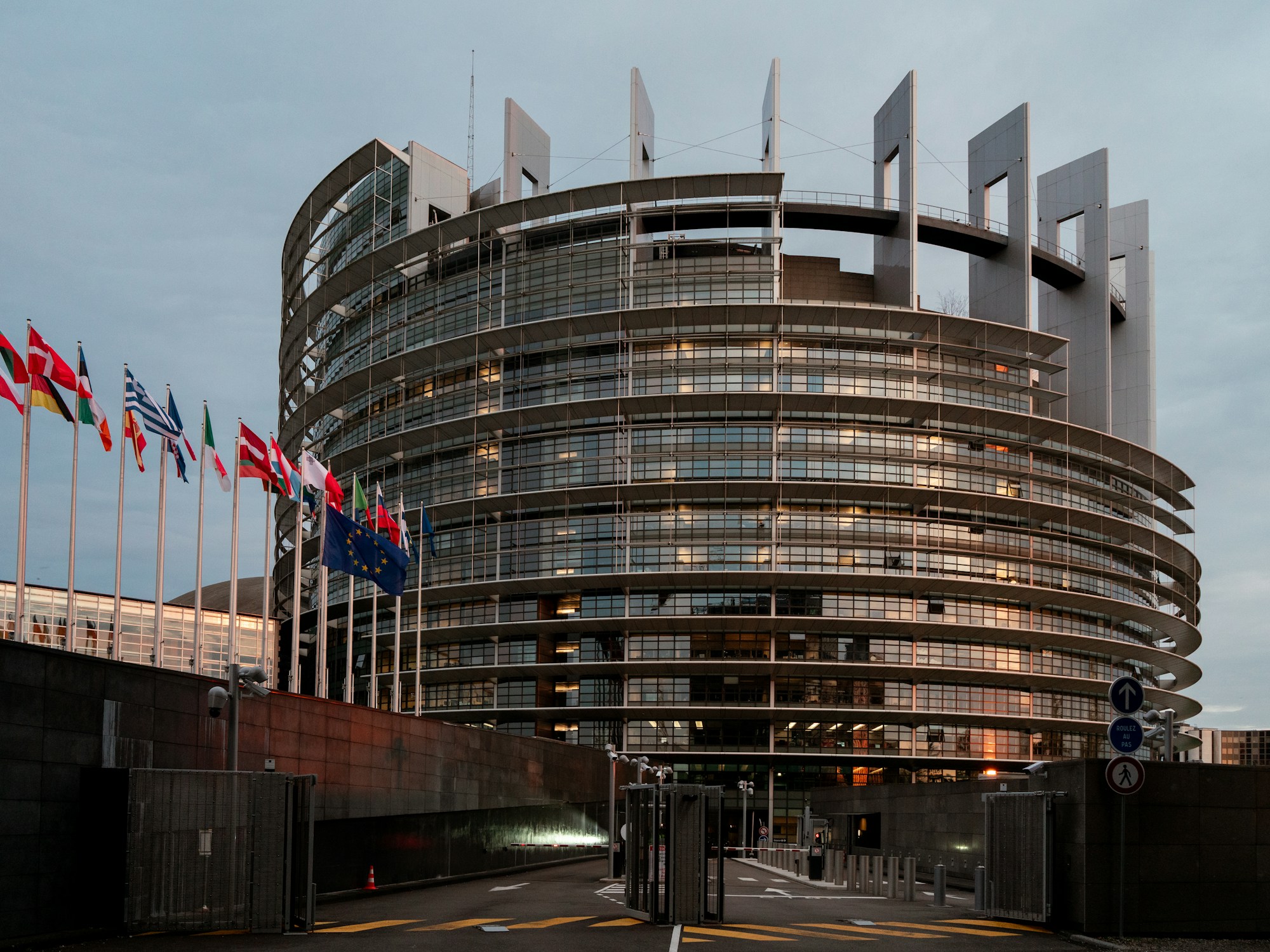
European Commission President Ursula von der Leyen opened the door Wednesday to Canada becoming the European Union’s first associate member, a status that does not exist in the bloc’s treaties.
Von der Leyen made the offer during her annual State of the European Union address to the European Parliament in Strasbourg, France, with Prime Minister Mark Carney seated in the chamber as guest of honour. She said the EU wants to bring its relationship with Canada “to the highest level possible,” according to reporting by CNBC, Bloomberg and Reuters.
“We see the world with the same eyes: from AI to climate change, from the Arctic to geopolitics,” von der Leyen said, in remarks reported by CNBC. “And we have stood together: on Ukraine, on defence, on raw materials and on supply chains. But above all … Europe and Canada believe in democracy.”
The proposal is at an early stage and von der Leyen offered no detail on what associate membership would involve, Reuters reported. No timeline, no legal instrument and no list of rights or obligations accompanied the announcement.
That absence is the central fact of the offer rather than an omission from it. The EU treaties set out one route into the bloc, and it is closed to Canada. Article 49 of the Treaty on European Union limits membership applications to European states, as this publication reported on Sept. 14 after Carney said Canada was not seeking to join. Associate membership is not a lower rung on that same ladder. It is a category the treaties do not define at all, which is precisely why it can be offered to a country the accession article excludes. Creating it requires no treaty change because there is nothing yet to change.
Canada and the EU are already bound by two major agreements, the Comprehensive Economic and Trade Agreement and the Strategic Partnership Agreement, and the two sides have been preparing a broader trade and security package for this week in Strasbourg. What associate membership would add to that existing architecture has not been stated.
The reception in the chamber was not uniform. Members of the European Parliament gave Carney a standing ovation when Parliament President Roberta Metsola introduced him, and Metsola said she was “especially proud” to welcome him, telling the chamber, “From this house, we’re projecting Europe as a geopolitical actor.” But MEP Manon Aubry challenged the proposal directly, asking von der Leyen, “Who gave you a democratic mandate for this?” MEP Nicola Procaccini accused her of bowing to Carney and asked, “How is it possible that the United Kingdom does not have priority when it comes to becoming an associate member?”
Carney is the first foreign head of government to attend a State of the European Union address. He is scheduled to deliver his own speech to the Parliament on Thursday morning, with von der Leyen in attendance.
The offer lands while Canada is in an escalating trade conflict with the United States, which has imposed 50 per cent tariffs on a range of Canadian goods and prompted dollar-for-dollar countermeasures from Ottawa that took effect Sept. 8. Roughly 70 per cent of Canadian exports go to the U.S. market, and Carney has spent the year pledging to build trade and security ties elsewhere.
Von der Leyen also used the address to call for a European Security Council, and said the bloc would “step up together with our like-minded partners like Canada, the UK and others” on artificial intelligence, naming model evaluation, verification, early warning and AI security as areas for joint work.
What happens next is undefined. Nothing announced Wednesday commits either side to a negotiation, and any arrangement giving Canada a formal standing inside EU structures would have to be built from nothing, then agreed to by the member states that were not asked about it beforehand.